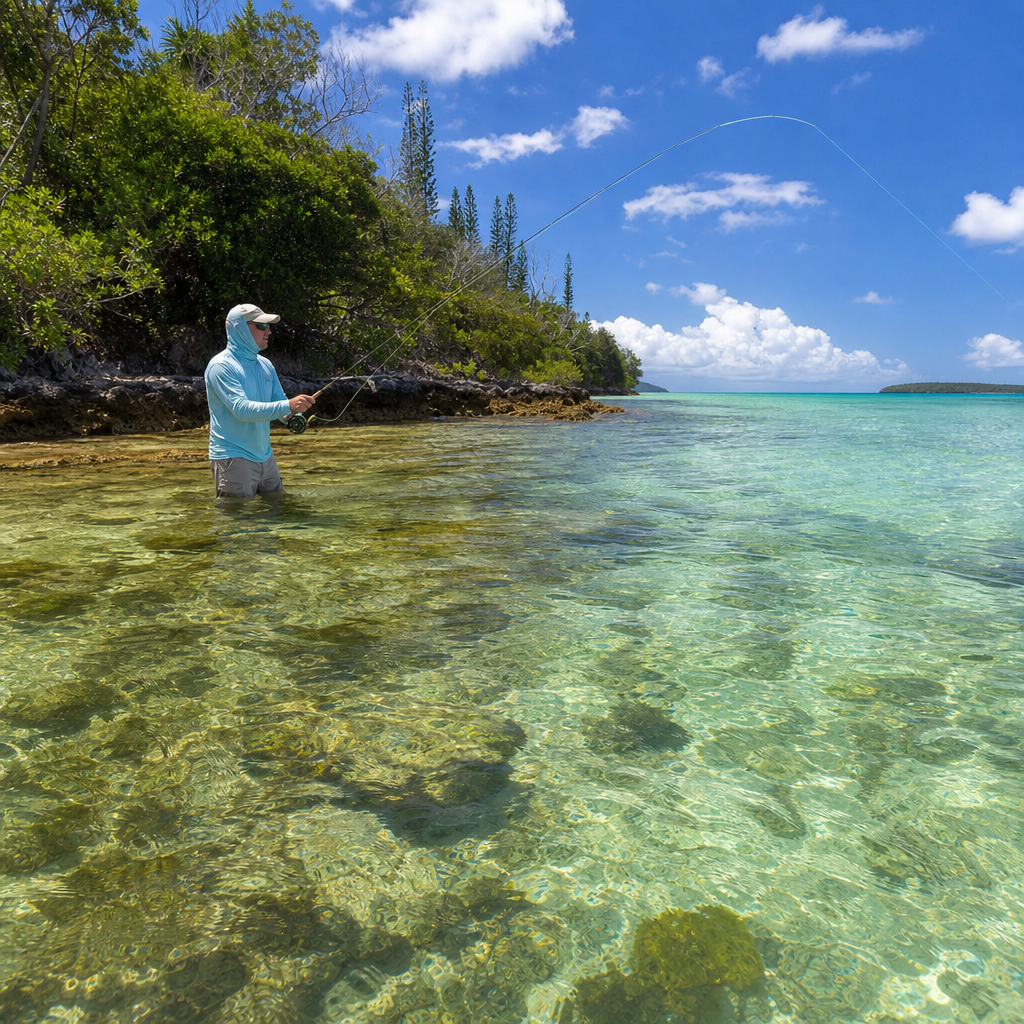
Fly fishing in New Caledonia offers something rare in Oceania: vast protected lagoons, accessible flats, and bluewater edges where anglers can sight-cast to iconic tropical species in remarkably clear water. New Caledonia is a French territory in the southwest Pacific, east of Australia, surrounded by one of the world’s largest barrier reef systems and a UNESCO-listed lagoon. For fly anglers, that geography matters because it creates multiple fishable environments within short range: shallow coral flats for bonefish and trevally, channels and reef passes for giant trevally, offshore drop-offs for pelagic species, and mangrove-influenced zones where juvenile predators hunt bait. When people ask whether New Caledonia is worth the trip, my answer is yes, provided they understand that success depends on tides, footwear, casting discipline, and local logistics more than on pure fish abundance.
As a hub within Oceania fly fishing destinations, New Caledonia deserves attention because it sits between better-known fisheries. Christmas Island often dominates tropical flat-fishing conversations, and Australia’s Great Barrier Reef and Queensland coast receive more mainstream coverage, yet New Caledonia combines several advantages that experienced anglers value: lower pressure on many flats, a broad species mix, year-round potential, and a reliable tourism infrastructure in and around Nouméa. The term “flats fishing” here usually means spotting fish in knee- to thigh-deep water and presenting a shrimp, crab, or baitfish fly ahead of a moving target. “Bluewater fly fishing” refers to teasing or casting larger flies near reef edges and offshore structure for tuna, mahi-mahi, wahoo, or sailfish. Knowing the distinction is essential because the tackle, boats, and daily plans differ dramatically.
It also matters to approach New Caledonia with realistic expectations. This is not a numbers game in the style of some bonefish atolls. Conditions can be windy, coral can punish careless wading, and fish such as giant trevally often appear suddenly and refuse just as quickly. Yet that challenge is precisely why serious fly anglers rank the destination highly. I have found that the best days in New Caledonia come when anglers prepare for a mixed fishery rather than obsess over one species. A morning may begin with bonefish on white sand, shift to triggerfish over turtle grass, and end with aggressive trevally crashing bait on a reef edge. That variety, combined with the sheer scale of the lagoon, makes New Caledonia one of the most compelling fly fishing destinations in Oceania.
Why New Caledonia stands out in Oceania
New Caledonia’s core advantage is habitat diversity. The main island, Grande Terre, is fringed by extensive lagoon systems protected by barrier reef. Inside that reef are coral flats, channels, bommies, seagrass beds, and sheltered bays that can all fish differently on the same tide cycle. Around the Loyalty Islands and smaller outer islets, anglers find even more lightly pressured water. Compared with many Pacific destinations, travel between an international arrival point and fishable water can be relatively straightforward. Most visitors fly into Nouméa, stay near the capital or on nearby islets, and access flats by skiff, panga-style boats, or 4×4-supported wading missions.
Another reason New Caledonia matters in the wider Oceania conversation is species overlap. Anglers who are researching fly fishing destinations in Oceania often compare New Caledonia with Aitutaki, Christmas Island, Fiji, Vanuatu, and northern Australia. New Caledonia belongs in that shortlist because it gives legitimate shots at bonefish, giant trevally, bluefin trevally, triggerfish, barracuda, queenfish, milkfish in some areas, and offshore pelagics. It does not replace every specialized destination. If your single goal is large numbers of bonefish, other islands may be easier. If your goal is a broad tropical saltwater experience with the chance at several trophy species in one week, New Caledonia is exceptionally strong.
Seasonality is favorable, but not simplistic. Warm water persists most of the year, and fishing is possible in all seasons. In practice, many traveling fly anglers prefer the drier, slightly cooler months from roughly April through November because humidity is lower and weather windows can be more stable. Summer can still fish well, especially for certain pelagics, but tropical heat, storms, and runoff may complicate plans. Tidal amplitude, moon phase, and wind direction routinely matter more than month alone. That is why local guide input is invaluable. A guide who understands which flat drains first on a spring tide or which pass stays clear in southeast wind can save days of trial and error.
Premier fly fishing locations in New Caledonia
The Nouméa lagoon is the logical starting point for many anglers. Close to accommodations, marinas, and charter operators, it provides quick access to mixed flats and reef structure without requiring domestic transfers. Nearshore areas around Îlot Maître, Îlot Canard, and other lagoon islets can produce trevally, barracuda, and reef species, while wider lagoon flats farther from the city offer better sight-fishing opportunities. Although proximity to Nouméa means more boat traffic than remote zones, the area still fishes well, especially on weekdays and under favorable tides. For traveling anglers balancing fishing with family travel, this region offers the best convenience-to-opportunity ratio.
The southwest lagoon and outer reef sectors are where many serious saltwater fly anglers focus. Here, expansive white sand and coral flats hold bonefish and triggerfish, and adjacent channels create genuine opportunities for giant trevally. On a typical guided day, anglers may pole a flat at first light for tailing fish, then move to current lines or reef corners as the tide rises. The key is range. Productive water is spread out, and a good skiff with a guide who knows the passes is more than a luxury; it is part of the fishery. In this zone, I have seen the clearest demonstration of New Caledonia’s appeal: multiple species encountered within visual range in a single drift.
Poé and the Bourail region on the west coast deserve special mention for anglers willing to travel overland from Nouméa. The lagoon near Poé is famous for scenery and broad shallow areas that can be wadable on the right tide. Conditions vary with wind, but when light is good, the area can offer excellent sight-fishing. This is also one of the better places for self-directed anglers to explore carefully, though hiring a local guide remains the smarter option because coral heads, access limits, and tide timing are not intuitive. The combination of reef proximity and protected inner water gives Poé strategic value for anglers wanting both flats and edge habitat.
The Isle of Pines is one of New Caledonia’s signature destinations, both visually and from a fishing standpoint. Its turquoise bays and coral shelf systems create ideal terrain for stalking trevally, reef species, and occasional bonefish. Travel logistics are more involved, and weather can affect access, but the fishing pressure is usually lower than near Nouméa. Many experienced anglers build a split itinerary, spending several days near the capital and then moving south for more remote water. That approach reduces risk if wind closes one area and broadens the species list significantly.
The Loyalty Islands, including Lifou, Maré, and Ouvéa, are less standardized for fly fishing tourism but hold tremendous promise. Ouvéa in particular has long, shallow lagoon systems that look highly fishable for classic flats species. Because infrastructure, guide availability, and transport can be less predictable than on Grande Terre, these islands are best approached through advance local contacts. For adventurous anglers, however, they represent the frontier side of fly fishing in New Caledonia: remote flats, less educated fish, and the possibility of discovering underfished water.
| Location | Best For | Access Style | Main Consideration |
|---|---|---|---|
| Nouméa Lagoon | Mixed species, convenience | Half-day or full-day skiff trips | More traffic near city |
| Southwest Lagoon | Bonefish, triggerfish, GT | Guided skiff essential | Wind and tide timing are critical |
| Poé/Bourail | Wading flats, scenic exploration | Road access plus local boat support | Coral and shifting conditions |
| Isle of Pines | Remote sight-fishing variety | Flight or ferry plus local arrangements | Higher logistics complexity |
| Loyalty Islands | Adventure and lightly pressured water | Advance planning required | Limited guiding infrastructure |
Target species and how they behave
Bonefish are often the species anglers ask about first, and for good reason. New Caledonia has fishable populations, with fish commonly found over sand-and-turtle-grass flats, especially where current pushes shrimp and small crustaceans. They are not always as densely packed as in the most famous global bonefish destinations, but they can be larger than many visitors expect. Presentations need to be quiet and accurate. In shallow, clear water, a heavy fly landing too close will spook fish instantly. Small tan or pink shrimp patterns, modest bead-chain eyes, and long fluorocarbon leaders are standard. Early shots matter because repeated false casts on the flats usually end the opportunity.
Giant trevally are the emotional center of many New Caledonia trips. They patrol reef edges, channel mouths, surf lines, and bait-rich flats, sometimes appearing as solitary cruisers and sometimes materializing behind hooked fish. Their reputation is deserved: they are brutally strong, intolerant of weak knots, and famous for exposing slow strip sets. Successful GT fly fishing requires an aggressive, almost mechanical sequence: identify fish, lead it enough to be seen but not lined, strip hard to trigger pursuit, then execute repeated low strip strikes until the hook is buried. Rod lifting costs fish. So do undergunned reels, soft leaders, and hesitation around coral. Twelve-weight outfits, heavy drag systems, and abrasion-resistant bite sections are standard for a reason.
Bluefin trevally, golden trevally, barracuda, queenfish, and triggerfish add depth to the fishery. Bluefin trevally are often more available than GT and are spectacular on fly because they hunt visually, move quickly, and hit hard without the same tackle demands. Triggerfish are a specialty target on hard-bottom flats, where they tail and tip down while feeding on crabs, worms, and shellfish. They are intelligent, often infuriating fish that reward patience more than power. Precise casts and subtle retrieves beat splashy presentations. Barracuda and queenfish provide exciting topwater or fast-strip opportunities, especially when wind or light makes technical flats shots difficult.
Offshore, New Caledonia can also produce yellowfin tuna, dogtooth tuna in some outer reef areas, mahi-mahi, wahoo, and occasional billfish on fly when conditions align. This is usually a guide-driven game involving teasing, live-bait schools, current edges, or floating debris. It should be treated as a separate discipline rather than an add-on after a flats session, because leaders, hooks, and boat handling differ. Anglers who want a full Oceania saltwater program often split days intentionally: flats on suitable tides, bluewater when wind or swell reduces visibility in the lagoon.
Gear, tactics, and practical tips for success
A smart quiver for New Caledonia includes an 8-weight for bonefish and smaller flats species, a 10-weight for general trevally and reef work, and a 12-weight for giant trevally and heavy bluewater use. Reels must have sealed drags; tropical salt and heat expose weak systems quickly. Fly lines should match water depth and fish type: tropical floating lines for most flats fishing, intermediate lines for channels and deeper edges, and specialized GT tapers for large-profile flies. Leaders should be simple and strong. For bonefish, 10- to 16-pound fluorocarbon tippets are common depending on coral risk. For trevally, stepped leaders ending in 60- to 100-pound class shock sections are normal.
Fly selection should cover shrimp, crab, baitfish, and surface patterns without excess duplication. Gotcha-style flies, Crazy Charlies, spawning shrimp variants, and small mantis shrimp patterns handle most bonefish situations. For triggerfish, crab flies that land softly and ride hook point up are essential. For trevally, brush flies, poppers, and baitfish patterns tied on strong saltwater hooks perform well, especially in black, white, olive, blue, and tan combinations. Durability matters more than novelty. In coral environments, epoxy, reinforced heads, and robust hook choices save time and frustration.
Wading safety is non-negotiable. Hard-soled or purpose-built flats boots are necessary because coral cuts, urchins, and slippery limestone can end a trip quickly. Lightweight sun gloves, buffs, long sleeves, and high-SPF sunscreen are equally important; UV exposure over reflective water is intense even on cloudy days. Polarized glasses in copper and gray lenses both have value. I carry both because copper enhances contrast on broken bottom, while gray reduces glare in bright tropical overhead light. Many missed fish in New Caledonia are not casting failures but identification failures: anglers simply do not see fish early enough.
The final tip is to fish the schedule, not just the destination. Book guides who plan around tides, moon phase, and target species priorities. Ask directly whether the trip is wading-heavy or skiff-heavy, whether GT shots are realistic in your travel month, and what average casting distances matter. In my experience, anglers who practice accurate 40- to 60-foot casts with quick pickup and re-delivery do far better than anglers who focus on maximum distance. New Caledonia rewards efficiency, observation, and adaptability. If you are building a broader fly fishing destinations list for Oceania, place it high on your shortlist, then invest in local knowledge before you travel.
Planning your trip as part of an Oceania fly fishing itinerary
For anglers exploring Oceania comprehensively, New Caledonia works best as a versatile tropical saltwater stop rather than a one-species pilgrimage. It complements destinations such as Aitutaki for bonefish specialization, Christmas Island for volume flats action, and northern Australia for barramundi or bluewater diversity. A week is the minimum useful trip length because wind, tide windows, and travel days reduce actual prime fishing time. Ten days is better. Base yourself near Nouméa for easy logistics, then add a second location if budget and transport allow. Confirm guide credentials, boat safety gear, and tackle availability before arrival, because replacement equipment options can be limited outside main population centers.
The biggest takeaway is simple: fly fishing in New Caledonia is premier because it combines scenery, technical sight-fishing, and species variety at a level few Oceania destinations can match. The best locations include the Nouméa lagoon for access, the southwest lagoon for serious flats and trevally opportunities, Poé for scenic wading potential, the Isle of Pines for remote mixed fishing, and the Loyalty Islands for exploratory travel. Success depends on timing, quality guides, durable tropical tackle, and disciplined presentations. If you are researching fly fishing destinations across Oceania, use New Caledonia as a key hub on your map, then start comparing seasons, species goals, and travel style so you can plan the right trip with confidence.
Frequently Asked Questions
What makes New Caledonia such a standout destination for fly fishing?
New Caledonia stands out because it combines several world-class saltwater fly fishing environments in one destination. Anglers can move from protected lagoon flats to coral edges, channels, reef passes, and nearby bluewater without needing to travel great distances. That variety is rare, and it creates opportunities to target a broad range of species with different techniques during the same trip. The island chain is surrounded by one of the world’s largest barrier reef systems, and the UNESCO-listed lagoon is especially important for fly anglers because it provides extensive shallow water, clean sight-fishing conditions, and habitat that supports both resident and transient game fish.
Another major draw is water clarity. In the right conditions, the flats and lagoon edges can be exceptionally clear, allowing anglers to spot fish before casting. That makes the experience highly visual and technical, which is exactly what many saltwater fly anglers are looking for. Instead of blind casting all day, you often get the chance to stalk fish, study their behavior, and make deliberate presentations. For species like bonefish, trevally, triggerfish, and cruising reef predators, that visual element is a huge part of the appeal.
New Caledonia also offers a sense of scale and relative remoteness that many experienced anglers value. Large protected marine areas, expansive lagoons, and lightly pressured flats can create a fishery that feels uncrowded compared with more famous tropical destinations. While success always depends on weather, tides, and local knowledge, the region has earned a reputation for giving anglers access to high-quality water and a legitimate shot at iconic Indo-Pacific species in a spectacular setting.
What are the premier fly fishing locations in New Caledonia?
The premier locations generally revolve around the lagoon systems, coral flats, reef edges, and outer barrier zones that define New Caledonia’s fishery. Around Grande Terre, anglers often focus on expansive lagoon flats and shallow reef areas where bonefish, trevally, triggerfish, and other tropical species feed on moving tides. These areas are especially productive when they combine turtle grass, sand pockets, coral rubble, and nearby drop-offs, since fish use those transitions to hunt and travel. Protected inner-lagoon zones can be ideal for technical sight-fishing, while channels and reef margins offer shots at larger, more aggressive predators.
The outer reef and reef passes are another major attraction. These areas are where the calm, shallow world of the lagoon meets stronger current and deeper water, and that transition often concentrates bait and predatory fish. For fly anglers, reef edges and passes can be prime locations to target giant trevally, bluefin trevally, and other powerful species that patrol structure and tidal movement. These zones demand heavier tackle, sharper boat handling, and precise presentations, but they also deliver some of the most memorable opportunities in the fishery.
The Loyalty Islands and other less-developed surrounding areas are also highly regarded, especially for anglers seeking remote water and a greater sense of exploration. Depending on logistics, local access, and guiding options, these outlying areas can provide excellent flats fishing as well as reef and bluewater opportunities. In practice, the best location often depends less on a single famous spot and more on matching conditions to the day. Wind direction, tide height, sunlight, and cloud cover can quickly determine whether a sheltered flat, a coral edge, or an outer pass will fish best, which is why experienced local guides are so valuable.
Which fish species can you target on fly in New Caledonia?
New Caledonia offers a diverse saltwater fly fishing lineup, and that diversity is one of its biggest strengths. Bonefish are a headline species on many flats, particularly where shallow sand and coral areas allow for sight-casting. These fish can be fast, selective, and highly rewarding on a well-placed shrimp or crab pattern. Trevally are another major draw, ranging from hard-fighting bluefin and golden trevally to the legendary giant trevally, which many anglers consider one of the ultimate saltwater fly targets. GTs are brutally powerful, aggressive around bait and structure, and demand strong tackle, quick reactions, and a disciplined strip-set.
Triggerfish add another technical dimension. On tropical flats, they are often seen tailing or feeding in very shallow water, and they can be both frustrating and addictive to target. They require accurate casts, careful fly placement, and close attention to how they react. Permit-like in difficulty for many anglers, they are prized not because they are easy, but because fooling one on fly feels earned. Depending on the area and season, anglers may also encounter barracuda, various reef species, queenfish, emperors, milkfish in some situations, and pelagic fish near reef edges or offshore water.
Species availability changes with habitat and conditions. Shallow protected flats are best for bonefish and triggerfish, while current edges, channels, and reef zones are more likely to produce trevally and other predators. Some anglers build an entire trip around one species, while others prefer a mixed approach that lets them capitalize on whatever presents itself each day. That flexibility is often the smartest strategy in New Caledonia, because the fishery rewards anglers who can shift from delicate presentations on the flats to heavier, faster retrieves around the reef when opportunities arise.
What gear and fly patterns work best for fly fishing in New Caledonia?
A well-rounded setup usually starts with multiple rods rather than a single all-purpose outfit. An 8-weight or 9-weight is ideal for flats species such as bonefish, smaller trevally, and triggerfish, especially when casting medium-sized shrimp and crab patterns in moderate wind. For larger predators, particularly giant trevally around reef edges and passes, a 10-weight to 12-weight is the standard choice. These heavier rods help turn over big flies, manage aggressive fish in current, and apply maximum pressure before a fish reaches coral or structure. A fast-action rod is usually preferred because wind is a frequent factor and quick, accurate casting matters.
Reels should be saltwater-sealed and matched with strong drag systems. In tropical saltwater, fish often make long blistering runs, and any weakness in the drag or backing setup gets exposed quickly. Floating tropical fly lines are the default for flats fishing, while intermediate lines can be helpful in channels, reef edges, or slightly deeper presentations. Leaders should be built with abrasion resistance in mind, particularly around coral. Fluorocarbon is commonly used for its toughness and sink rate, and many anglers carry a range of leader strengths to adapt to everything from wary bonefish to reef-hunting trevally.
As for flies, shrimp and crab patterns are the foundation for much of the flats fishing. Bonefish and triggerfish often respond well to natural-looking patterns tied in tan, olive, cream, pink, and muted orange, with weights matched to depth and bottom type. For trevally, baitfish patterns, streamers, and brush flies in white, black, blue, chartreuse, and combinations with flash are proven options. Durable hooks are essential, especially for powerful fish that can straighten inferior hardware. It is also wise to pack stripping guards, quality sunglasses with copper or amber lenses, sun protection, flats boots with solid grip, and a waterproof pack. In New Caledonia, success often comes down to being prepared for both delicate sight-casting and sudden high-impact encounters with much larger fish.
What are the best practical tips for planning a successful fly fishing trip to New Caledonia?
The most important tip is to plan around conditions, not just calendar dates. Tides, wind, cloud cover, and seasonal weather patterns all influence how fishable the flats and reef systems will be. Bright light is especially helpful for sight-fishing, while excessive wind can limit visibility and casting accuracy. Because of that, anglers should build flexibility into their itinerary whenever possible. A multi-day window greatly improves your odds of hitting favorable conditions, and it gives guides the freedom to choose protected water or more exposed reef zones depending on the day.
Hiring an experienced local guide is strongly recommended. New Caledonia’s lagoon and reef systems are vast, and productive water is not always obvious to visiting anglers. A good guide understands tidal timing, safe navigation around coral, fish behavior on specific flats, and how weather changes affect daily strategy. That local knowledge can dramatically shorten the learning curve and improve both safety and catch rates. It also helps if your guide knows when to switch targets. If the bonefish flat is too windy, for example, the best move may be to fish a sheltered triggerfish area or work a reef edge for trevally instead.
From a practical standpoint, anglers should prepare for tropical sun, humid conditions, and long days on the water. Lightweight sun-protective clothing, a hat, buff, sunscreen, polarized glasses, and hydration are essential. Wading requires caution because coral, uneven bottoms, and sharp structure can make footing tricky, so proper footwear matters. It is also smart to practice casting before the trip, especially double hauling, quick pickups, and accurate presentations at common saltwater distances. Many opportunities in New Caledonia happen fast, and the angler who can deliver a fly quickly and cleanly often gets the shot. Finally, travel with realistic expectations. This is a premium fishery with genuine trophy potential, but it is still technical salt