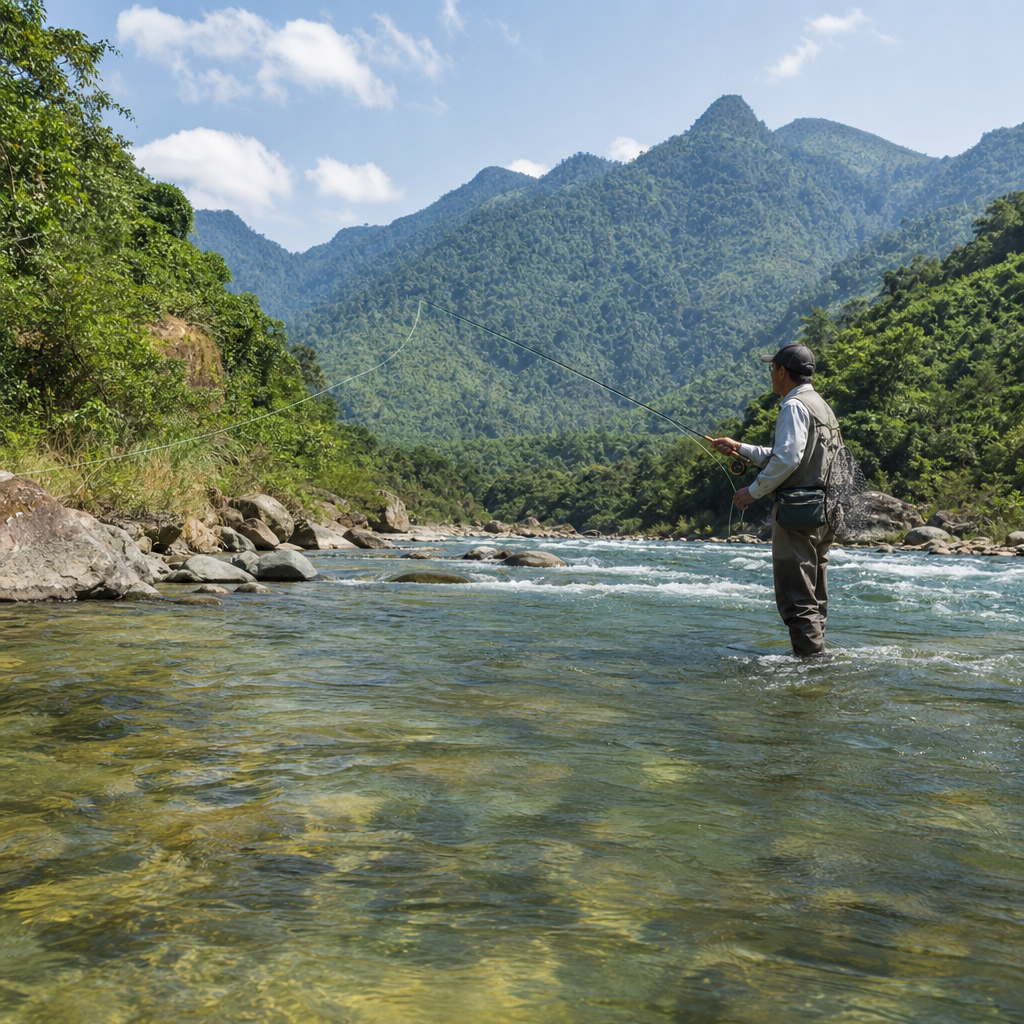
Vietnam is rarely the first country named in conversations about fly fishing destinations in Asia, yet it deserves a serious place on that map. Stretching from the cool northern highlands near the Chinese border to tropical deltas in the south, Vietnam offers rivers, reservoirs, mountain streams, mangrove coastlines, and saltwater flats-style environments that create unusual variety for traveling anglers. For readers building a broader understanding of fly fishing destinations across Asia, Vietnam works as an essential hub because it combines emerging opportunity, diverse species, and rapidly improving travel access within one long, geographically varied country.
In practical terms, fly fishing in Vietnam means adapting classic techniques to local water types rather than expecting a mature, lodge-driven scene like New Zealand or Montana. The country does not yet have dense fly-shop infrastructure, formally mapped catch-and-release beats, or a large domestic fly-fishing culture. What it does have is fishable water in many provinces, a strong adventure-travel framework, and a mix of freshwater and inshore saltwater species that reward anglers willing to research seasons, hire local boat support where needed, and travel light. I have found that success in Vietnam depends less on secret spots than on understanding water temperature, flow, access, and regional weather windows.
Three terms matter from the start. First, destination fly fishing refers to planning travel around specific fisheries, target species, and seasonal conditions, not simply bringing a rod on vacation. Second, warmwater fly fishing covers lowland rivers, reservoirs, and estuaries where species behavior differs from trout water and often favors streamers, poppers, baitfish imitations, and crustacean patterns. Third, hub content means this page is designed to orient you across Vietnam and point you toward the wider Asia fly fishing landscape by water type, region, and travel style. If you understand those categories, Vietnam becomes much easier to fish intelligently.
Why does this matter now? Vietnam’s tourism network has expanded dramatically, domestic flights connect major regions quickly, and interest in experiential travel is pushing more anglers beyond traditional Western destinations. At the same time, pressure on global marquee fisheries has made exploratory travel more appealing. Vietnam offers that exploratory value. You can fish cool northern streams near Sapa, probe central highland lakes around Da Lat, or hunt aggressive inshore species off the central and southern coasts. The country also sits within a broader Asian fly fishing circuit that includes Thailand, Malaysia, Indonesia, Japan, Mongolia, India, Bhutan, and Sri Lanka, making it a smart stop for anglers building multi-country itineraries.
Vietnam’s freshwater fly fishing regions
The most important starting point is regional geography. Northern Vietnam holds the best-known mountain water, especially in Lao Cai, Ha Giang, and parts of Yen Bai and Son La, where steep gradients create pocket water, riffles, and plunge pools. These streams are not classic stocked trout rivers. Instead, they are exploratory fisheries for native and introduced species in cooler water, with access often involving trekking, motorbike transfer, or hiring local guides who know trails and village permissions. In the far north, elevation matters more than latitude. Even in a tropical country, streams above roughly 1,200 meters can hold significantly cooler temperatures and more oxygen, especially outside the hottest months.
Central Vietnam and the Central Highlands present a different freshwater picture. Around Da Lat and Lam Dong Province, reservoirs, lakes, and upland streams offer opportunities for warmwater and stillwater tactics. These waters are useful for anglers who enjoy searching structure with intermediate lines, slow-sinking tips, and small baitfish patterns. In broader terms, the highlands are less about one iconic fish and more about varied, lightly documented opportunities. This is common across Asia: many excellent fly fishing destinations are underpublicized because they developed around conventional tackle, local food fisheries, or domestic recreation rather than imported fly culture.
Southern Vietnam is often overlooked by freshwater-focused anglers, but the Mekong system and associated floodplain waters deserve attention. Much of this zone is more suitable for conventional methods because of turbidity, boat-based access, and dense vegetation, yet there are windows when fly tactics shine, especially for peacock bass in managed or introduced populations, snakehead in weedy margins, and other aggressive warmwater species in canals, ponds, and backwaters. Sight fishing is less reliable than in clear highland streams, but short-range casting to structure can be excellent. Anglers used to bass bugging or jungle-style warmwater fishing often adapt quickly here.
For trip planning, the headline is simple: north for streams and cooler upland exploration, central highlands for mixed lakes and rivers, south for adventurous warmwater fishing linked to the Mekong and lowland waters.
Target species and how they fish on the fly
Vietnam is not defined by one flagship game fish, so species selection should be realistic and region-specific. Snakehead are among the most compelling freshwater targets. They are air-breathing ambush predators that patrol lily edges, weed mats, ditches, and slack margins, and they attack surface flies with startling force. In Vietnam, as in Thailand and Malaysia, a weedless frog, diver, or deer-hair surface bug can be the right answer in warm, shallow water. The key is accuracy and patience. Cast tight to cover, let the fly sit, then move it minimally. Snakehead often inspect before detonating.
Carp and related cyprinids also deserve more respect from traveling anglers. In clear or semi-clear waters, they can offer technical sight fishing comparable in difficulty to selective trout. Small nymphs, worm imitations, or lightly weighted patterns drifted naturally near feeding lanes can produce. The challenge is not fish size alone but presentation. Asian river carp frequently feed along current seams, gravel edges, and soft drop-offs, and they spook easily in thin water. A 4- or 5-weight outfit with long leaders can be more effective than heavier gear.
Reservoirs and impoundments may hold predatory species that respond to streamers, including peacock bass where established, snakehead, and various local fish that are not internationally famous but are highly catchable. This matters because destination quality is not only about famous species; it is also about reliable behavior. Any fish that consistently attacks baitfish patterns around timber, inflow points, and low-light shoreline structure can create memorable fly fishing. In Vietnam, I would rather plan around water type and feeding behavior than chase uncertain species lists copied from old forum posts.
Saltwater and brackish species expand Vietnam’s appeal considerably. Along central and southern coasts, anglers can target trevally, queenfish, barracuda, milkfish in specialized settings, grouper around structure, and juvenile tarpon in some estuarine systems. These fisheries are less standardized than in the Seychelles or Christmas Island, but they are real. Nearshore bait concentrations, river mouths, and sheltered bays create opportunities for intermediate and sinking lines with clouser-style baitfish patterns, deceivers, and small poppers. If your idea of great fly fishing includes variety rather than a single iconic species, Vietnam delivers.
Best seasons, weather windows, and trip timing
Vietnam’s length creates major climate variation, so there is no single national fly fishing season. In the north, the best freshwater conditions often fall between October and April, when temperatures are cooler, humidity is lower, and many streams run clearer than during peak monsoon periods. December through February can be cold in the mountains, which is an advantage for anglers seeking active fish in oxygen-rich water, though fog and drizzle can complicate travel. Summer in the north can still fish, but rainfall, flashier flows, and muddy access roads increase uncertainty.
Central Vietnam is more complicated because the rainy season can peak later than many visitors expect, often from September into December, especially along the coast. That means spring and early summer can be productive for both freshwater and inshore saltwater travel, depending on exact province. The Central Highlands frequently fish best outside the heaviest rains, when lake levels stabilize and feeder streams are accessible. If you are combining Da Nang, Hoi An, Nha Trang, or Quy Nhon with fishing, monitor local wind forecasts as closely as rainfall because coastal fly fishing becomes difficult fast in rough conditions.
Southern Vietnam generally offers more consistent warmth year-round, with the dry season from roughly December to April being easiest for travel and access. The wet season can still produce fish, especially in floodplain systems where rising water activates feeding, but mobility becomes harder. Tides matter in the south and in estuaries nationwide. Many brackish fisheries fish best on moving water when bait is pushed off flats, drains, and mangrove edges. A traveler who ignores tidal charts often mistakes poor timing for poor destination quality.
| Region | Best general window | Main opportunities | Primary caution |
|---|---|---|---|
| Northern mountains | October to April | Streams, upland rivers, exploratory freshwater | Cold snaps, remote access, rain-swollen streams in summer |
| Central Highlands | January to August | Lakes, reservoirs, mixed warmwater fishing | Localized rain and fluctuating water levels |
| Central coast | March to August | Inshore saltwater, estuaries, river mouths | Wind, surf, late-year storms |
| South and Mekong | December to April | Snakehead, canals, brackish systems, boat access | Turbidity, vegetation, wet-season logistics |
The lesson is straightforward: choose a region first, then match your species, gear, and transportation to that region’s seasonal realities rather than trying to force a national one-size-fits-all itinerary.
Gear, access, and travel logistics for anglers
Most Vietnam fly fishing trips work best with a compact, versatile quiver. For northern streams, a 4- to 6-weight rod covers small streamers, nymphs, and dry-dropper style prospecting. For snakehead and heavier freshwater work, a 7- or 8-weight with a strong butt section handles bulky flies and hard strikes. For the coast, an 8- to 10-weight setup is the practical standard, paired with tropical lines that tolerate heat. In all regions, abrasion resistance matters. Rock, concrete canal edges, mangrove roots, and fish with rough mouths punish light tippet quickly.
Flies should be selected by function, not romance. I pack clousers in white, chartreuse, tan, and olive; deceivers and hollow-style baitfish patterns for saltwater; poppers and sliders for low light; weedless frogs for snakehead; balanced leeches and baitfish for reservoirs; and generic nymphs, small streamers, and terrestrials for mountain streams. Polarized glasses are non-negotiable. So are quick-dry clothing, waterproof packs, and footwear suited to both slick rock and village paths. Many productive Vietnamese waters are accessed by combinations of car, small boat, walking trail, and informal launch points, so mobility beats bulk.
Licensing and regulation are less standardized than in famous fly-fishing countries, which creates both freedom and responsibility. Some waters may be locally managed, privately influenced, or effectively open access but socially controlled by nearby communities. Always ask before crossing farmland, using irrigation channels, or launching in village areas. Conservation ethics matter even where formal catch-and-release rules do not. Barbless hooks, minimal fish handling, and respect for food-fish harvest traditions go a long way. I have found that local boatmen and residents are usually helpful when approached with courtesy and clear expectations.
Vietnam also works well as part of a wider Asia itinerary. Anglers who fish Thailand for snakehead and giant gourami, Malaysia for jungle rivers and peacock bass, or Indonesia for saltwater species will recognize similar tactical themes in Vietnam, but usually with lighter overall angling pressure. That makes this country valuable within the broader fly fishing destinations landscape: not because it replaces the region’s established hotspots, but because it complements them with exploratory water, cultural depth, and strong travel infrastructure at relatively moderate cost.
How Vietnam compares with other Asia fly fishing destinations
Compared with Japan, Vietnam has far less formal trout infrastructure and fewer highly developed guide services, but it offers more tropical diversity and generally lower trip costs. Compared with Mongolia, it lacks a single globally dominant species like taimen, yet it is far easier to combine fishing with family or general travel. Compared with Thailand, Vietnam has a less mature pay-lake and urban guide scene, but in some regions it feels less commercial and more exploratory. Compared with India or Bhutan, Vietnam provides easier internal transportation and more coastline-driven options.
That comparative position is exactly why Vietnam should be included in any serious discussion of fly fishing destinations in Asia. It serves anglers who value discovery, varied water, and flexible itineraries. It is less ideal for someone seeking a guaranteed trophy program with polished lodge logistics. It is more ideal for travelers who can read water, adjust tackle, and enjoy mixed-species days. In destination planning, fit matters more than hype.
For your next step, map Vietnam by region, choose one target style such as mountain streams, snakehead, or inshore saltwater, and build a trip around season and access. As a hub within the wider Asia fly fishing destinations topic, Vietnam rewards anglers who plan carefully and explore confidently. Start with one region, travel with adaptable gear, and let the country expand your idea of what fly fishing in Asia can be.
Frequently Asked Questions
What makes Vietnam an interesting fly fishing destination compared with other countries in Asia?
Vietnam stands out because of its sheer environmental variety packed into a long, narrow country. In one trip, anglers can move from cool mountain streams in the north to broad central rivers, large reservoirs, mangrove-lined estuaries, and tropical southern coastlines. That range creates opportunities that feel far more diverse than many travelers expect. While countries such as Thailand, Mongolia, Japan, or Malaysia may be mentioned more often in fly fishing conversations, Vietnam deserves attention for offering a blend of freshwater and saltwater environments within a relatively compact travel framework.
Another reason Vietnam is compelling is that it remains comparatively under-discussed in the fly fishing world. For adventurous anglers, that matters. Less-publicized destinations often provide a stronger sense of exploration, more local cultural immersion, and a chance to fish waters that have not been heavily standardized around international angling tourism. Vietnam is not a plug-and-play fly fishing destination in every region, and that is part of the appeal. It rewards curiosity, flexibility, and a willingness to learn local conditions rather than relying on a familiar global sport-fishing template.
Just as important, Vietnam’s geography supports a wide range of fishing styles. Stream-oriented anglers may be drawn to upland rivers and cooler headwaters, while others may prefer warmwater species in lakes and lowland rivers. Coastal travelers can investigate estuaries, inshore waters, and flats-style environments where presentation, tide timing, and baitfish imitation become especially important. For readers exploring fly fishing across Asia, Vietnam is valuable precisely because it broadens the conversation beyond the usual headline destinations and shows how diverse the region’s angling possibilities really are.
What kinds of waters can fly anglers expect to fish in Vietnam?
Vietnam offers a notably broad mix of fishable water types, which is one of its biggest strengths as a destination. In the north, particularly in upland and mountainous areas, anglers can encounter smaller rivers and streams with clearer, cooler water, especially during favorable seasons. These waters often provide the kind of structure fly fishers like to read: riffles, runs, plunge pools, pocket water, undercut banks, and boulder seams. While conditions vary widely by rainfall, elevation, and season, northern waters are often the most appealing to anglers seeking classic river and stream scenarios.
Moving into central and inland regions, Vietnam also has larger rivers and reservoirs that open the door to different tactics. Reservoirs can be productive for exploratory fly fishing because they combine drop-offs, flooded structure, shorelines, and inflows that attract feeding fish. On bigger rivers, fly anglers may focus on current edges, eddies, deeper pools, and soft-water transitions where predatory species ambush bait. These waters usually call for versatility in line choice and fly size, with streamers, baitfish patterns, and subsurface presentations often taking priority over delicate dry-fly fishing.
In the south, the country becomes especially interesting for anglers who enjoy brackish and saltwater environments. The Mekong-influenced lowlands, mangrove creeks, estuaries, coastal lagoons, and inshore areas can produce a very different style of fly fishing centered on tides, bait movement, and shoreline structure. In these areas, anglers may sight fish in cleaner water when conditions allow or blind-cast along mangrove roots, drop-offs, channels, and flats-style edges. Altogether, Vietnam is not defined by one signature fly fishing environment. It is defined by contrast, and that contrast is exactly what makes it worth exploring.
When is the best time to plan a fly fishing trip to Vietnam?
The best time depends heavily on the specific region you want to fish, because Vietnam’s climate shifts dramatically from north to south. There is no single nationwide “perfect season” that applies everywhere at once. Northern Vietnam experiences cooler seasons and a more noticeable temperature swing, so anglers targeting mountain streams or upland rivers often look for periods with manageable water levels, milder temperatures, and reduced storm influence. In many cases, avoiding peak monsoon conditions is more important than chasing a single calendar month.
Central Vietnam can be particularly sensitive to seasonal rain patterns and storm activity, including typhoons in some periods. Water clarity, flow volume, and river access can change quickly, which means anglers should research regional weather rather than treating the country as one uniform fishery. Reservoirs and inland warmwater areas may remain fishable across a broad part of the year, but productivity often improves when temperatures are comfortable and runoff is not excessive. If you are building an itinerary around inland freshwater, shoulder-season travel is often a smart starting point.
For southern and coastal fishing, dry-season windows are typically the most practical because they improve travel reliability, visibility, and water conditions. In estuaries and saltwater zones, factors such as wind, tides, cloud cover, and recent rain can be just as important as the month itself. As a rule, the strongest trip planning approach is to first choose the style of fly fishing you want—mountain streams, reservoirs, rivers, estuaries, or coastal flats-style water—then match that target to the best regional weather period. Vietnam rewards destination-specific planning much more than generic timing advice.
What gear and fly patterns are most useful for fly fishing in Vietnam?
A practical Vietnam setup starts with versatility. Because the country offers everything from small streams to brackish creeks and inshore saltwater, the ideal gear depends on the region, but many traveling anglers do well by packing more than one rod. For upland freshwater, lighter outfits can be useful for smaller rivers and stream fishing, especially where short casts, controlled drifts, and compact presentations matter. For bigger rivers, reservoirs, and warmwater predatory species, a medium-weight rod with a stronger butt section is often more useful because it handles larger flies, wind, and more aggressive fish more effectively.
If coastal or estuary fishing is part of the plan, saltwater-ready tackle becomes important. That means corrosion-resistant reels, smooth drags, appropriate fly lines for warm climates, and leaders designed for abrasion and stronger fish. Intermediate and floating lines can both be valuable depending on depth and water movement. In mangrove zones and tidal creeks, anglers often need flies that can be presented tight to structure and stripped with control through current seams or along muddy edges. Durable hooks and materials matter because tropical conditions, salinity, and hard-fighting fish quickly expose weak gear.
In terms of fly selection, Vietnam generally favors adaptable patterns over highly specialized local imitations for most visiting anglers. Streamers, baitfish patterns, shrimp flies, crab-style patterns for relevant saltwater scenarios, and general attractor flies are sensible choices. In freshwater, nymphs and small streamers may work in moving water, while larger baitfish or leech-style patterns can be effective in stillwater and river predator situations. Surface flies should not be ignored, especially in low light or where fish are active near structure. The smartest approach is to carry a wide range of sizes, colors, and sink rates, because Vietnam’s defining feature is not one species or one hatch—it is environmental variety.
Is Vietnam better suited to experienced fly anglers, or can beginners enjoy it too?
Vietnam can be rewarding for both, but it tends to favor beginners who are open-minded and experienced anglers who enjoy problem-solving. It is not always the kind of destination where every location comes with established lodge infrastructure, highly standardized guide systems, and easy-to-predict fly fishing logistics. That means experienced anglers often appreciate it immediately because they are comfortable adapting to new water, changing tactics quickly, and treating the trip as exploration rather than guaranteed routine. For them, Vietnam offers the pleasure of discovery and the chance to fish waters that feel fresh and lightly interpreted.
That said, beginners can absolutely enjoy Vietnam if they approach it with realistic expectations and a flexible itinerary. A novice does not need to master every fly fishing discipline to have a good trip. In fact, Vietnam can be a very memorable place to learn because the scenery, cultural depth, and range of environments add value even beyond the fishing itself. A beginner who works with local knowledge, focuses on a specific region instead of trying to cover the entire country, and uses straightforward techniques such as basic streamer fishing or simple shore-based casting can have a very satisfying introduction.
The key is matching skill level to trip design. If you are new to fly fishing, choose accessible water, keep your tackle system simple, and prioritize local guidance whenever possible. If you are advanced, Vietnam offers room to experiment across rivers, reservoirs, mangroves, and coastal systems with a more technical and exploratory mindset. In both cases, the country is best approached not as a single famous fishery with one signature method, but as a layered destination where preparation, curiosity, and adaptability greatly improve the experience.