Namibia rewards anglers who want space, wild scenery, and fisheries that still feel largely untamed. For anyone researching fly fishing destinations in Africa, this country deserves a dedicated place on the map because it combines Atlantic saltwater opportunities, desert rivers, seasonal floodplains, and remote wilderness experiences within one sparsely populated nation. I have planned and assessed destination content across southern Africa for years, and Namibia consistently stands out for one reason: variety packed into an enormous landscape where access, timing, and local knowledge matter more than glossy marketing. That makes it ideal as a hub within a broader Africa fly fishing framework.
Fly fishing in Namibia means using artificial flies to target fish in habitats ranging from surf-washed beaches near the Skeleton Coast to freshwater systems in the Caprivi Strip, now more commonly called the Zambezi Region. Key terms matter here. Saltwater fly fishing refers to sight fishing or blind casting for species such as kob, leerfish, and shark from beaches, estuaries, and nearshore water. Freshwater fly fishing covers river, lagoon, and floodplain systems where anglers pursue tigerfish, tilapia, nembwe, catfish, and other warm-water species. Destination planning includes seasonality, water clarity, wind, legal access, road conditions, lodging, and guide quality, not just fish species lists.
Why does Namibia matter within African fly fishing destinations? Because it offers a different profile from better-known fisheries in South Africa, Seychelles, Tanzania, or the Okavango. It is less about dense lodge networks and more about self-reliance, long distances, and choosing the right window. The country’s Atlantic coastline is cold and nutrient rich due to the Benguela Current, supporting strong marine food chains. Inland, the northeast connects to the great river systems of southern Africa, creating some of the continent’s most exciting warm-water fly fishing. For travelers building an Africa itinerary, Namibia can function as a standalone trip or a strategic leg linked with Botswana, Zambia, or South Africa.
This hub article covers the country comprehensively, focusing on where to fish, what species to expect, when to go, what tackle works, and how to think about logistics. It also helps readers understand which Namibian regions deserve deeper exploration in related destination articles. If your goal is to compare African fly fishing destinations intelligently, Namibia is not the easiest option, but it is one of the most distinctive and rewarding.
Namibia’s main fly fishing regions
The easiest way to understand Namibia is to split it into three broad fly fishing zones: the Atlantic coast, the central and southern inland systems, and the far northeast river country. Each zone fishes differently and serves a different type of angler. The coast draws saltwater anglers comfortable with wind, mobile tactics, and changing surf conditions. The inland central and southern areas are more limited for classic fly fishing but can offer stillwater or dam opportunities when conditions align. The northeast is the flagship freshwater region and the most important area for anglers specifically searching for African river fly fishing.
Along the coast, towns such as Walvis Bay, Swakopmund, Henties Bay, and Terrace Bay are reference points rather than single fixed fisheries. Much of the action happens on open beaches, around gullies, and in areas where baitfish concentrations attract predators. On fly, the most realistic targets are kob, also called kabeljou in southern African angling language, and leerfish, known in South Africa as garrick. In the right conditions, anglers also encounter smaller sharks and rays. This is demanding fishing. Heavy wind is common, water temperatures are cool, and long casts are often less important than reading structure, current seams, and bait movement.
The inland center and south of Namibia are not the country’s strongest draw for dedicated fly fishers, but they should not be dismissed. Farm dams, reservoirs, and managed waters can hold tilapia, bass where introduced, and carp. These venues are typically secondary options rather than destination fisheries, yet they matter for residents, overland travelers, and anglers mixing fishing with wildlife or business travel. Expectations should be realistic. Namibia’s defining freshwater fly fishing identity lies elsewhere.
The Zambezi Region, by contrast, is a serious destination. The Kwando, Zambezi, Chobe, Linyanti-linked systems, and associated channels and floodplains support tigerfish, one of Africa’s signature game fish on fly. This area borders Botswana, Zambia, Zimbabwe, and Angola-connected watersheds, so fish movement and seasonal flooding shape the experience. Unlike a technical chalkstream or a heavily managed trout fishery, these waters are dynamic. Productive banks, channels, and lagoons can change meaningfully between seasons. That is exactly why local guidance is so valuable here.
| Region | Primary Water Type | Key Fly Species | Best General Window | Trip Style |
|---|---|---|---|---|
| Skeleton Coast and central coast | Surf, beaches, estuaries | Kob, leerfish, shark | Variable; often best when wind and water clarity settle | Mobile shore-based saltwater |
| Walvis Bay lagoon area | Lagoon, tidal edges, nearby coast | Mullets, occasional predators, mixed species | Season dependent, tide dependent | Short-session exploratory fishing |
| Central and southern dams | Reservoirs, farm dams | Tilapia, carp, bass in select waters | Warm stable periods | Supplementary freshwater |
| Zambezi Region | Rivers, channels, floodplains | Tigerfish, tilapia, nembwe, catfish | Late dry season into dropping water periods | Boat-based freshwater safari |
Best species for fly anglers in Namibia
Tigerfish are the headline freshwater species and the fish most likely to pull international fly anglers into Namibia. Hydrocynus vittatus, the species found through much of southern Africa, is built for violence: hard jaws, sharp teeth, explosive takes, and blistering runs. On fly tackle, they are not subtle. Intermediate and sinking lines, wire bite tippets, and durable streamers are standard. The best tigerfish fishing often coincides with dropping water, when baitfish are concentrated and predators become more predictable. In practice, this means many visiting anglers target late season periods after floodwaters begin to recede, though exact timing varies annually.
Kob are arguably the most important saltwater fly target on Namibia’s coast. These fish patrol surf zones and gutters, often feeding around structure, discolored water, and bait concentrations. They are famous among conventional shore anglers in southern Africa, but fly anglers can absolutely target them with large baitfish patterns on shooting heads or fast-sinking lines. Success depends on reading the beach correctly. I have seen competent casters struggle because they ignored current lanes and focused only on distance. On the coast, positioning and timing matter more than hero casts.
Leerfish provide one of the most exciting visual saltwater opportunities when they push bait into accessible water. They are fast, aggressive, and often responsive to well-presented streamers. In estuarine or calmer coastal conditions, they can be an exceptional fly target, though Namibia is less predictably centered on them than some South African systems. Sharks and rays also appear, but these are usually opportunistic rather than primary targets for visiting fly anglers. Heavy tackle is required, and ethical handling standards should be taken seriously.
Secondary freshwater species round out the experience. Tilapia are widespread and underrated on fly, especially when targeted deliberately with nymphs, small streamers, or bread-and-butter warm-water patterns. Nembwe, a hard-fighting cichlid known in the upper Zambezi system, can be a rewarding bycatch or targeted fish. African sharptooth catfish are common and can provide memorable action, particularly around structure and in warmer, slower sections. These species add depth to Namibian fly fishing because they keep the day interesting when the primary predator bite turns inconsistent.
When to go and how conditions shape success
Seasonality in Namibia is not a small detail; it is the planning foundation. On the coast, wind direction, swell, water color, tide stage, and bait presence can change the outlook in hours. Productive saltwater fly fishing usually comes when the surf is fishable, the water is not excessively dirty, and predatory fish are moving close enough to range. Local anglers track these variables obsessively because broad calendar advice only goes so far. A month with theoretical promise can still fish poorly during a run of strong wind or heavy sea conditions.
In the Zambezi Region, the annual flood pulse governs everything. High water expands into floodplains, opening habitat and dispersing fish. As water falls, fish are forced into channels and edges, often creating better concentration and clearer tactical options. Many experienced operators favor periods when levels are stabilizing or dropping rather than peak flood. Water temperature, clarity, and bait distribution all affect tigerfish behavior. If you are choosing dates from abroad, ask not only about season but also about current river height, recent trends, and whether fishing is happening in main channels, backwaters, or lagoons.
Weather also affects comfort and logistics. Namibia’s interior can be intensely hot, while winter mornings in desert zones may start cold. The roads between regions are long, often gravel, and sometimes punishing. A schedule that looks efficient on a map can become exhausting in reality. For that reason, most successful fly fishing itineraries in Namibia are built around one core region instead of trying to combine coast and northeast in too few days. The country is large enough to punish rushed planning.
Tackle, techniques, and guide strategy
For coastal Namibia, a practical fly setup usually starts with 8- to 10-weight rods, corrosion-resistant reels, and integrated shooting head or shooting line systems matched to surf conditions. Clouser-style baitfish flies, epoxy minnows, brush flies, and other durable streamers in white, chartreuse, olive, and natural anchovy or mullet tones are proven choices. Stripping baskets help in wind and shore break. Wading safety matters because beaches can look gentle while hiding strong lateral movement and unexpected drop-offs. Polarized glasses are useful, but surf reading often depends as much on wave shape and water texture as on direct sighting.
For tigerfish, 8- or 9-weight rods are standard, though some anglers prefer a 10-weight when fishing big flies or heavier current. Bite tippets are mandatory; short wire traces or modern knotable wire systems reduce bite-offs dramatically. Fast-action rods help turn over weighted streamers and manage abrupt directional changes from charging fish. Productive retrieves are usually assertive and varied. A common mistake is stripping too slowly after the cast lands. Tigerfish often respond to sharp movement that imitates a fleeing baitfish, and they frequently eat close to the boat.
Guides make a disproportionate difference in Namibia because fisheries are spread out and conditions are local. On the coast, a good guide shortens the learning curve on access points, tides, beach structure, and safe movement. In the northeast, a strong guide understands seasonal fish positioning, boat control, leader systems, and how to manage a day around changing river conditions. Ask specific questions before booking: What species are being targeted on fly right now? Which lines are clients using most? How many hours are spent running versus fishing? Are boats set up for casting from elevated decks or low gunwales? The precision of the answers usually tells you whether the operator truly knows the fishery.
Trip planning, conservation, and Namibia’s role in African fly fishing
Travel logistics shape the quality of any Namibian fly fishing trip. Hosea Kutako International Airport near Windhoek is the main arrival point, but many productive fisheries require domestic transfers or long drives. Vehicle choice matters, especially on gravel roads where tire damage and slow travel are common. In remote regions, fuel planning, spare water, communications, and realistic day lengths are not optional. This is one of the few destinations where overlanding competence directly affects fishing success because reaching the water efficiently can preserve entire sessions.
Accommodation options range from practical guesthouses on the coast to river lodges and mobile safari-style setups in the northeast. The right choice depends on whether fishing is the primary objective or one part of a broader Namibia itinerary focused on wildlife, photography, or family travel. Anglers chasing tigerfish should generally prioritize proximity to launch points over luxury. Every hour saved on transfer time is an hour gained during prime morning or late-afternoon feeding windows.
Conservation deserves attention because Namibia’s angling future depends on habitat integrity, sensible harvest, and cross-border river stewardship. Community conservancy models have given Namibia a globally recognized reputation in wildlife management, and that broader conservation culture supports fishing tourism indirectly. In the northeast, river health is inseparable from upstream land use, floodplain connectivity, and pressure from subsistence netting. On the coast, responsible catch-and-release practices, careful fish handling, and adherence to local regulations matter, particularly for larger breeding fish. Anglers should verify licensing rules, protected areas, and current bag limits before traveling.
As a hub within African fly fishing destinations, Namibia occupies a distinctive middle ground. It is not as polished as top Indian Ocean flats fisheries, not as widely publicized as South African estuaries, and not as singularly famous as some tigerfish waters farther north. Its advantage is contrast. Few countries let you pair bleak Atlantic surf, desert horizons, and explosive tropical river predators in one national portfolio. If you are building knowledge of fly fishing destinations in Africa, start with Namibia’s regional structure: coast for hard-earned saltwater, northeast for headline freshwater, and interior waters for supplemental opportunities. From there, drill into the specific fishery that matches your style, season, and tolerance for travel. Namibia rewards anglers who prepare carefully, fish patiently, and appreciate wild places as much as the catch. Use this hub as your starting point, then map the region, choose one zone well, and plan a trip with enough days to let Namibia reveal what makes it special.
Frequently Asked Questions
What makes Namibia a unique fly fishing destination compared with other countries in Africa?
Namibia stands out because very few places offer such a striking mix of fisheries within one country. An angler can look at Atlantic surf and estuaries on one trip, then shift attention to remote desert rivers, broad northern systems, and seasonal wetlands that feel completely different in character. That diversity is paired with something many experienced fly fishers value just as much as species count: space. Namibia is sparsely populated, and many of its best fishing areas retain a genuine frontier feel, so days on the water can feel quiet, uncrowded, and highly immersive.
Another reason Namibia deserves attention is that the setting is not just scenic, but defining. In many destinations, the fishing is the main event and the landscape is secondary. In Namibia, the environment is inseparable from the experience. Fishing along the Skeleton Coast, exploring river systems that cut through arid terrain, or casting in the Caprivi-region floodplains creates a sense of place that is hard to replicate elsewhere. For anglers who care about adventure, natural drama, and the feeling of discovering water that still seems lightly pressured, Namibia offers something deeper than a standard lodge-and-beat model.
It is also a destination that rewards adaptability. Rather than arriving with a single target species and one style of presentation, anglers often do best when they approach Namibia as a multi-environment trip. Saltwater fly fishing opportunities can differ dramatically from freshwater options in the north, and water levels, seasonal access, and local conditions matter more here than in heavily standardized fisheries. That unpredictability is part of the appeal. Namibia is less about guaranteed volume and more about pursuing memorable fish in wild settings where the overall journey is as important as the catch itself.
Which parts of Namibia are best known for fly fishing, and what types of water can anglers expect?
Namibia’s fly fishing appeal is spread across several very different regions, and each one deserves to be understood on its own terms. Along the Atlantic coast, anglers find surf zones, rocky shoreline structure, and estuarine areas that can produce exciting saltwater opportunities. This side of the country tends to attract anglers interested in aggressive coastal species, changing tides, wind management, and the technical challenge of presenting flies effectively in moving saltwater conditions. It is visually dramatic fishing, often framed by desert meeting ocean.
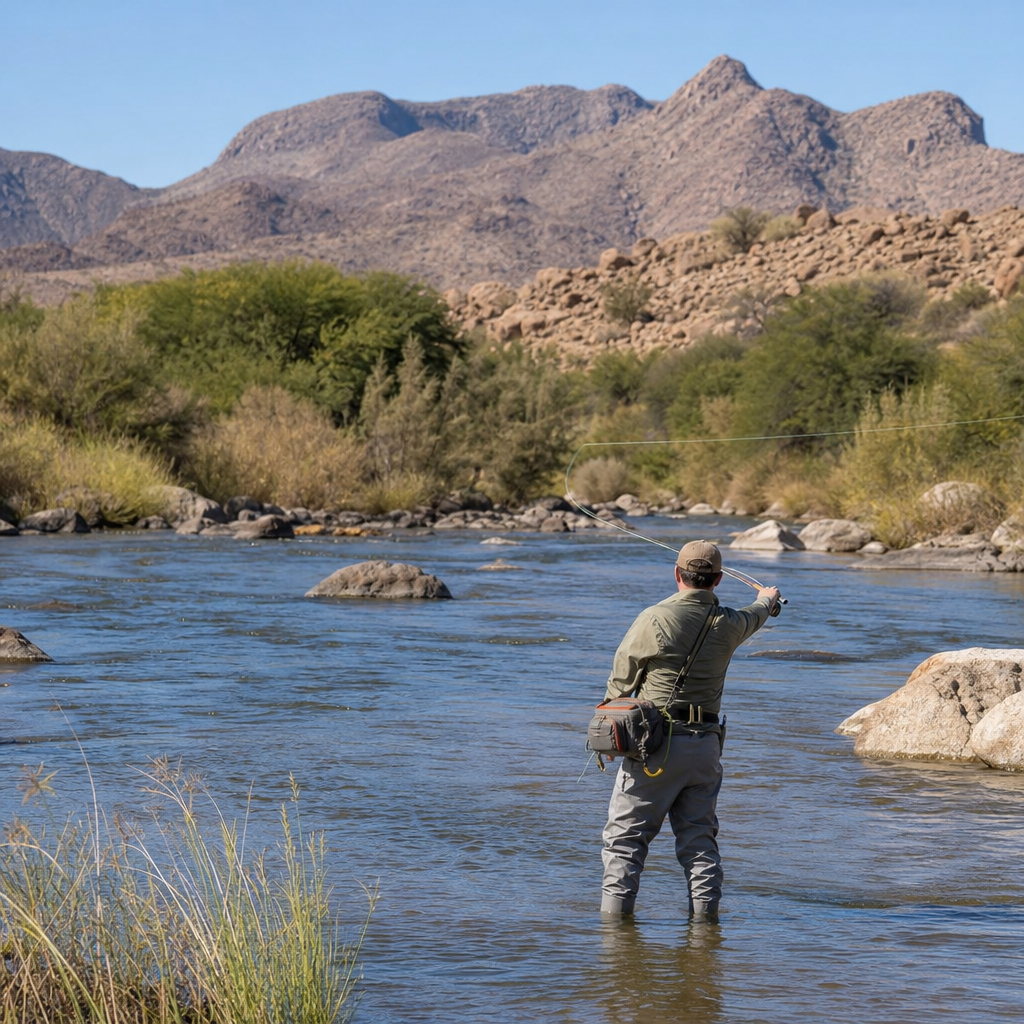
Farther inland, Namibia’s desert river systems carry a completely different mood. These are not classic lush trout valleys or densely vegetated tropical rivers. Instead, they often run through stark, open landscapes where water can feel precious and conditions can change substantially with rainfall and seasonal flow. Fishing in these environments demands flexibility and good local knowledge, because access, clarity, and fish behavior are influenced by a climate that can be severe and highly variable. For many traveling anglers, this is exactly what makes the experience compelling: the fish are part of a much larger ecological story.
In the north and northeast, particularly in areas influenced by the Okavango, Zambezi, Kwando, and associated floodplain systems, anglers encounter some of Namibia’s most exciting freshwater options. These waters are better known for warmwater species and can offer productive sight-fishing, structure-based fishing, and seasonal opportunities tied to flood cycles. Channels, lagoons, side arms, and floodplain edges all create habitat variety, and that variety affects where fish hold and how they feed. In practical terms, anglers should expect Namibia to offer everything from coastal wading and beach casting to boat-based river fishing and exploration of remote freshwater systems shaped by seasonal hydrology.
What species can fly fishers target in Namibia?
Species vary by region, and that is one of the strongest reasons to consider Namibia seriously as a fly fishing destination. Along the coast, anglers often focus on hard-fighting saltwater species that respond to baitfish patterns, surf presentations, and mobile, search-oriented fishing. Depending on the exact location and season, common interest centers on species associated with the Atlantic shoreline and estuaries, where tide movement, water clarity, and bait presence strongly influence success. Coastal fishing here is often less about standing in one place and more about reading water, covering ground, and matching conditions intelligently.
In northern Namibia, freshwater fly anglers frequently look toward species such as tigerfish, which hold a near-mythic reputation among African fly fishers for good reason. Tigerfish are fast, violent, aerial, and famously unforgiving of weak tackle or hesitant hook sets. They are a major draw in the Zambezi-region waters and can turn an ordinary day into one of the most memorable sessions an angler ever has. Beyond tigerfish, anglers may encounter a range of other warmwater species depending on the river system, floodplain connectivity, and time of year. Some may not be internationally famous in the same way, but they add depth and variety to the trip.
It is important to approach Namibia with realistic expectations about species targeting. This is not always a destination where every fishery is tightly packaged around one marquee species with highly predictable outcomes. In many areas, success is linked to mobility, seasonal timing, and local guidance. For anglers who enjoy technical problem-solving and are excited by the possibility of multiple species across radically different habitats, Namibia delivers a richer experience than destinations marketed purely around numbers. The draw is not only what you might catch, but where and how you catch it.
When is the best time to plan a fly fishing trip to Namibia?
The best time depends heavily on which region of Namibia you plan to fish, because the country’s fisheries are shaped by very different weather and water systems. Coastal fishing is influenced by wind, swell, water temperature, and local bait movement, so ideal windows can differ from inland recommendations. In the north and northeast, river levels and floodplain conditions are major factors, especially in systems tied to seasonal flooding. A trip that is well timed for one area may be poorly timed for another, which is why broad, one-size-fits-all advice can be misleading.
For freshwater anglers, particularly those targeting tigerfish and related warmwater species, the most productive periods often revolve around water transitions rather than static calendar dates alone. Falling water, stable visibility, and bait concentration can improve fishing significantly in some systems, while high flood conditions may spread fish out and make them less predictable. In practical planning terms, that means travelers should research not just “dry season versus wet season,” but also how specific rivers fish before, during, and after major hydrological shifts. Local operators and current regional reports are extremely valuable here.
For coastal anglers, the productive season can hinge on sea conditions, migratory patterns, and how comfortable you are fishing in wind. Namibia’s coast is famous for dramatic conditions, which can be a positive for adventurous anglers but may challenge those expecting easy, sheltered water. The smartest approach is to define your priorities first. If your goal is a mixed itinerary with both saltwater and freshwater possibilities, plan around the region that matters most, then build the rest of the trip as a complementary experience. Namibia rewards thoughtful timing, and careful scheduling can make the difference between a good trip and an exceptional one.
Do anglers need a guide for fly fishing in Namibia, or can they fish independently?
Independent fishing is possible in some parts of Namibia, especially for experienced travelers who are comfortable with logistics, self-sufficiency, and changing conditions. That said, many visiting anglers benefit enormously from using a knowledgeable local guide or outfitter, particularly on a first trip. Namibia is a country where distance, access, seasonal water changes, road conditions, permits, and fish location can all have a major impact on the outcome of the trip. A guide does not just improve your chances of catching fish; a good one shortens the learning curve and helps you spend more time fishing effectively.
This is especially true in remote or highly seasonal freshwater systems, where understanding current water levels, navigable routes, productive holding areas, and local safety considerations is essential. In coastal environments, guides can also be valuable because tides, surf structure, fish movement, and weather windows are not always obvious to a first-time visitor. Even skilled saltwater anglers often find that local knowledge quickly pays for itself. Namibia can look open and simple on a map, but on the ground it is often nuanced, with conditions that shift quickly and fisheries that reward precise decision-making.
For anglers who do prefer independent travel, preparation matters. That means confirming access rules, understanding conservation regulations, carrying appropriate recovery and safety gear for remote driving, and building flexibility into the itinerary. It also means accepting that some of Namibia’s best fishing is best approached through local expertise rather than pure exploration. In short, you can fish Namibia on your own in certain situations, but if your aim is to maximize limited travel time, safely access productive water, and understand the character of each fishery, a guide is usually a very wise investment.