India is not the first country many anglers picture when they think about fly fishing destinations, yet it should be. From the snow-fed rivers of Himachal Pradesh and Jammu and Kashmir to the clear mountain streams of Uttarakhand and the forested valleys of Arunachal Pradesh, India offers remarkable variety for trout, mahseer, and lesser-known native species. In practical terms, fly fishing in India means adapting to dramatic altitude changes, highly seasonal water conditions, region-specific regulations, and a mix of remote wilderness and accessible lodges. For anglers building an Asia fly fishing itinerary, India deserves hub status because it connects several distinct fisheries within one country, each with different techniques, target species, and travel demands.
When I plan trips across Asia, I treat India as a destination cluster rather than a single fishery. The phrase fly fishing destinations in India covers coldwater trout streams in the Himalayas, warmwater mahseer rivers in the foothills and peninsular drainages, and smaller backcountry waters where local knowledge matters more than guidebook summaries. That range matters for travelers who want options. A newcomer can begin with stocked or well-known trout sections near established camps, while experienced anglers can chase wild fish in technical pocket water or sight-cast to powerful mahseer in broad rivers. India also matters because its fisheries sit inside larger ecological and cultural landscapes: protected forests, mountain villages, pilgrimage routes, tea regions, and former colonial angling circuits that still influence access and lodge infrastructure today.
To understand the country, define three key terms. First, wild trout water refers to rivers or tributaries where fish reproduce naturally, creating more selective fish and less predictable catches than stocked beats. Second, mahseer fishing generally means targeting large carp-like game fish of the Tor genus and related groups, prized for speed and strength; many anglers compare the best takes to Atlantic salmon or steelhead-level excitement on suitable tackle. Third, a beat is a managed section of river, often associated with a lodge, club, or rotating access system. These distinctions shape everything from fly selection to budgeting. India’s best fly fishing destinations reward anglers who match expectations to water type instead of assuming every river fishes the same way.
Because this article serves as a hub for Asia-focused travel planning, it covers where to fish, what species to expect, when to go, how logistics work, and where the main opportunities and limitations lie. India can produce memorable days, but it is not a plug-and-play destination. Roads can be slow, monsoon timing changes river clarity fast, permits can be inconsistent by state, and conservation standards vary across watersheds. Anglers who prepare properly, however, gain access to one of Asia’s most varied fly fishing landscapes.
Why India stands out among Asia fly fishing destinations
India stands out because few countries combine high-elevation trout rivers and lowland or foothill warmwater fisheries at this scale. In one broad national itinerary, you can fish freestone streams above 2,000 meters, move to larger glacial rivers with rainbow and brown trout, then shift to mahseer systems where six-, seven-, or eight-weight rods come into play. That species and habitat range is unusually wide for one destination. It also gives traveling anglers flexibility when weather disrupts plans. If a snowmelt-heavy river turns milky, a smaller tributary or lower-gradient stream may remain fishable.
Another reason India matters is that many fisheries are still underrepresented online compared with Japan, Mongolia, Bhutan, or New Zealand-style destinations in the region. That does not mean they are untouched; it means the best information often sits with specialist outfitters, local guides, old angling clubs, and conservation projects rather than generic travel articles. On the ground, I have found that success depends less on secret flies and more on understanding local timing: pre-monsoon windows, post-flood recovery, insect activity in mountain valleys, and access limitations linked to forestry rules or security conditions.
India also offers strong narrative appeal for anglers who value more than numbers. A morning on a cedar-lined Himalayan river, lunch in an orchard village, and evening hatches under snow peaks create a travel experience distinct from standard destination fishing. For many international visitors, that combination of angling and place is the deciding factor.
Top regions for trout fly fishing in India
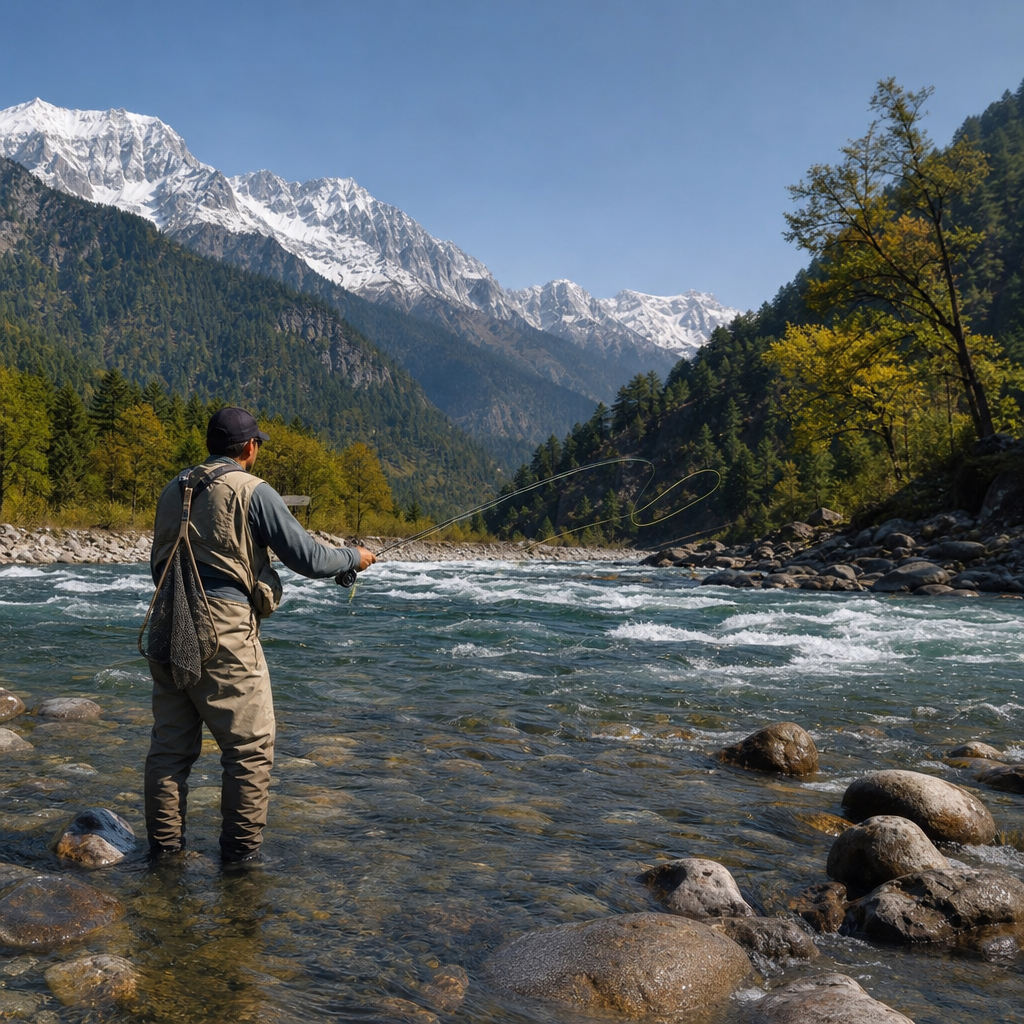
The most established trout fly fishing destinations in India are concentrated in the Himalayan north. Himachal Pradesh is often the most practical starting point. Rivers and tributaries around Kullu, Manali, Tirthan Valley, Barot, and Pabbar have long angling histories and a workable tourism base. Brown trout and rainbow trout are the main targets, with some waters holding self-sustaining fish and others influenced by hatchery support. The Beas drainage and its tributaries can offer productive nymphing, dry-dropper fishing, and short-line pocket-water tactics, especially in shoulder seasons when flows are stable.
Uttarakhand has classic mountain water as well, though access and local pressure vary. Smaller streams in the upper Ganges and Yamuna systems can fish well for trout in cooler zones, while the broader state is better known to many anglers for mahseer opportunities in lower reaches. Jammu and Kashmir has a near-mythic reputation because of rivers such as the Lidder and associated streams. Political and security realities mean conditions for travel can change, but as a fishery region it remains historically significant. Clear flows, cold water, and strong aquatic insect life make it one of India’s most evocative trout landscapes.
Arunachal Pradesh is less mainstream but increasingly discussed by destination anglers. The state’s remoteness, biodiversity, and complex logistics mean it is not the easiest first trip, yet exploratory anglers value it because rivers remain comparatively wild. Sikkim and parts of the northeastern hill regions also warrant attention, although infrastructure and permitting can be more limiting than in Himachal.
| Region | Main species | Best general window | What to expect |
|---|---|---|---|
| Himachal Pradesh | Brown trout, rainbow trout | March to June, September to November | Accessible valleys, mixed stocked and wild fisheries, technical pocket water |
| Jammu and Kashmir | Brown trout, rainbow trout | Spring and autumn | Historic trout rivers, clear cold flows, variable travel considerations |
| Uttarakhand | Trout in upland streams, mahseer in lower systems | Season depends on elevation and monsoon timing | Diverse water, split coldwater and warmwater opportunities |
| Arunachal Pradesh | Trout in select upland waters, other native species | Short stable weather windows | Remote fishing, expedition planning, strong wilderness character |
For trout, standard techniques include Euro-style nymphing in broken currents, indicator rigs in deeper slots, and attractor dry flies during opportunistic surface activity. Insects are not cataloged as comprehensively as in famous Western trout states, so practical observation beats rigid hatch matching. I carry caddis, mayfly nymphs, stonefly patterns, small streamers, and terrestrial imitations, then adjust to local water color and fish behavior.
Mahseer waters and warmwater opportunity
No survey of India’s fly fishing destinations is complete without mahseer. Golden mahseer, hump-backed mahseer, and related forms occupy a special place in South Asian angling history. They are powerful, migratory, and highly sensitive to habitat change. Well-known mahseer regions include parts of Uttarakhand, Karnataka, and stretches linked to the Cauvery system, although management history there is complicated and anglers should verify current regulations and conservation guidance before booking. Some rivers that once defined Indian sportfishing have seen closures, restrictive access, stock concerns, or changing lodge models.
Mahseer fishing is not simply trout fishing with bigger flies. River scale is often larger, currents are heavier, and presentations may involve swinging baitfish patterns, stripping streamers along structure, or dead-drifting nymph-like offerings through travel lanes. Six- to eight-weight outfits are common, with strong reels and abrasion-resistant leaders. A fish in the ten- to twenty-pound class is a realistic benchmark on some systems, and larger specimens are possible where conservation and habitat still support them. Even when catches are modest, one visible follow or one hard take can define the trip.
The key challenge is that mahseer fisheries in India require current local intelligence. Dams, sand mining, pollution, poaching, and monsoon-driven river shifts can change quality quickly. Responsible operators now emphasize catch-and-release, careful handling, barbless hooks, and restricted effort. Anglers should favor outfitters who can explain their fishery data clearly rather than relying on old reputation alone.
Best time to go and how seasons shape fishing
The best time for fly fishing in India depends almost entirely on elevation and monsoon influence. In Himalayan trout regions, spring through early summer often brings good conditions as snowmelt begins but before monsoon rains dominate. Autumn is frequently the most reliable period because water levels stabilize, clarity improves, and trout feed aggressively before winter. Mid-monsoon can render many rivers unfishable through high flow and turbidity. In practical trip planning, September through November is often the safest all-around window for northern trout water, while April through June can be excellent if runoff remains manageable.
For mahseer, pre-monsoon and post-monsoon periods usually offer the best combination of water level and fish activity, but exact timing differs by drainage. A river in Uttarakhand may fish on a very different schedule from one in southern India. Temperature matters as much as rainfall. Warmwater species can become more active in transitional periods when flows are dropping and baitfish gather along edges, seams, and tailouts.
If you are asking the most common planning question, the direct answer is this: for first-time visitors seeking trout, target autumn in Himachal Pradesh or Jammu and Kashmir if conditions allow; for mahseer, work with a specialist operator and schedule around local water data rather than fixed calendar assumptions. India rewards flexible itineraries more than rigid bookings.
Access, permits, guides, and practical trip planning
Access in India ranges from straightforward to highly conditional. Some waters are reached from established lodges within a few hours of major airports such as Delhi, Chandigarh, Dehradun, or Srinagar. Others require long road transfers, inner-line permits, forest permissions, or coordination with local communities. Regulations are not standardized nationally, so each state and river system can operate differently. That is why a reputable guide service is more than a convenience; it is often the difference between legal, efficient fishing and wasted travel days.
On my own planning checklists, I verify five things before confirming any India trip: current fishing permissions, transport time from the nearest airport, river backup options during rain, tackle recommendations by species, and medical or communication limitations in remote zones. Mobile coverage can disappear quickly in mountain valleys. Wading safety also deserves attention because many rivers are steep, slick, and pushy. Studded boots may help where permitted, but felt sole policies and local conditions should be checked in advance.
International anglers should bring a focused kit rather than overpacking. For trout, a 4- or 5-weight rod around 8.5 to 9 feet covers most scenarios, with a 3-weight useful on tighter tributaries and a 6-weight for larger rivers or streamers. For mahseer, a 7- or 8-weight is the sensible starting point. Add fluorocarbon tippet, polarized glasses, quick-dry layers, rain protection, and a compact medical kit. If traveling across regions, pack for both near-freezing mornings in the mountains and hot afternoons in lower valleys.
Conservation realities and how to fish responsibly
India’s fly fishing future depends on conservation. Trout waters face pressure from warming temperatures, road building, sedimentation, overharvest, and indiscriminate stocking that can weaken wild-fish priorities. Mahseer waters face even broader threats, including habitat fragmentation from dams, extraction pressures, and illegal netting. The most credible operators and clubs now frame fishing as part of river stewardship, not just recreation. That approach is essential.
Responsible anglers should choose catch-and-release waters where possible, minimize fish air exposure, use rubberized nets, and avoid fishing stressed trout during extreme heat or low-flow periods. On mahseer rivers, heavy enough tackle shortens fights and improves release survival. Supporting camps that employ local residents, fund anti-poaching patrols, or coordinate with fisheries departments has a real effect. So does asking direct questions: Are fish measured and logged? Are spawning areas rested? Are stocking policies evidence-based? Vague answers are a warning sign.
As a hub within Asia fly fishing destinations, India offers something rare: technical trout streams, legendary warmwater game fish, and travel experiences rooted in distinct mountain and river cultures. Start with a region that matches your skill and risk tolerance, use a guide with current local knowledge, and plan around season rather than cheap airfare. If you do that, India can become the most surprising and rewarding stop in your Asia fly fishing journey.
Frequently Asked Questions
What makes India a worthwhile destination for fly fishing?
India stands out as a fly fishing destination because it combines exceptional species diversity with an unusual range of landscapes and fishing conditions. In a single country, anglers can pursue trout in cold, high-altitude rivers in Himachal Pradesh, Jammu and Kashmir, and Uttarakhand, then shift focus to mahseer in larger foothill rivers and warmer systems farther south and west. That kind of variety is rare. India also offers a sense of exploration that many more established fly fishing destinations no longer have. Some regions are relatively well known, but many fisheries still feel lightly publicized compared with famous trout waters in Europe, New Zealand, or North America.
Another major appeal is the environmental contrast from one destination to the next. Snow-fed rivers, boulder-strewn mountain streams, glacial systems, forest valleys, and remote hill-country waters all demand different tactics and reward anglers who enjoy adapting their approach. For travelers, that means fly fishing in India is not just about catching fish; it is also about understanding regional geography, seasonal river behavior, access realities, and local culture. When done well, a trip can be both technically satisfying and deeply immersive.
Perhaps most importantly, India offers fishing for anglers with different goals. Some travelers want wild trout in scenic mountain settings. Others are drawn by the power and prestige of mahseer, often described as one of the great game fish of Asia. There is also growing interest in lesser-known native species in more specialized or exploratory settings. For anglers who value adventure, variety, and the chance to fish waters that still feel distinctive and regionally rooted, India is a very compelling choice.
Which regions in India are best known for fly fishing, and what species can anglers expect there?
Several regions define India’s fly fishing reputation, and each offers a different experience. Himachal Pradesh is one of the best-known areas for trout fishing, with cold rivers and tributaries that support brown trout and rainbow trout in suitable waters. Its mountain streams and river valleys appeal to anglers who enjoy classic freestone conditions, pocket water, and sight-oriented fishing in clear flows. Uttarakhand is another important destination, especially for anglers looking for a combination of scenic Himalayan water and technical trout fishing. Depending on elevation, river type, and season, these waters can range from intimate streams to broader rivers where presentation and reading current become especially important.
Jammu and Kashmir has long held a strong reputation for trout, particularly in cool river systems influenced by snowmelt and spring-fed flows. In the right season, anglers may find productive dry-fly and nymphing opportunities in striking alpine and subalpine settings. Arunachal Pradesh represents a different kind of appeal. It is less about established international fly fishing fame and more about remote, forested valleys, lesser-known native fisheries, and exploratory travel. Anglers interested in uncommon species and less conventional fishing settings often find this region especially intriguing, although logistics can be more demanding.
For mahseer, anglers often look beyond the highest trout country to larger rivers in foothill and lower-elevation environments. Mahseer fishing can involve broad runs, rocky structure, and stronger currents, with techniques that differ significantly from standard trout tactics. In practical terms, your ideal region depends on your target species, comfort with travel complexity, and the style of fishing you enjoy most. Trout-focused anglers often gravitate to the Himalayan states, while those chasing India’s iconic warmwater game fish may prioritize river systems known for mahseer and similar powerful species.
When is the best time to go fly fishing in India?
The best time to go fly fishing in India depends heavily on the region, elevation, and species you want to target. This is one of the most important planning factors because Indian fisheries are shaped by snowmelt, pre-monsoon heat, monsoon rainfall, and winter cold. In trout regions of the Himalayas, spring through early summer often provides productive conditions as rivers begin to open up and insect activity becomes more consistent. Late summer and autumn can also be very good in certain waters once heavy monsoon flows have receded and visibility improves. In many destinations, these post-monsoon windows are especially attractive because water levels stabilize and fish become more accessible.
The monsoon itself is a critical consideration. In many parts of India, heavy seasonal rains can transform rivers quickly, making them high, discolored, difficult to wade, or temporarily unfishable. Even where fishing remains technically possible, safety and access may become limiting factors. Anglers who are used to stable summer fishing seasons elsewhere should not assume that a single national timeframe applies across India. Conditions can differ dramatically between neighboring states and even between nearby valleys at different elevations.
For mahseer and other warmwater opportunities, productive timing may differ from trout seasons and often depends on river temperatures, migratory movements, and local regulations. Because of this, the smartest approach is not to ask for the best month for India as a whole, but rather the best window for a specific region and species. If you are organizing a trip, it is wise to consult current local information, especially regarding water levels, weather, road access, and any fishery-specific rules. In India, timing can be the difference between a memorable trip and a frustrating one, so seasonal planning deserves serious attention.
What gear and techniques work best for fly fishing in India’s rivers and streams?
Gear selection in India should match the fishery rather than the country in general, because conditions vary so much. For trout in mountain streams, a lighter setup is often ideal, such as a 4-weight to 6-weight rod depending on river size, casting room, and expected fish size. Smaller streams may reward short, accurate casts, high-sticking, and careful drifts through pocket water, while larger rivers may call for longer leaders, controlled line management, and a broader mix of dry flies, nymphs, and streamers. A versatile trout angler in India should be prepared for everything from delicate presentations in clear water to heavily weighted nymphing in faster currents.
Altitude and seasonal flow matter as much as fly choice. Snow-fed waters can run cold and strong, making subsurface tactics especially important early in the season. As flows moderate and insect life becomes more active, dry-fly opportunities can improve, particularly on clearer mountain stretches. Good wading footwear is essential because many Indian rivers are rocky, uneven, and slippery, and anglers should not underestimate how physically demanding repeated elevation changes and rough approaches can be. Polarized glasses, layered clothing, rain protection, and a compact but adaptable tackle system are all practical essentials.
For mahseer, gear becomes much heavier. These fish are powerful, and the rivers they inhabit often demand stronger rods, durable reels, and lines suited for larger flies or more forceful presentations. Streamers, baitfish patterns, and other attractor-style flies may play a larger role than they do in classic trout fishing. Retrieval speed, fly depth, and positioning near structure are often central to success. Regardless of species, anglers do best in India when they stay flexible. A rigid, one-style approach rarely works across such varied environments. The most successful travelers bring adaptable tackle, remain open to local advice, and adjust quickly to water clarity, current speed, and fish behavior.
Do anglers need permits, guides, or special preparation for a fly fishing trip in India?
Yes, preparation is important, and in many cases it goes well beyond simply booking transport and packing a rod. Depending on the state, river, and local administration, anglers may need fishing permits, access permissions, or advance arrangements through lodges, outfitters, clubs, or regional authorities. In more remote areas, there may also be travel documentation requirements unrelated to fishing itself, especially near border regions or protected zones. Regulations can change, and access conditions are not always standardized, so relying on current local sources is essential.
Hiring a guide is often a very smart decision, particularly for first-time visitors. A knowledgeable guide can help with access points, reading unfamiliar water, adapting flies and techniques to local conditions, and avoiding wasted time on stretches that are out of season or temporarily unproductive. Guides are also valuable for practical logistics such as transportation, river safety, cultural norms, and regional expectations around catch-and-release practices. In remote or less developed fisheries, they may be indispensable. Even experienced international anglers benefit from local expertise because India’s river conditions can shift quickly and local knowledge often matters more than general fly fishing experience.
Preparation should also include physical, environmental, and cultural planning. High-altitude destinations require attention to acclimatization, hydration, and realistic pacing. Weather can change rapidly, roads may be slow or unpredictable, and mobile connectivity may be limited in some valleys. Anglers should also respect local communities, land use, and conservation priorities. In a country with such diverse fisheries, responsible travel matters. The best trips are usually the ones built around good timing, proper permits, realistic logistics, and a willingness to work with local operators who understand both the fishery and the region.