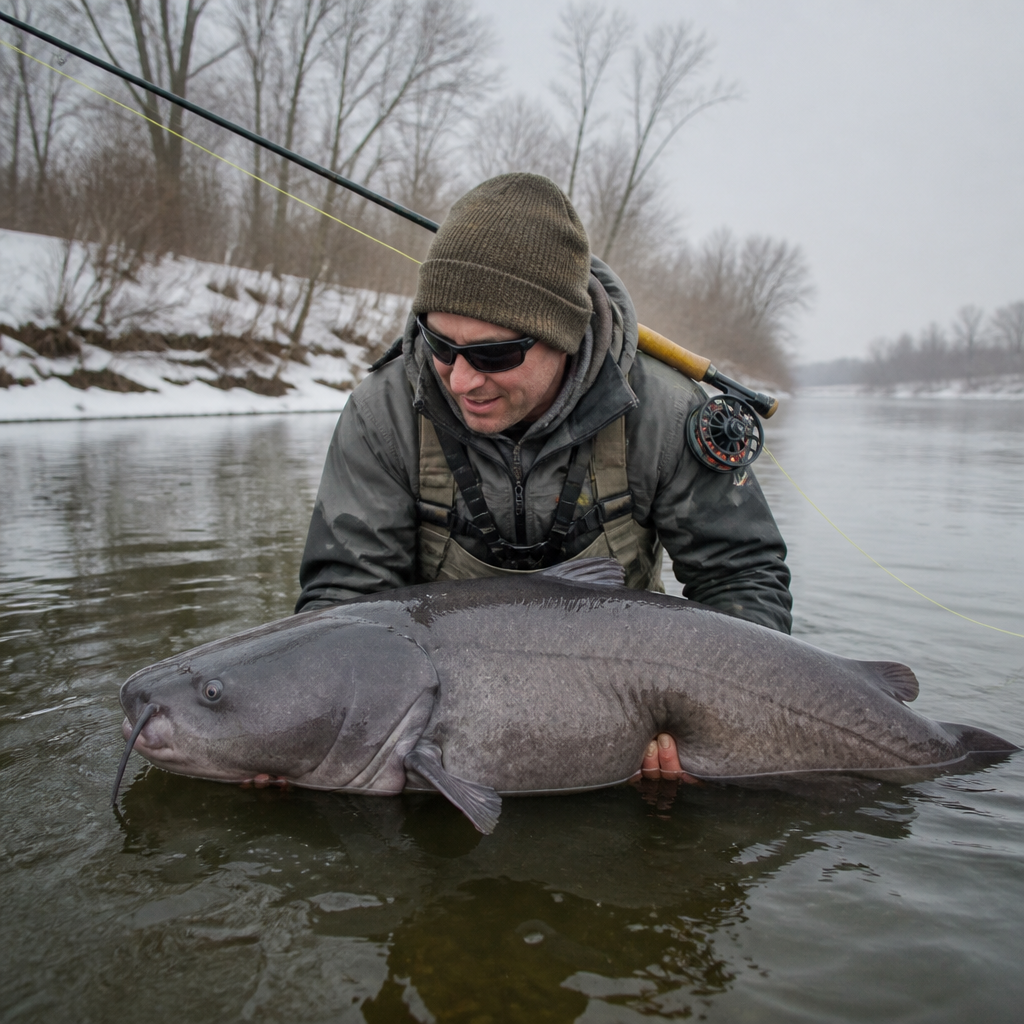
Winter fly fishing for catfish rewards anglers who understand that cold water changes almost everything except the fish’s need to eat. In winter, catfish move less, hold in predictable areas, and respond best to presentations that stay in the strike zone longer. That makes this season challenging, but it also makes it highly patternable. After many cold mornings on tailwaters, warmwater rivers, and southern reservoirs, I have found that winter success comes from reading temperature, current, and depth more carefully than in any other season.
Before getting into tactics, define the terms. Winter fly fishing means targeting fish with fly tackle during the coldest period of the year, when water temperatures commonly fall below 50 degrees Fahrenheit and metabolic rates slow. Catfish in this context usually means channel catfish, blue catfish, and flathead catfish, though channels and blues are the most realistic fly targets in winter because they continue feeding more consistently. Strategies and tips refers to the complete system: where to find fish, how to rig, what flies to use, how to retrieve, and how to stay safe in cold conditions.
This topic matters because winter is when most anglers quit, yet catfish often stack in limited holding water. That concentration creates real opportunity for the fly angler willing to fish methodically. It also matters because standard warm-season advice fails in cold water. Fast strips, shallow flats, and random bank casting waste time in January. Precise depth control, slower presentations, and heavier flies become far more important. A good winter plan turns catfish from accidental catches into a legitimate cold-season target.
Winter also serves as the hub of the broader seasonal picture. Learning winter fly fishing teaches principles that carry into pre-spawn spring, summer low light windows, and autumn transitions. You learn to read dissolved oxygen, current breaks, tailrace seams, and forage behavior. You also learn discipline. In cold water, a fly may need to sit almost motionless near bottom before a take develops into nothing more than weight. Anglers who can detect that subtle eat in winter become better fishers year-round.
Where Winter Catfish Hold and Why
The first winter question is simple: where are the catfish today? In rivers, focus on slower current adjacent to depth. Outside bends, scour holes below dams, bridge pilings, deep runs under bluff banks, and soft eddies below current seams are prime. Catfish conserve energy in winter, so they rarely hold in heavy flow unless food is pushed directly to them. I start by finding the deepest available water near an easy feeding lane, then work outward to transition edges rather than blind-casting long banks.
In reservoirs and lakes, winter catfish often relate to channel edges, creek mouths, submerged river ledges, and the base of steep points. Blue catfish commonly suspend or travel along old river channels following shad, while channel catfish are more likely to hold near bottom on flats bordering deeper water. Warm-water discharges from power plants can completely change the pattern by concentrating bait and raising metabolism. In smaller ponds, the deepest basin near an inflow or wind-protected bank is usually the first place worth probing.
Temperature stability matters more than absolute warmth. A muddy backwater that spikes five degrees in sun can attract fish briefly, but a stable 44- to 48-degree area near forage is often more reliable than a shallow pocket that cools overnight. Tailwaters are especially valuable because discharge can moderate temperature and aggregate fish. Use a thermometer, not guesswork. One degree can be meaningful in winter. If you can identify the warmest stable water with food nearby, you are already ahead of most anglers.
Tackle, Lines, and Winter Rigging
A 7- to 9-weight rod covers most winter catfish situations. I prefer an 8-weight for versatility because it throws weighted flies, protects tippets, and still handles a strong channel or blue in current. Pair it with a large-arbor reel that has a smooth drag, because winter fish often feel sluggish until they hit heavy flow or realize they are hooked near the net. Floating lines work in shallow rivers, but sink-tip and full-sinking lines are the real winter tools because bottom contact drives success.
Leader design should be short and simple. In cold water, turnover matters less than getting down. For sink-tips, I often use 3 to 5 feet of 15- to 20-pound fluorocarbon. For full-sinking lines, 2 to 4 feet is enough. Fluorocarbon sinks faster, resists abrasion on rock and wood, and maintains good strength in winter conditions. Long tapered leaders are usually counterproductive because they lift the fly and reduce strike-zone time. If fish are especially tentative, drop down only as far as structure allows.
Weighted flies, lead or tungsten eyes, and line density should be treated as one system. If current is strong, changing from brass to tungsten often matters more than changing patterns. In deeper lakes, count down the fly to a known depth and repeat the same sink time on every cast. I keep notes on line sink rate, depth, and retrieve speed because winter catfish can be remarkably consistent. The angler who replicates one productive presentation exactly will outfish the angler who constantly experiments without a baseline.
Best Winter Flies for Catfish
Winter catfish flies should imitate easy food and move water without demanding speed. The best patterns are baitfish, leeches, crayfish, and scentless attractor designs with strong silhouettes. Channels and blues will eat streamers that represent stunned shad or small sunfish, especially around tailraces and reservoirs. I rely on Clouser-style baitfish, rabbit-strip leeches, woolly buggers tied heavy, and craw patterns with trimmed profiles. Black, olive, white, and chartreuse remain dependable because they offer contrast in stained winter water.
Size matters, but not in the way many anglers expect. In very cold water, a moderate fly that hovers near bottom often outfishes an oversized pattern that creates too much lift. Size 2 to 2/0 covers most situations. In shad-oriented fisheries, white and pearl 2/0 streamers excel. In rivers with dark substrate and woody cover, black or olive rabbit patterns can be deadly because they pulse even when barely moved. Flatheads are less reliable in winter, but a slow large-profile fly near timber can still produce occasional fish in milder southern systems.
| Winter Situation | Best Fly Style | Color | Why It Works |
|---|---|---|---|
| Tailwater with shad | Clouser-style streamer | White/pearl | Matches stunned baitfish and sinks quickly |
| Stained river hole | Rabbit-strip leech | Black | Pulses at slow speed and shows strong silhouette |
| Rocky ledge or channel edge | Craw pattern | Olive/brown | Imitates bottom forage without fast retrieve |
| Cold pond basin | Weighted woolly bugger | Olive/chartreuse | Versatile profile for insects, leeches, and fry |
Presentation: How to Fish Slow Without Fishing Dead
The defining winter skill is controlled slowness. That does not mean no movement. It means enough action to signal vulnerability without pulling the fly away from inactive fish. My most reliable retrieve is a cast slightly upstream or across-current, a full sink, then short one- to three-inch strips with long pauses. In lakes, I use a countdown, then a crawl-strip cadence: two tiny strips, pause, one strip, pause. Most takes come during the pause or immediately after the fly starts moving again.
Depth control is everything. If the fly never touches or tracks just above bottom, you are probably fishing over winter catfish rather than to them. In rivers, mend early, let the line sink, and maintain contact without dragging the fly unnaturally. In reservoirs, adjust sink time before adjusting fly pattern. A good rule is to change one variable at a time: first depth, then retrieve speed, then angle, then fly. Winter fish often reward systematic fishing more than creative fishing.
Hooksets should be firm strips rather than dramatic trout-style lifts. Catfish often inhale a fly and simply add heaviness. If you lift aggressively with too much slack, you lose contact. Strip until the line comes tight, then raise the rod smoothly. Because catfish mouths are tough, sharp hooks matter. I touch up points throughout the day, especially after bouncing rock. Many missed fish blamed on winter lethargy are really the result of dull hooks and poor line control.
Reading Conditions: Water Clarity, Flow, and Weather Windows
Winter catfish can be caught in clear or stained water, but each requires adjustments. In clear water, reduce fly size slightly, use more natural colors, and lengthen pauses. Fish can inspect the fly longer, so less commotion often helps. In stained water, increase profile and contrast. Black, purple, and chartreuse produce because catfish locate food through a combination of vision, vibration, and chemoreception. Although flies do not carry natural scent, a bulky material like rabbit creates subtle movement that fish can detect at close range.
Flow changes often trigger feeding. A modest increase in dam generation can reposition catfish onto seams and current edges where drifting forage becomes available. The opposite can happen in rivers after a severe cold snap or sudden drop in discharge, when fish slide deeper and become less willing to move. Watch hydrographs from the U.S. Geological Survey and dam schedules from the U.S. Army Corps of Engineers or local utilities. On many winter fisheries, that information is as valuable as any fly box.
Weather windows are real, but they are narrower than in spring. The best periods are often the second day of a warming trend, the afternoon after sun has stabilized a shallow edge, or the beginning of a generation pulse below a dam. Bluebird conditions after a hard freeze can be tough unless the waterbody has thermal stability. Wind can help on lakes by pushing bait toward channel edges, but too much wind makes depth control difficult. When conditions improve, fish the prime area thoroughly before moving.
Species-Specific Tips for Channel Cats, Blues, and Flatheads
Channel catfish are usually the most approachable winter fly target. They tolerate a range of habitats, feed opportunistically, and often group in holes, channel bends, and tailwater edges. When I guide newer fly anglers, channels provide the best learning curve because they take smaller flies and do not always require extreme depth. If you can present a size 2 black leech slowly along bottom in 8 to 15 feet of water, channel cats will tell you quickly whether the location is right.
Blue catfish are the premium winter target where available because cold water often concentrates them around deep channels and shad. They can be more pelagic than channels, especially in reservoirs, but in rivers they still use current breaks predictably. Target blues with white baitfish flies on sinking lines and focus on ledges, tailraces, and deep bends connected to forage. Be ready for size. Even a mid-sized blue on fly tackle can test backing, knots, and drag settings much harder than a channel cat of similar length.
Flathead catfish are generally the least reliable winter option because their feeding activity drops sharply in very cold water. In southern systems with milder winters, they may still take large, slow flies near wood or rocky cover during warm spells. However, if your goal is consistent action, do not build a winter plan around flatheads. Treat them as a bonus fish. This matters because many anglers waste the best winter hours probing heavy cover for flatheads when nearby channel edges are holding active channels and blues.
Safety, Ethics, and Building a Winter Game Plan
Cold-water safety is part of winter fly fishing strategy, not an afterthought. Wear layered synthetic or wool clothing, carry a dry bag, and use a wading staff in rivers with slick rock or variable generation. If you fish from a boat, wear a life jacket the entire time. Cold shock and reduced dexterity arrive fast. I also keep spare gloves, chemical warmers, and a thermometer accessible. Good decisions save trips. Great fishing is irrelevant if you cannot safely reach, fish, and leave the water.
Ethics matter because winter fish can be concentrated and vulnerable. Handle catfish with wet hands, support larger fish horizontally, and minimize time out of water. In tailwaters and reservoirs where trophy blues gather seasonally, selective harvest and local regulation awareness are essential. Many fisheries now emphasize conservation of larger breeding fish. Barbless or debarbed hooks can speed release, especially when fish are lightly hooked. The goal is repeatable winter fishing, not burning a location by overpressuring fish that are using a limited holding area.
A practical winter plan starts with three questions: where is the most stable water, where is the forage, and how will I keep the fly near bottom? Answer those before you step in. Then simplify. Pick one promising area, one sinking setup, and two confidence flies, and fish them thoroughly. Winter fly fishing for catfish is not about covering the most water. It is about understanding a small amount of water deeply. Do that consistently, and the coldest season can become your most dependable time to connect with catfish on the fly.
Frequently Asked Questions
Where do catfish usually hold in winter, and how can I find them when fly fishing?
In winter, catfish rarely roam as widely as they do in warm water, which is good news for fly anglers because it makes their location far more predictable. As water temperatures drop, catfish look for areas where they can conserve energy while still having access to food. That usually means deeper holes, slow-current seams near deeper channels, outside bends, tailwater depressions, wintering pools, reservoir ledges, and the softer water adjacent to current breaks. In rivers, pay particular attention to transitions: where fast water spills into a slower bucket, where a deep run flattens into a hole, or where submerged wood creates a cushion of softer flow. In reservoirs and lakes, focus on creek channels, drop-offs, submerged roadbeds, riprap warmed by sun, and flats close to deeper water.
The most productive winter spots are often those that combine three things: stable depth, manageable current, and nearby forage. Catfish do not want to chase hard in cold water, so they tend to hold where a meal can drift or crawl into range. That means you should spend less time blind-casting big areas and more time methodically probing likely holding water. A fish finder helps on lakes, but even without electronics, careful observation goes a long way. Look for slower surface texture, eddies, subtle depth changes, bird activity around bait, and warmer inflows. On tailwaters, generation schedules can completely reposition fish, so checking flow releases before you go is essential. Winter catfish are often grouped up, so once you contact one fish, slow down and work the area thoroughly because there are often more nearby.
What water temperature and weather conditions are best for winter fly fishing for catfish?
Water temperature matters more than almost any other factor in winter because it influences both catfish metabolism and their willingness to move for a fly. While catfish can remain catchable in very cold water, they generally feed in shorter windows and respond best when conditions are stable or slightly improving. A small rise in water temperature, even just a degree or two, can make a major difference. That is why the best winter days are often not the coldest, brightest mornings, but rather late-morning to afternoon periods after several hours of sun, mild warming trends, or stable weather between fronts. In southern waters, these windows can be especially strong after a cold spell begins to break.
Stable conditions usually outfish dramatic swings. A hard cold front often slows activity, especially in shallow water, while warming trends tend to position fish more predictably along transition zones and edges. Tailwaters are a special case because discharge and dam releases can override weather patterns by changing current speed, depth, and oxygen levels. On rivers, slightly stained water can help because it gives catfish confidence, but heavy muddy runoff often makes presentation difficult unless you are fishing slow, tight to cover, and with flies that push water or carry scent-like appeal through motion. Wind can also help or hurt. On reservoirs, a light breeze may push bait toward banks or channel edges, while strong wind can make precise, slow presentations much harder. Overall, the best approach is to track water temperature, watch for stable or warming trends, and fish the warmest, most consistent part of the day with patience and confidence.
What flies, tackle, and rigs work best for winter catfish on a fly rod?
Winter catfish are usually not interested in burning down a fast-moving fly, so your setup should be built around depth control, slow presentation, and strike-zone time. In most situations, a 7- to 9-weight rod is ideal because it handles weighted flies, sinking lines, and strong fish without feeling underpowered. A reel with a reliable drag matters, especially around wood, rocks, or current. Fly lines should match the water you are fishing: full-sinking lines and sink-tip lines are often the best winter choices because they keep the fly near bottom where catfish are holding. Floating lines can still work in very shallow, slow water, but they are generally less efficient when fish are deep and inactive.
Leader systems can stay simple. Many anglers overcomplicate them, but winter catfishing often rewards stout, short leaders that turn over heavy flies cleanly and help maintain contact. Flies should have profile, weight, and movement without requiring a fast retrieve to come alive. Excellent choices include rabbit-strip leeches, woolly bugger variations, baitfish patterns with lead or dumbbell eyes, crayfish imitations, and bulky chenille or marabou flies that pulse when barely moved. Black, olive, brown, purple, and combinations with chartreuse all produce, depending on water clarity. In stained water, darker silhouettes and larger profiles stand out well; in clearer water, more natural baitfish or muted leech patterns can be better. The key is not just fly choice but how long the fly stays in the fish’s face. If your pattern cannot get down or stay down, it is the wrong tool for winter, no matter how good it looks in the vise box.
How should I present the fly to cold-water catfish in winter?
The single biggest adjustment for winter catfish is slowing down. In warm weather, fish may track and eat a moving fly aggressively, but in winter your best presentations are usually deliberate, bottom-oriented, and almost stubbornly patient. Think in terms of keeping the fly in the strike zone for as long as possible rather than covering water quickly. That often means casting slightly upstream or across-current, allowing the fly to sink fully, then using short strips, small hops, gentle crawls, or even long pauses. Many takes come when the fly is barely moving or just lifting off bottom after a pause. In reservoirs and stillwaters, a slow hand-twist retrieve or tiny strip-strip-pause sequence often outperforms anything faster.
Depth and angle are critical. If you are not occasionally ticking bottom or passing very close to it, you are probably too high in the water column. That does not mean snagging constantly, but it does mean fishing with intent and maintaining contact. Watch your line carefully because winter takes are often subtle: a slight stop, a soft heaviness, or a slow draw rather than a sharp strike. Set with a firm strip-set first, then raise the rod once the fish is connected. Cover the water in layers if needed, but once you identify the productive depth and pace, repeat it precisely. Winter catfish are highly patternable because they often respond to a very specific combination of depth, speed, and location. When you find that combination, stay disciplined and do not speed up just because the action feels slow. Winter success usually belongs to the angler who is willing to fish methodically and trust a patient presentation.
What are the biggest mistakes anglers make when winter fly fishing for catfish?
The most common mistake is fishing too fast. Many anglers bring warm-season habits into winter and strip flies at a pace that simply does not match cold-water behavior. Catfish still need to eat, but they are far less willing to chase, so speed works against you more often than not. Another major mistake is fishing the wrong water. In winter, not all “good-looking” water is actually productive. Shallow banks, broad flats, and heavy current that might hold fish in summer can be nearly empty during cold periods. Successful anglers focus on slower, deeper, more stable holding water and work it thoroughly instead of rushing from spot to spot.
Other frequent errors include failing to get deep enough, using lines or flies that do not hold near bottom, and ignoring small temperature changes that can transform the day. Some anglers also overlook the importance of timing. The first hour after sunrise may be far less productive than late morning or afternoon after a bit of warming. On tailwaters, ignoring release schedules can ruin an otherwise smart plan because changing current can reposition fish completely. Finally, many people quit too soon after one slow stretch. Winter catfish fishing is rarely a numbers game driven by constant action. It is a pattern game driven by conditions, location, and presentation. If you stay patient, fish slowly, monitor temperature and current, and make each cast count in high-probability water, winter can become one of the most consistent and rewarding times of year to catch catfish on a fly.