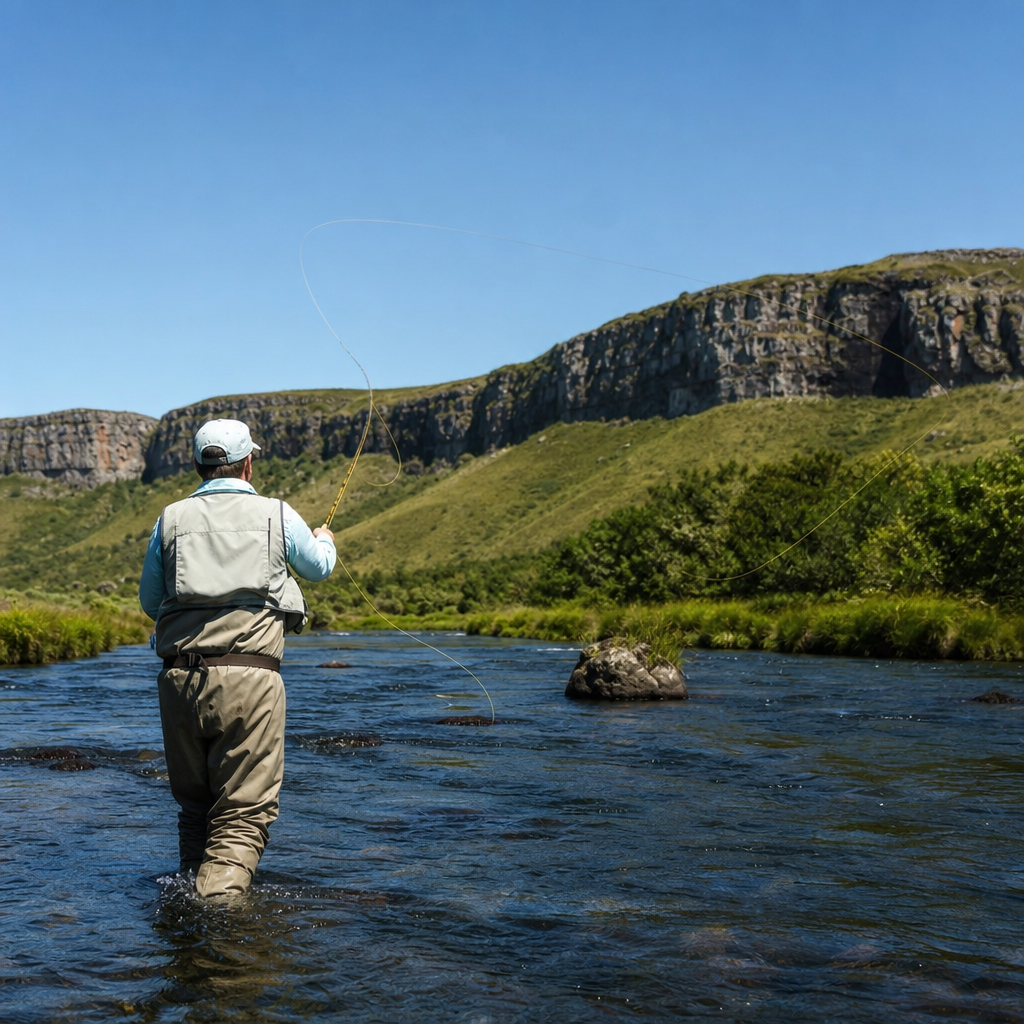
Fly fishing in Uruguay rewards anglers who value quiet water, technical presentations, and surprising variety in a country often overshadowed by Patagonia, the Amazon, and the saltwater glamour of neighboring coasts. Uruguay is not the first South American destination most fly fishers name, yet that is exactly why it deserves attention: pressure is light, travel logistics are straightforward, and the fisheries span grassland streams, broad rivers, Atlantic lagoons, estuaries, and surf. For readers exploring fly fishing destinations across South America, Uruguay works best as both a standalone trip and a strategic hub for understanding the continent’s southern warmwater and coastal opportunities. In practical terms, fly fishing here means targeting species such as golden dorado, tararira, pejerrey, sea-run predators in brackish zones, and seasonal migratory fish with tackle ranging from 5-weight outfits to 10-weight saltwater setups.
Uruguay’s fishing character is shaped by the Pampas, not the Andes. The landscape is mostly rolling pasture, low-gradient drainages, marshes, and river systems connected to the Río de la Plata and the South Atlantic. That geography matters because it changes technique. Instead of long drifts through freestone trout runs, anglers often cast to weed edges, current seams around structure, lagoon drop-offs, muddy backwaters, and wind-affected shorelines. Reading water here means looking for oxygen, bait concentration, and ambush cover more than classic riffle-pool sequences. I have found that visiting anglers do best when they stop expecting a smaller version of Argentine trout country and start thinking like warmwater hunters: cover water, watch temperature, match forage, and be ready for explosive takes close to the boat or bank.
As a South America hub, Uruguay also helps clarify regional contrasts. Argentina remains dominant for trout and large-scale dorado programs on the Paraná basin; Chile offers iconic trout rivers and lake systems; Brazil supplies peacock bass, jungle species, and extensive flats-style salt opportunities; and Colombia adds migratory and jungle fisheries that are still emerging for fly anglers. Uruguay fits between these better-known narratives. It offers easier distances, a stable tourism framework, and productive fisheries that can be sampled without charter flights or remote camps. That mix makes it attractive for anglers building multi-country itineraries, families combining fishing with coastal travel, and experienced casters seeking uncrowded venues where presentation skill matters more than famous branding.
Why Uruguay Matters Within South America
Uruguay matters because it broadens what South America means to a fly fisher. Too many destination guides reduce the continent to Patagonia trout, jungle predators, or tropical flats. Uruguay adds a temperate Atlantic and estuarine dimension with productive freshwater systems that hold aggressive species year-round. It is especially valuable for anglers who enjoy sight-adjacent fishing around structure, floating lines with bulky flies, and mixed-species days where adaptation is part of the appeal. The country is compact, roads are good, and access from Montevideo or Punta del Este is simple compared with many continental fisheries. That convenience is not trivial. More fishing hours and fewer transit variables usually produce better outcomes than ambitious itineraries with constant transfers.
The national context also supports flexible planning. Lodging standards are consistent, vehicle rental is easy, and guides who specialize in dorado, tararira, pejerrey, and coastal species usually operate within manageable driving distance of major towns. In South American trip design, Uruguay can function as a warm-up stop before Argentine Patagonia, a shoulder-season destination when southern trout waters are closed or slow, or a coastal add-on after urban travel in Montevideo. For content architecture within fly fishing destinations, this page is the broad entry point: anglers interested in South America should understand Uruguay alongside Argentina, Chile, Brazil, and the continent’s northern frontiers because it fills the gap between marquee fisheries and practical, high-quality access.
Top Fly Fishing Spots in Uruguay
The Río Negro is the anchor freshwater system for many visiting anglers. Running across the country, it creates a network of reservoirs, side channels, and marshy margins that hold tararira and seasonal dorado, especially where current, bait, and structure overlap. Near Paso de los Toros and downstream sectors, anglers work weed beds, timber, and shoreline indentations with streamers, divers, and deer-hair patterns. The river is broad, so boat positioning matters; short, accurate casts to edges consistently outfish blind bombing to open water. During warmer months, surface eats from tararira can be violent, and dorado will often sit near current breaks where small baitfish collect.
The Uruguay River along the western border offers some of the country’s best-known dorado water, particularly near Salto and Paysandú. This is not the giant-dorado game associated with Argentina’s upper Paraná, but it can be very good for mobile anglers fishing stream mouths, rock structure, and current seams. Water level changes affect clarity and safety, so local guidance is important. I have seen days turn on a few degrees of temperature rise and a shift from stained to greenish water. In those conditions, intermediate lines and baitfish patterns with flash become especially effective.
Coastal lagoons deserve more international attention. Laguna de Rocha, Laguna Garzón, and connected marsh systems can produce pejerrey, mullet-feeding predators, and seasonal brackish action where fresh and saltwater species overlap. These fisheries are wind-sensitive, but they are ideal for anglers comfortable fishing from shore, kayak, or small skiff. The east coast near José Ignacio, La Paloma, and Cabo Polonio also offers surf and estuary prospects for bluefish, weakfish-like croakers, and other opportunists, particularly when bait schools push close. Around Montevideo and the Río de la Plata shoreline, urban-access water can surprise you, though clarity and conditions vary sharply with wind and river discharge.
| Region | Primary species | Best conditions | Typical tackle |
|---|---|---|---|
| Río Negro | Tararira, dorado | Warm water, stable levels, weed edges | 6-8 weight, floating or intermediate line |
| Uruguay River | Dorado, mixed warmwater species | Moderate flow, good clarity, active bait | 7-9 weight, floating/intermediate line, wire or heavy fluoro |
| Atlantic lagoons | Pejerrey, estuary predators | Wind lanes, moving water near inlets | 5-7 weight, floating line, small streamers |
| Ocean beaches and estuaries | Bluefish, croaker-related species, seasonal migrants | Bait presence, low light, clean surf | 8-10 weight, stripping basket, salt-safe reel |
Species, Seasons, and Tackle Selection
Tararira, often compared to wolf fish in behavior though not taxonomy, is one of Uruguay’s most entertaining fly rod targets. It thrives in warm, weedy water and attacks gurglers, sliders, poppers, and rabbit-strip streamers with real aggression. A 6- or 7-weight rod handles most situations, but an 8-weight is useful around dense vegetation or larger fish. Because tararira have abrasive mouths and strike hard boatside, a short bite tippet of heavy fluorocarbon is prudent. Golden dorado require stronger gear: 7- to 9-weight rods, reels with smooth drags, and leaders built to turn over bulky flies while surviving teeth and current. Many guides favor 30- to 40-pound shock material; some use short wire traces when fish are especially aggressive, though that can reduce fly movement.
Pejerrey are a different game entirely. These slender, schooling fish often respond to smaller baitfish imitations on 5- or 6-weight outfits, and they reward subtle retrieves more than raw disturbance. In brackish lagoons and estuaries, match-the-hatch thinking matters. If the forage is tiny silversides, oversized streamers underperform. For Atlantic coastal species, step up to 8- or 9-weight tackle with corrosion-resistant reels, intermediate or shooting-head lines, and durable flies tied on strong hooks. Uruguay’s coast is windy enough that line management becomes a skill in itself; a stripping basket is not optional in surf conditions.
Seasonally, spring through early autumn is generally strongest for warmwater freshwater fishing, with peak surface activity often occurring during stable warm spells. Summer can be excellent at dawn and dusk, though midday heat may push fish into heavier cover or deeper edges. Dorado in larger rivers respond to flow, bait movement, and clarity as much as calendar timing. Coastal opportunities can spike during bait migrations and periods of cleaner water. Winter is not a write-off, especially for pejerrey and selective estuary fishing, but the program becomes more condition-driven and less visually explosive.
Effective Fly Fishing Techniques in Uruguay
The single most reliable technique in Uruguay is accurate casting to structure followed by a controlled retrieve that matches the species’ feeding posture. For tararira in backwaters and marsh edges, cast tight to reeds, weed pockets, undercut banks, or isolated timber. Let the fly sit for a beat, then strip with irregular pauses. Many eats happen on the pause. Surface bugs work best when fish are already active, temperatures are high, and low light reduces refusal. If follows occur without commitment, switch from a noisy popper to a subtler slider or unweighted rabbit pattern that hangs longer in the strike zone.
For dorado, think current first. Position the boat or wadeable angle so the fly lands upstream or across from likely holding water, then strip fast enough to keep it broadside and alive. Dorado are visual, territorial ambush feeders; they often respond to acceleration. Bright flies in chartreuse, yellow, orange, black, and white all have a place, but color should follow water clarity. In stained water, contrast matters more than realism. In clearer conditions, profile and speed become more important. Solid hook-setting technique is critical: use a firm strip set, then clear line immediately to the reel. Trout-style lifting costs fish.
In lagoons and on the coast, wind management separates efficient anglers from frustrated ones. Shorten false casts, carry line low on the back cast, and use water tension when possible to reload. Retrieve speed should track forage behavior. Silverside imitations often work best with steady hand-twist or short strips, while bluefish-style coastal predators react to faster pulls and abrupt changes. When fish are scattered, cover water methodically by fan casting rather than repeatedly hammering one angle. Uruguay’s fisheries reward movement and observation. Birds, bait flickers, nervous water, and temperature shifts regularly tell you more than a map does.
Planning a Successful Trip
Montevideo is the easiest international gateway, and Punta del Este works well for coastal itineraries. A rental car opens most of the country, but guided days are worth the investment on larger rivers and unfamiliar lagoons because conditions change quickly and many productive areas are subtle rather than scenic. Ask guides specific questions before booking: target species, boat type, seasonal expectations, transfer time, casting distances, and whether tackle is included. Serious anglers should still bring their own rods, tropical-safe lines for summer heat, and a backup spool because one line rarely covers every scenario.
Clothing and fish handling deserve attention. Uruguay’s sun can be intense, and weather shifts from cool mornings to hot afternoons are common. Lightweight sun protection, a rain shell, polarized glasses with copper or amber lenses, and quick-dry footwear are standard. For fish care, rubber nets, long pliers, jaw spreaders only when necessary, and efficient photography routines minimize stress. Many dorado and tararira fisheries are best managed through immediate release, especially in accessible waters near population centers. Regulations and local norms vary, so confirm current rules through guides or regional authorities before fishing.
As a South America hub, the main lesson is simple: include Uruguay in the conversation, not as a footnote but as a distinct destination with its own strengths. It offers technical warmwater fly fishing, accessible travel, and underfished rivers, lagoons, and coastlines that fit well into broader continental planning. Anglers who arrive with the right expectations, species-specific tackle, and a willingness to adapt usually leave impressed by how much water a compact country can hold. If you are building a South America fly fishing itinerary, start by mapping Uruguay’s Río Negro, Uruguay River, and Atlantic lagoons, then match season, species, and technique to the experience you want most.
Frequently Asked Questions
What are the best places to go fly fishing in Uruguay?
Uruguay offers a surprisingly broad mix of fly fishing water for a relatively compact country. Some of the most interesting zones include the Río Negro system, the Uruguay River, Atlantic-facing lagoons such as Laguna de Rocha and Laguna Garzón, interior streams and smaller grassland rivers, and selected estuarine and surf environments near the coast. The Río Negro is often one of the first freshwater destinations serious anglers look at because it provides access to broad river structure, quieter sections, and habitat that can hold predatory species willing to eat streamers. The Uruguay River, forming part of the western border, is another major option, especially for anglers interested in bigger water and mobile fish. In the east, the lagoon and estuary systems create a very different style of fishing, often involving wind, tide or current influence, and a more visual, hunt-oriented approach.
What makes Uruguay especially appealing is not one single famous river, but the diversity packed into a manageable travel itinerary. You can move from inland freshwater to brackish lagoons and then to the surf within a relatively short distance compared with many larger South American countries. That means an angler can plan a trip around variety instead of committing to one fishery type for an entire week. It also means local conditions matter a great deal. Water levels, wind direction, seasonal rainfall, and even slight salinity changes can strongly influence where fish hold. For that reason, the “best” spot is often the one matching current conditions rather than the one with the biggest name. Anglers who do best in Uruguay usually stay flexible, fish with a guide when exploring a new region, and treat the country as a collection of technical opportunities rather than a single headline destination.
What species can you catch on the fly in Uruguay?
One of Uruguay’s strengths is that it offers more species diversity than many visiting anglers expect. Depending on where you fish, likely targets can include tararira, also known as wolf fish, as well as other warmwater and estuarine predators that respond well to streamers, baitfish patterns, and topwater flies. Tararira are among the best-known freshwater fly targets in Uruguay because they are aggressive, structure-oriented, and capable of explosive strikes, especially in warmer months. In the right water, they are ideal fish for streamer anglers who enjoy covering banks, weed edges, submerged wood, and drop-offs with deliberate presentations. In lagoons, estuaries, and coastal systems, anglers may also encounter species that reward a more tactical style, including fish that feed on shrimp, small baitfish, and juvenile forage concentrated by tide, current, or wind.
The exact species list varies significantly by region and season, which is why Uruguay is best approached as a fishery with several personalities. Inland, the focus is often on predatory freshwater fish that tolerate warmer water and thrive around vegetation, slower seams, and ambush cover. Closer to the coast, the game can shift toward brackish and salt-influenced species, where matching local forage and understanding moving water become more important than simply covering structure. This variety is part of Uruguay’s appeal. You are not just chasing one iconic fish; you are adapting to several fisheries within one country. That adaptability rewards experienced fly anglers, but it also makes Uruguay a great destination for curious travelers who enjoy learning new presentations, changing fly styles, and solving different problems from one day to the next.
What fly fishing techniques work best in Uruguay?
Successful fly fishing in Uruguay usually comes down to presentation discipline, reading subtle holding water, and adjusting quickly to habitat changes. In freshwater rivers and lagoons, streamer fishing is often the foundation. Moderately sized baitfish patterns, deer hair divers, topwater poppers, and articulated flies can all be effective, particularly for aggressive predators such as tararira. The key is not simply casting large flies at random structure. Better results usually come from thoughtful angle control, deliberate pauses, and retrieving in ways that trigger fish holding tight to weeds, timber, undercut banks, or current breaks. In quieter water, a slow strip with pauses may outperform a fast retrieve, while in stained or warmer water, a louder topwater or more assertive strip can help fish locate the fly.
In estuaries, lagoons, and surf zones, techniques become more situational. Wind management is critical, and so is line control. Intermediate or sink-tip lines can be useful when bait is holding below the surface, while floating lines may be ideal for shallower marsh edges or visual opportunities. Anglers should pay close attention to current seams, bait movement, and water color transitions, because fish often position themselves where food is naturally funneled. Uruguay is not a place where a single generic retrieve solves everything. It rewards anglers who fish methodically, make repeated presentations from different angles, and adjust leader length, fly weight, and retrieve speed based on what the fish and water are telling them. In practical terms, that means being willing to slow down. Technical presentations, accurate casts, and controlled retrieves generally outperform blind speed and constant movement.
When is the best time of year to fly fish in Uruguay?
The best time to fly fish in Uruguay depends on the species and environment you want to target, but in general the warmer months are especially productive for many freshwater predator fisheries. Spring through early autumn often brings active fish, warmer water temperatures, and strong opportunities for streamer and topwater fishing. Summer can be excellent in the right conditions, particularly early and late in the day, though midday heat, vegetation growth, and changing water quality in some areas may require more strategic planning. For inland predators, warming trends often improve activity, while abrupt cold fronts can temporarily shut fish down or push them deeper into cover. That is why local timing matters more than broad calendar assumptions.
Coastal and estuarine opportunities can also be highly seasonal, but they are even more tied to wind, bait presence, salinity, and water movement than to air temperature alone. In those fisheries, a supposedly good month can fish poorly if strong winds muddy the water or bait fails to concentrate, while an overlooked weather window can produce outstanding action. For traveling anglers, the most reliable approach is to choose a broad target season and then fine-tune plans with up-to-date local information. Uruguay’s travel logistics make that easier than in many more remote destinations, and the country rewards anglers who remain flexible. Rather than asking for one perfect month, it is usually smarter to ask which region is fishing best during your travel window. That mindset leads to more productive days and lets you take advantage of Uruguay’s diversity instead of forcing a single pattern everywhere.
What gear should I bring for a fly fishing trip to Uruguay?
A versatile setup is usually the smartest choice for Uruguay because conditions and target species can vary so much between inland rivers, lagoons, estuaries, and surf. For many freshwater situations, a 6- to 8-weight rod is a practical all-around option, especially if you plan to throw streamers, poppers, and medium-sized baitfish flies for predatory species. If you expect larger flies, heavier cover, or stronger wind, leaning toward the heavier end of that range makes sense. In coastal or brackish environments, many anglers are comfortable with a 7- to 9-weight outfit, depending on fly size, wind strength, and the size and power of the fish. A reliable reel with a smooth drag is important, but line choice is often even more critical. Bringing both floating and intermediate lines, and possibly a sink-tip if your itinerary includes deeper channels or wind-swept water, will give you far more flexibility than relying on a single setup.
Leaders and terminal tackle also deserve attention. In freshwater predator fishing, abrasion resistance matters because fish often live around weeds, wood, and rough cover. If you are targeting toothy species like tararira, ask in advance whether wire or heavier bite-resistant material is advisable. Fly selection should include baitfish imitations in natural and high-visibility colors, topwater bugs, divers, and a few patterns that push water in stained conditions. For coastal fishing, add shrimp patterns, slim baitfish flies, and durable materials that hold up to current and repeated casting in wind. Beyond tackle, polarized sunglasses are essential for reading structure and spotting movement, and weather-appropriate clothing matters because Uruguay’s conditions can change quickly, especially near the coast. Wading gear should be chosen according to your exact itinerary; some trips are boat-based, others involve muddy banks, marshy edges, or firm river margins. In short, think in terms of adaptability: a compact but well-planned gear list will serve you much better than an oversized kit built for only one type of water.