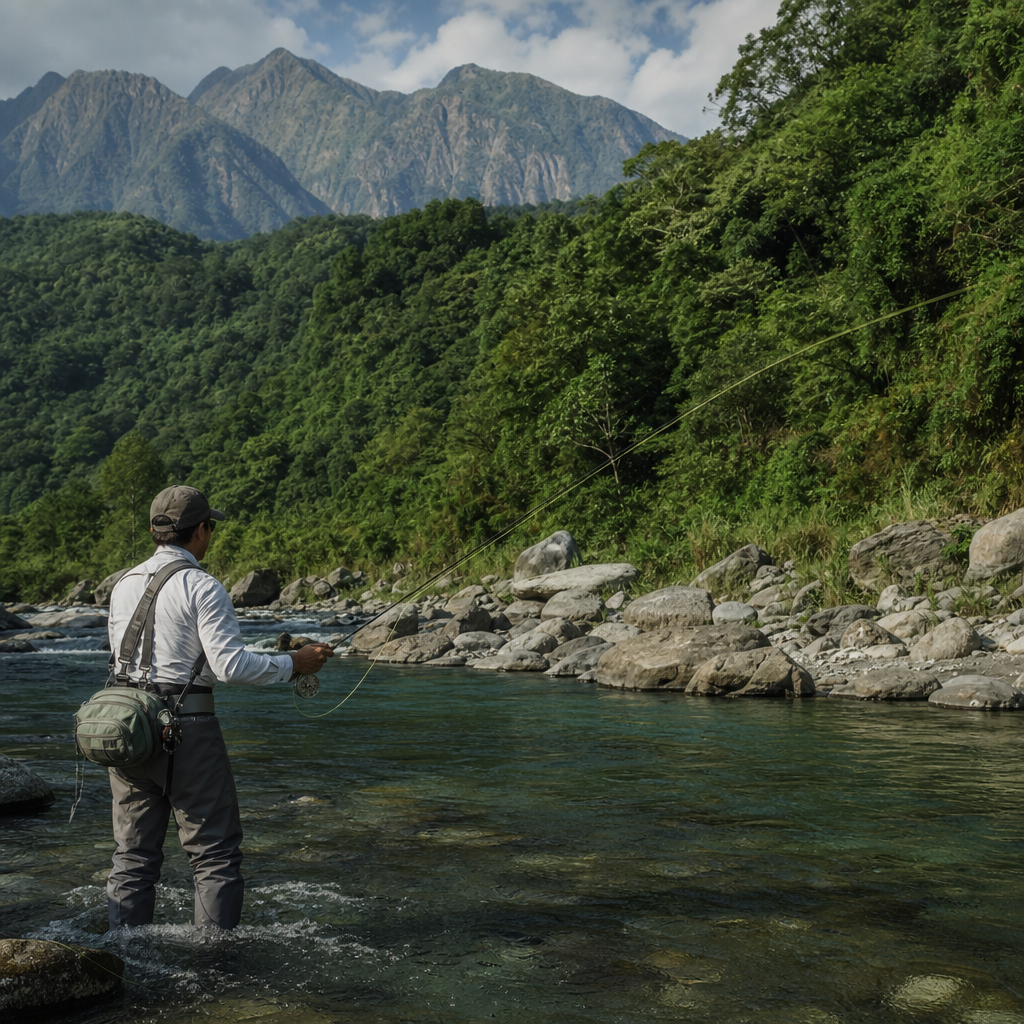
Fly fishing in Taiwan rewards anglers with a rare mix of mountain scenery, technical freshwater challenges, and easy access to diverse water within a compact island. For readers exploring fly fishing destinations across Asia, Taiwan deserves attention because it combines steep forested watersheds, subtropical lowland rivers, reservoir systems, and a growing catch-and-release culture shaped by conservation pressure. In practical terms, fly fishing means presenting an artificial fly with the weight of the fly line rather than the lure itself, using rods, reels, tapered leaders, and mending techniques to control drift or swing. In Taiwan, that approach is most often applied to stream species such as masu salmon relatives in protected contexts, native minnows and goby-like targets, stocked trout in managed waters, and aggressive predators in reservoirs or estuaries where streamer tactics excel.
What makes Taiwan especially important as an Asian hub is contrast. Japan is better known globally for mountain trout, Mongolia for taimen, and Thailand for exotic stillwater giants, yet Taiwan offers a dense, accessible introduction to many Asian fly fishing realities in one place: fast pocket water, typhoon-shaped riverbeds, warm-weather insect activity, pressured urban anglers, and regulations that can change from one watershed to the next. I have fished and scouted rivers from northern New Taipei down through central mountain roads and into the humid south, and the pattern is consistent: success depends less on distance and more on reading hydrology, seasonal rainfall, and local access rules. Anglers who arrive expecting classic Western hatch charts alone usually struggle. Those who treat Taiwan as a technical, water-reading destination usually do well.
As a sub-pillar hub for Asia, this guide covers the essential question a traveling angler asks first: where should I start, and how should I fish it? The answer begins with geography. Taiwan’s central mountain range creates short, steep catchments that rise quickly after rain and drop quickly when weather stabilizes. That means river condition matters more than calendar date. Water clarity, discharge, and road safety often determine whether a trip succeeds. Species, legal access, and presentation style all follow from that foundation. If you understand Taiwan, you understand many of the same decision-making principles needed throughout Asian fly fishing destinations.
Fly fishing in Taiwan also matters because it highlights a broader Asian trend: the best fishing often exists where ecology and recreation are in tension. Habitat fragmentation, dam releases, concrete channelization, and poaching have affected many rivers. At the same time, local clubs, indigenous communities, reservoir managers, and park authorities have created pockets of responsible angling. For travelers building an Asia itinerary, Taiwan can function as both a standalone destination and a training ground for reading monsoon-influenced waters. The core skills are straightforward but unforgiving: accurate short casts, high-stick nymphing, line control in pocket water, stealth in clear pools, and disciplined streamer retrieves when fish are holding deep or reacting to sudden flow changes.
Top fly fishing spots in Taiwan and how each water fishes
The best fly fishing spots in Taiwan are concentrated in mountain and foothill systems where water remains cool enough for active fish and wading is possible outside peak rain events. Northern Taiwan offers convenience and variety. The Nanshi River system in the greater Taipei watershed is one of the most practical starting points because sections can be reached on a day trip, and anglers can find riffles, pocket water, and slower seams that suit nymphs and small streamers. It is not a pristine wilderness experience everywhere, but it teaches line control quickly. In low, clear conditions, fish sit tight behind boulders and under cut banks, and a drag-free presentation matters more than fly pattern complexity.
Central Taiwan holds many of the island’s classic mountain opportunities. Upper tributaries associated with the Dajia, Zhuoshui, and nearby headwater systems provide colder flows, more gradient, and the kind of broken current where a short rod shines. In these waters, I prefer a nine-foot leader tapered to lighter tippet when fish are selective, but I switch to stronger material immediately after rain because fish use structure aggressively and current pressure is high. Reservoir inflows around Sun Moon Lake and other impoundments can also fish surprisingly well, especially where baitfish stack near current tongues and submerged timber. These areas are ideal for streamer fishing at first and last light.
Southern and eastern Taiwan are less predictable but can be excellent when weather settles. Rivers in Hualien and Taitung counties often run with dramatic clarity between rain systems, and the surrounding scenery is spectacular. The challenge is timing. A reach that is perfect one morning can become unfishable after upstream rain, even if the local sky remains clear. In the south, foothill streams and estuarine edges create warmwater options where small clousers, baitfish imitations, and shrimp-like patterns can draw strikes from aggressive species that are overlooked by trout-focused travelers. For anglers covering Asia broadly, this matters because Taiwan is not only a cold-water story; it also previews the tropical and subtropical diversity found across the region.
| Region | Best water type | Primary approach | Main challenge |
|---|---|---|---|
| Northern Taiwan | Accessible freestone rivers | Euro-style nymphing, dry-dropper rigs | Angling pressure and wary fish |
| Central mountains | Steep headwaters, reservoir inflows | Pocket-water nymphing, small streamers | Road access, sudden flow change |
| Eastern valleys | Clear post-rain river windows | Stealth presentations, terrestrials | Weather timing and safety |
| Southern foothills and estuaries | Warmwater rivers, brackish edges | Baitfish and shrimp patterns | Heat, variable salinity, fast storms |
When anglers ask for the single best place to fly fish in Taiwan, the honest answer is that no river wins every month. The best spot is the safe, clear watershed available after recent weather. That is why local intelligence matters. Check river cameras where available, monitor Central Weather Administration forecasts, and ask tackle shops about turbidity rather than simply asking whether fish are “on.” In Asia generally, and in Taiwan especially, water condition beats reputation.
Species, regulations, and seasonal timing
Taiwan’s fish community is diverse, but not every species is appropriate or legal to target in every place. The most sensitive example is the Formosan landlocked salmon, often called the Formosan salmon, a critically protected fish associated with upper reaches of the Dajia system. It is not a sport target. Responsible anglers should understand its significance as a conservation icon and avoid any conduct that pressures protected populations or restricted habitat. This matters because destination content about fly fishing in Asia must distinguish between fish you can admire, fish you may legally pursue, and fish that require highly specific local permission.
Legal targets vary by watershed and management regime. In managed ponds and some stocked mountain venues, trout may be available under clear fee structures and catch rules. In wild rivers, anglers often encounter native minnows, opsariichthys-type fish, gobies, and opportunistic predators that respond well to flies despite receiving little international attention. Reservoir margins can hold larger warmwater fish that chase streamers, while estuarine zones may produce brackish species on crab, shrimp, or baitfish patterns. The practical lesson is that Taiwan rewards flexible anglers more than purists. If you insist on one species, your options narrow sharply. If you enjoy technical fishing for whatever the water offers legally, opportunities expand.
Seasonality in Taiwan follows rainfall and temperature more than the neat spring-summer-fall progression familiar in drier climates. The prime windows for mountain streams are usually the cooler, more stable periods outside typhoon season, often from late autumn into spring, with additional short opportunities between weather systems. Summer can still fish early and high in the mountains, but heat, thunderstorms, and dangerous flow spikes limit consistency. After a major rain event, many rivers need time to clear, yet fish often feed hard in the first stable drop when water shifts from opaque to greenish. I have had some of the best sessions 24 to 72 hours after rain, not because insect life exploded, but because fish moved into edges and softer seams where a tight-line nymph could stay in the strike zone.
Regulations deserve careful attention. Taiwan’s rules can involve local closures, protected zones, permit requirements, and restrictions tied to parklands or indigenous territories. Some waters are effectively off-limits without local knowledge or explicit authorization. Barbless hooks are increasingly expected in ethical catch-and-release settings even when not universally mandated. Wading across spawning or nursery habitat is poor practice anywhere in Asia, and in Taiwan’s smaller systems the impact is immediate. Before fishing, confirm access, species legality, and whether a private managed section offers a better low-risk introduction than a wild drainage under uncertain rules.
Techniques that consistently work on Taiwanese water
The most effective fly fishing techniques in Taiwan are short- to medium-range methods built around contact and control. Pocket-water nymphing is the foundation. Because many streams are steep and broken, fish hold in micro-lanes behind rocks, in plunge-pool tails, and along current cushions next to boulders. A long overhead cast is often unnecessary. Instead, approach from downstream, keep only the leader or a small amount of line on the water, and guide the drift with a high rod tip. Tungsten nymphs in sizes 12 to 18, often in dark natural tones with a small hotspot, consistently produce because they get down quickly in compact slots.
Dry-dropper rigs are also highly effective, particularly in moderate flows with visible surface activity or terrestrial input. Foam attractors, small stimulators, and bushy high-floating dries work well as indicators and as legitimate food items when beetles, ants, or hoppers fall from streamside vegetation. The dropper should usually be shorter than many visiting anglers expect, often 30 to 60 centimeters, because fish in broken pocket water make rapid decisions and the nymph needs to ride close to the dry. In clearer pools, lengthen the leader and reduce false casts. Fish in Taiwanese streams often tolerate current noise but not repeated line flash overhead.
Streamer fishing comes into its own in reservoirs, deeper runs, off-color water, and low-light periods. Small baitfish profiles in olive, white, black, and tan are enough for most situations. I have found that a strip-pause retrieve outperforms constant stripping in impounded water, while rivers favor quartering presentations that let the fly swing and then dart. If rain has recently raised the river, fish often pin against slack edges rather than mid-channel. This is where a weighted streamer or jig-style fly can draw reaction strikes. In warm southern waters, shrimp and crustacean imitations can be more reliable than classic trout streamers.
Presentation details matter more than pattern obsession. In Taiwan, I carry fewer flies than many traveling anglers but more leader material and split shot alternatives. The key variables are depth, drift angle, and stealth. Polarized glasses are essential for reading pale slots and submerged rock shelves. Felt soles are restricted or discouraged in some places due to invasive-species concerns, so modern rubber wading boots with studs are a safer default. A wading staff is not optional on unfamiliar rivers. Taiwanese streams rise and push with unusual force because of gradient and polished rock, and many injuries happen during simple repositioning, not dramatic crossings.
Gear, logistics, and how Taiwan fits a broader Asia fly fishing trip
A practical Taiwan fly fishing setup starts with a 3- to 5-weight rod for mountain streams and a 6- or 7-weight for reservoir, warmwater, or estuary work. A nine-foot 4-weight is the most versatile single choice. Pair it with a floating line, tapered leaders from 7.5 to 12 feet, fluorocarbon tippet for nymphing, and a compact fly box built around beadhead nymphs, attractor dries, caddis-like patterns, terrestrials, and small streamers. For warmwater sessions, add clouser-style flies, shrimp patterns, and weed-resistant hooks. Rain shell, waterproof pack liners, and quick-dry layers are mandatory because Taiwan’s weather shifts quickly and humidity keeps cotton wet for hours.
Travel logistics are comparatively easy by Asian standards. Taiwan’s rail network, highways, and urban accommodation make it possible to base in Taipei, Taichung, Hualien, or Kaohsiung and fish day trips with a rental car or local guide. That accessibility is one reason this destination works so well as a regional hub. Anglers planning a wider Asia circuit can use Taiwan between larger expeditions in Japan, Malaysia, Thailand, or Mongolia because gear resupply, transport, mobile connectivity, and medical infrastructure are reliable. At the same time, convenience should not be confused with simplicity. Mountain roads can close after landslides, and river access points that appear near on a map may require steep descents or involve private land.
Hiring a local guide is often the fastest way to shorten the learning curve. A good guide in Taiwan does far more than row or point to fish. They interpret local closures, monitor weather at watershed level, understand which species are acceptable to target, and know when to leave a river that is rising before danger becomes obvious. That kind of judgment is worth paying for, especially for first-time visitors. If you are building internal destination content across Asia, Taiwan should link naturally to country-specific pieces on Japan for mountain trout culture, Thailand for tropical stillwaters, and Mongolia for trophy river predators, because it sits at the intersection of all three skill sets: finesse, adaptability, and respect for changing conditions.
Fly fishing in Taiwan is best approached as a smart, flexible adventure rather than a checklist trip. Choose safe water, match your technique to flow and species, and treat regulations as part of the fishing plan, not an afterthought. The payoff is substantial: beautiful mountain streams, overlooked warmwater action, and a deeper understanding of how fly fishing works across Asia’s varied landscapes. If you are planning your next fly fishing destination, put Taiwan on the shortlist, then build your itinerary around season, water clarity, and local guidance.
Frequently Asked Questions
What makes Taiwan a worthwhile destination for fly fishing?
Taiwan stands out because it offers an unusual amount of fly fishing variety in a relatively small geographic area. Anglers can move from cool, steep mountain streams to broader lowland rivers and reservoir environments without needing long domestic flights or complicated travel logistics. That compact diversity creates opportunities for very different styles of fishing, from technical dry-fly presentations in clear pocket water to streamer or nymph approaches in deeper runs and stillwater margins. For traveling anglers, that means more time adapting tactics to water conditions and less time simply getting from one region to another.
Another major draw is the landscape itself. Much of Taiwan’s fishable freshwater lies within dramatic forested watersheds, with fast gradients, boulder-strewn channels, and lush subtropical surroundings. The setting is not just scenic; it also shapes the fishing. Fast oxygenated water, frequent elevation changes, and highly variable flow conditions demand accurate casting, line control, and a thoughtful reading of current seams. Many anglers find that rewarding because success depends heavily on technique rather than just covering water with brute force.
Taiwan is also increasingly appealing because of a growing conservation-minded approach among parts of the angling community. In some areas, catch-and-release practices have become more common as pressure on fisheries has increased and awareness of habitat protection has improved. While regulations and local norms can vary by watershed, there is a stronger understanding today that preserving fish populations and respecting fragile upland environments are essential for the future of the sport. For anglers who value both challenge and stewardship, Taiwan offers a compelling balance of adventure, technical fishing, and ecological awareness.
Where are the best types of water to target for fly fishing in Taiwan?
The best water depends on what kind of fly fishing experience you want. Mountain streams are often the top choice for anglers seeking the classic Taiwan experience. These upper-watershed rivers tend to be clear, fast, and structured with plunge pools, riffles, pocket water, and undercut rocks. They reward stealth, short to medium casts, and precise drifts. In these settings, anglers often focus on fish holding in current breaks behind boulders, along soft edges, or in the transition zones where riffles drop into deeper pools.
Mid-elevation and lower-gradient rivers can be excellent as well, especially when mountain flows are blown out by rain. These waters may be broader and slightly less technical in appearance, but they often require more nuanced fish-finding. Depth changes, submerged structure, slower seams, and bank cover become more important. Depending on clarity and flow, nymph rigs and small streamers can be especially effective in these stretches, particularly when fish are feeding subsurface rather than looking up.
Reservoir systems and feeder creeks deserve attention too. While they do not always receive the same romantic attention as mountain streams, they can hold fish in stable or semi-stable conditions when rivers fluctuate. Shoreline structure, inflows, drop-offs, and wind lanes can all become productive zones. Seasonal changes matter significantly in these environments, and anglers willing to vary retrieve speed, fly depth, and presentation angle often do well. In general, the most productive strategy in Taiwan is to think in terms of water types rather than just famous names: small cold tributaries for technical presentations, medium rivers for adaptable nymphing, and reservoir edges for covering water with streamers or wet flies when conditions call for it.
What fly fishing techniques work best in Taiwan’s rivers and streams?
The most effective techniques in Taiwan usually begin with adaptability. Because river gradient, flow speed, and clarity can change quickly, anglers benefit from being comfortable with dry flies, nymphs, and small streamers rather than relying on just one style. In pocket water and broken current, short-line presentations are often very productive. Keeping as much fly line off conflicting currents as possible helps maintain a natural drift, which is critical in clear water where fish have limited time to inspect a fly but are highly sensitive to unnatural movement.
Dry-dropper setups are particularly useful in many Taiwanese streams. They allow anglers to cover both surface and subsurface feeding behavior at the same time, which is valuable when fish are opportunistic but not fully committed to rising. A buoyant attractor dry can function as both a possible meal and a strike indicator, while a lightly weighted nymph below targets fish holding just beneath the turbulence. In faster currents, high-stick or tight-line nymphing can also be very effective because it improves contact with the fly and reduces drag through complex seams.
Streamer tactics come into play in deeper pools, stained water, or after weather changes that push fish toward larger, more visible food items. In those situations, varying the retrieve is often more important than simply choosing a bigger fly. Short strips, pauses, swings through tailouts, and quartering casts across current can all trigger strikes. Just as important as fly choice is presentation angle. In Taiwan’s often-compact streams, anglers who approach from downstream, use the terrain for concealment, and adjust casting length to the pocket or seam in front of them generally outperform those who overcast or wade too aggressively. Precision, drift management, and stealth are usually the core skills that separate average results from consistently good fishing.
What flies, gear, and setup should anglers bring for fly fishing in Taiwan?
A versatile setup is the smartest approach. For most river and stream situations, a 3- to 5-weight rod is ideal. Lighter rods can be excellent for small mountain creeks where short casts and delicate presentation matter most, while a 5-weight offers extra versatility for nymph rigs, small streamers, and windier conditions. A floating line will handle the majority of freshwater fly fishing scenarios in Taiwan, especially in streams and nearshore reservoir edges. Leaders in the 7.5- to 9-foot range are common starting points, with tippet size adjusted to water clarity, fly size, and fish behavior.
Fly selection should cover attractor dries, small mayfly and caddis-style patterns, terrestrials, beadhead nymphs, soft hackles, and compact streamers. In fast freestone-style water, visible dry flies can be useful not only for surface takes but also for tracking a trailing nymph. Smaller nymphs in natural tones often produce consistently, especially in clear flows where fish may key on subtle presentations. During warmer periods or in lower-elevation waters, terrestrial patterns such as ants and beetles can be very effective near banks, overhanging vegetation, and shaded edges.
Wading gear should be chosen carefully because Taiwan’s rivers can be slippery, uneven, and subject to rapid change. Good traction is essential, and many anglers prioritize wading boots with strong grip suitable for slick rock. Lightweight clothing, sun protection, and rain preparedness matter more than some visitors expect because conditions can shift quickly from hot and humid to wet and cool, particularly with elevation gain. Polarized glasses are indispensable for spotting current seams, submerged rocks, and fish movement. It is also wise to carry a compact pack with extra tippet, indicators, split shot or tungsten options where legal and appropriate, forceps, and waterproof storage for electronics and documents. In Taiwan, successful preparation usually means packing for range rather than specialization.
What should visiting anglers know about seasons, weather, and local etiquette when fly fishing in Taiwan?
Seasonal planning is extremely important in Taiwan because weather has a direct effect on safety, water clarity, and fish behavior. Rain events can dramatically raise flows and discolor streams, especially in steep mountain catchments. Typhoon season and periods of heavy regional rainfall can make otherwise promising rivers unsafe or unfishable with very little warning. Before heading out, anglers should always check recent weather, river levels where available, road access conditions, and local advisories. A flexible itinerary is one of the best tools a visiting angler can have, since moving to a different elevation or watershed may be the difference between blown-out water and fishable conditions.
Time of day and temperature also matter. In warmer months, early morning and late afternoon are often more productive, particularly in lower-elevation water where midday heat can reduce activity. In cooler mountain environments, fish may remain active longer, but changing light still affects feeding windows. Reservoir and stillwater-adjacent opportunities can be especially sensitive to wind, cloud cover, and inflow conditions. Anglers who pay close attention to current weather patterns instead of assuming fixed seasonal rules generally make better decisions on where and how to fish.
Local etiquette is just as important as technique. Respect private land, agricultural access roads, posted restrictions, and community-use areas near rivers. Practice low-impact wading, avoid trampling streamside vegetation, and handle fish carefully if releasing them. Barbless hooks, minimal air exposure, and quick releases are all consistent with responsible modern fly fishing. It is also wise to approach local anglers and guides with humility and curiosity. Taiwan’s waters can be highly specific, and local knowledge about access, seasonal timing, and fish behavior is invaluable. A courteous attitude, attention to conservation, and a willingness to adapt to local conditions will usually improve both the fishing and the overall experience.