Exploring underground rivers for fly fishing combines speleology, hydrology, and technical angling into one of the most demanding forms of adventure fly fishing. In practical terms, an underground river is a flowing waterway moving through caves, sinkholes, lava tubes, or karst systems below the surface, often emerging later as a spring creek or canyon stream. For anglers, the appeal is obvious: low-pressure fish, unusual insect life, dramatic settings, and the challenge of reading water where daylight, weather, and conventional access barely apply. I have planned and fished cave-fed systems in limestone country and spring resurgences linked to subterranean flows, and the lesson is always the same: success depends less on heroic casting and more on preparation, safety discipline, and understanding how these hidden waters function.
As a hub within fly fishing destinations, this guide covers the core of adventure fly fishing in underground river environments: where these systems exist, what species live there, how gear choices change, which hazards matter most, and how to fish ethically without damaging fragile ecosystems. It also points toward related destination categories such as spring creeks, canyon rivers, backcountry streams, and warmwater cave-fed outflows, because many productive trips begin or end above ground. If you want a clear answer to whether underground river fly fishing is real, viable, and worth pursuing, the answer is yes—but usually in connected cave streams, sink reaches, and resurgence waters rather than in cinematic, fully navigable caverns. The best trips reward anglers who treat the river first as a living system and only second as an adventure setting.
What Counts as Underground River Fly Fishing
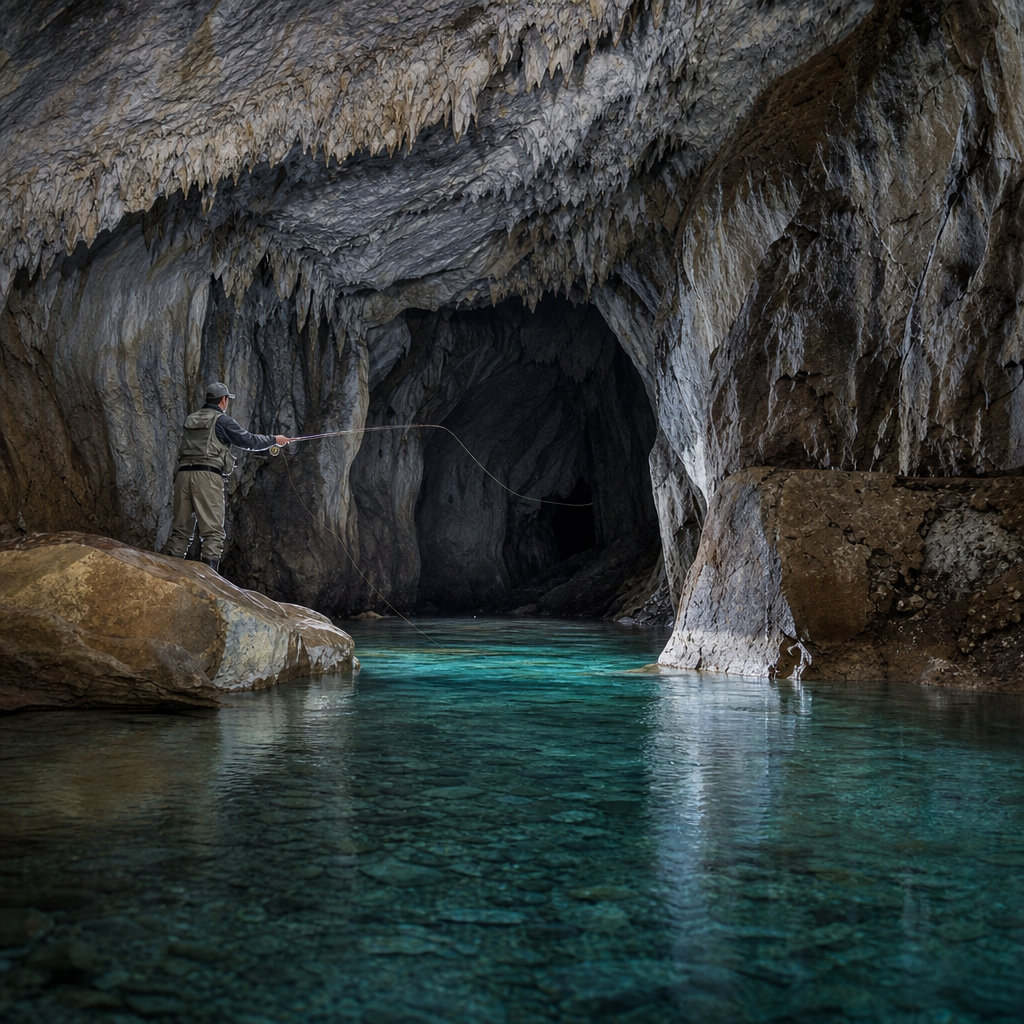
Underground river fly fishing refers to angling in waters that flow partly or entirely beneath the surface, or in fisheries directly shaped by subterranean movement. That includes accessible cave streams, karst windows, disappearing rivers that sink into limestone and reemerge downstream, spring-fed channels connected to aquifers, and tunnel-like lava formations with fishable runs. It does not usually mean drifting a raft through a giant cave while blind-casting at random. In reality, most fishable opportunities are compact, technical, and access-limited. You may enter from a sinkhole, fish near a cave mouth, or work a spring resurgence where groundwater stabilizes temperature and oxygen.
The geology matters because it determines water chemistry, current speed, and habitat structure. Karst terrain, common in parts of the Ozarks, Appalachia, the Dinaric Alps, and Mexico’s Yucatán region, forms when soluble rock such as limestone dissolves over time. The result is a network of conduits, springs, fractures, and subterranean channels. Those systems often create clear, mineral-rich water with stable temperatures that support trout, grayling, char, dace, and endemic cave-associated species in different parts of the world. In my experience, the most reliable fly fishing occurs where underground flow meets light, food, and enough habitat complexity to support regular feeding behavior.
Why Adventure Fly Fishing Anglers Seek These Waters
Adventure fly fishing is defined by remoteness, difficulty, and the need to adapt technique to unusual terrain. Underground river environments intensify all three. Fish in cave-influenced systems often see fewer anglers because access requires route finding, permits, local guidance, ropes, or simply a willingness to hike through rough, wet terrain. Water temperatures can stay consistent through summer heat and winter cold, which means fish remain active when nearby freestone rivers become too warm, too low, or too flashy. That stability can make an underground-fed destination a strategic option during difficult conditions elsewhere.
There is also a biological draw. Spring and cave systems commonly produce dense populations of scuds, sowbugs, cress bugs, midges, cranefly larvae, amphipods, and small baitfish. In some trout fisheries, these food sources create selective fish that feed steadily but inspect flies closely. That is part of the attraction. The setting feels wild, yet the fishing often comes down to precise drift control, sparse patterns, and careful wading. A trip can deliver the visual drama of caving and the technical satisfaction of a spring creek. For many anglers building destination plans, that combination turns underground rivers into a standout branch of adventure fly fishing rather than a novelty.
Best Underground River and Cave-Fed Fly Fishing Destinations
Not every cave system is fishable, and many are legally protected from angling, but several destination types consistently produce worthwhile trips. The Missouri and Arkansas Ozarks offer classic examples through major spring systems and cave-influenced trout rivers. While you may not fish deep inside caverns, many productive reaches are directly tied to subterranean flow, with cold, clear discharge supporting year-round trout habitat. The Driftless Area in the Upper Midwest is another model, where spring creeks emerge from limestone geology and behave like surface expressions of underground water. In Europe, Slovenia’s karst country and Bosnia and Herzegovina’s limestone rivers show how subterranean hydrology can create exceptional grayling and trout fisheries.
Other destinations lean warmer and more exploratory. Mexico’s cenote-linked channels, some cave-fed jungle streams, and certain lava-tube outflows in volcanic landscapes can hold cichlids, tarpon in select coastal systems, or unusual native species. In New Zealand and Tasmania, cave-fed streams may offer stable flows and highly technical sight fishing. In the United States, anglers also target spring resurgences in Tennessee, Kentucky, and parts of Texas where aquifer-driven water shapes bass, trout, and panfish habitat. The key is to research regulations, land access, and local conservation status before planning. Some caves are closed to protect bats, endemic invertebrates, or archaeological resources, and those restrictions should be treated as nonnegotiable.
| Destination type | Typical species | Water characteristics | Main challenge |
|---|---|---|---|
| Karst spring creek | Brown trout, rainbow trout, grayling | Cold, clear, stable flow | Selective fish and fine presentations |
| Cave mouth stream | Trout, dace, chub, char | Low light, broken current, ledges | Limited backcast room and footing |
| Disappearing river resurgence | Trout, smallmouth, panfish | Variable flow, oxygen-rich seams | Access logistics and changing levels |
| Lava-tube outflow | Trout or warmwater species | Cool discharge, basalt structure | Abrasion and confined casting |
Species, Food Sources, and Fish Behavior Underground
Fish behavior changes dramatically as light declines and habitat narrows. In fully dark cave reaches, permanent fish populations are uncommon unless the system has enough food and oxygen; more often, fish concentrate in transition zones near entrances, skylights, sink windows, and spring outflows. These areas receive drifting invertebrates and enough light for periodic feeding activity. Trout in cave-influenced water often hold close to structure because current lanes can be compressed by ledges, breakdown boulders, and undercut rock. Smallmouth in resurgence pools use the same hydraulic logic, pinning bait against seams where cold groundwater mixes with warmer surface flow.
Food webs also differ from standard freestone rivers. Instead of mayfly hatches driving the day, many underground-fed fisheries revolve around subsurface biomass: scuds, sowbugs, worms, midge larvae, cranefly larvae, and amphipods washed from aquatic vegetation or subterranean substrates. That is why patterns like scud imitations, zebra midges, worm flies, small streamers, and lightly weighted nymphs consistently outperform oversized attractors. Where cave entrances collect terrestrial fallout, beetles, crickets, and spiders can matter too. I have found that fish in these systems often feed more by position and drift timing than by aggressive movement. A dead-drift through the exact slot beats repeated false casting every time.
Gear, Rigging, and Technical Adaptations
The best fly rod for underground river fishing is usually shorter than your standard open-water setup. A 7’6″ to 8’6″ rod in 3- to 5-weight handles tight casting lanes, short drifts, and delicate presentations around rock walls. For larger resurgence pools or warmwater outflows, a 6-weight may be better, especially when throwing small streamers. Floating lines cover most scenarios, though a euro-nymph style leader or tight-line setup is excellent where currents are concentrated and backcast space is poor. Leaders commonly run longer and finer than many anglers expect because these waters are clear; 5X and 6X are routine in trout systems, while bass and mixed-species outflows tolerate stronger tippet.
Safety gear is as important as fishing gear. A climbing helmet or caving helmet with a mounted headlamp is essential anywhere rockfall, low ceilings, or darkness are possible. I carry two backup lights because batteries fail fastest in cold, wet environments. Studded boots or sticky-rubber soles help on algae-slick limestone, and a compact waterproof pack keeps layers, first aid, and communication devices dry. A wading staff is not optional in unfamiliar cave-fed channels. Submerged ledges and potholes can drop abruptly, and standard polarized visibility is reduced in dim light. For flies, start with gray, tan, olive, and pink scuds; black and red midges; small jig nymphs; size 14 to 20 sowbugs; and compact streamers like woolly buggers or sculpin patterns.
How to Approach, Read Water, and Present Flies
Reading water underground or near cave structures means focusing on hydraulics, not surface glitter. Look for oxygen lines where fast water drops into a plunge, softer seams beside breakdown rocks, undercut ledges near spring inflows, and tailouts where a confined channel spreads slightly and food collects. Fish often face into narrow feeding lanes because the environment gives them fewer options. That predictability helps. Instead of covering long banks, identify the three or four slots that concentrate current and fish each thoroughly from the best angle available.
Presentation should be controlled and efficient. Roll casts, bow-and-arrow casts, water-loaded flips, and short-line lobs replace overhead casting in confined areas. In many cave-mouth trout situations, the highest-percentage method is a lightly weighted scud or midge under a small yarn indicator, adjusted to drift inches above the bottom. In darker pockets, streamers can trigger territorial takes, but strip speed should stay modest because fish have less visual range. Stealth matters more than distance. Sound echoes, vibrations transmit through rock, and shallow clear water magnifies mistakes. I move slowly, keep false casts to a minimum, and fish the nearest prime water first because it is easy to spook fish standing too close to the slot.
Safety, Regulations, and Conservation Ethics
Underground river fly fishing has real hazards, and the first rule is simple: never enter a cave stream or confined gorge without understanding flash-flood risk. Rain falling miles away can raise water quickly in karst systems, even when skies above you are clear. Check watershed forecasts, not just local weather. If a cave requires technical entry, go only with qualified guides or experienced cavers; anglers are injured most often by slips, bad route choices, hypothermia, and underestimating rising water. Leave trip plans with someone outside the field, carry redundant light sources, and understand that mobile service is often nonexistent.
Conservation concerns are equally important. Cave ecosystems are biologically fragile and recover slowly from trampling, sediment disturbance, pollution, and careless handling of fish. Many underground waters shelter rare salamanders, crayfish, blind fish, bats, and specialized invertebrates. Use established access points, avoid touching cave formations, decontaminate boots and gear to reduce the spread of invasive organisms, and follow all local rules on seasonal closures. In trout systems, barbless hooks and quick releases are the right standard. If a site is known primarily for scientific or ecological value, do not force it into a fishing destination. The best adventure fly fishing respects the place enough to leave parts of it unfished.
Planning an Adventure Fly Fishing Hub Around Underground Waters
As a sub-pillar within fly fishing destinations, underground rivers connect naturally to several adjacent trip styles. Anglers researching this category often also want guidance on spring creek fly fishing, backcountry trout streams, canyon and gorge access, warmwater exploration, small-stream tactics, and destination safety planning. Build your trip calendar around hydrology: fish cave-fed and spring resurgence systems during hot summers, drought periods, or shoulder seasons when stable groundwater improves conditions. Pair them with nearby surface options so weather or access changes do not ruin the week. I routinely plan a destination with one anchor spring or cave-fed river, one freestone alternative, and one stillwater or warmwater backup.
The biggest payoff is perspective. Underground rivers teach patience, observation, and respect for hidden watershed processes that shape famous fisheries far downstream. They also remind anglers that adventure fly fishing is not only about helicopters, jungle lodges, or far-flung saltwater expeditions. It can mean following a limestone valley to a cold spring, crawling carefully to a cave mouth pool, and solving a technical fishery that most people walk past. If this style of fishing fits your goals, start with legal, guide-supported cave-fed rivers or spring systems, refine your gear and safety practices, and expand from there. Explore the connected destination categories, choose a region with reliable public information, and make your next fly fishing trip one that reaches the source as well as the fish.
Frequently Asked Questions
What exactly counts as an underground river in fly fishing, and how is it different from a normal stream?
An underground river is any flowing body of water that travels beneath the surface through cave systems, karst formations, lava tubes, sinkholes, fractured rock, or partially enclosed channels before re-emerging downstream. In fly fishing terms, that means you are not simply fishing a shaded creek or a canyon with overhangs. You are dealing with water that is directly influenced by subsurface geology, limited light, confined casting space, unusual current seams, and highly specialized aquatic life. These systems can range from fully enclosed cave rivers to spring-fed passages where parts of the channel disappear under rock and return a short distance later.
What makes underground rivers so different from ordinary trout streams is the combination of hydrology and environment. Water temperatures tend to be more stable, oxygen levels can vary by chamber and flow rate, and food availability may be driven more by cave-adapted invertebrates, washed-in terrestrial organisms, and seasonal nutrient pulses than by the classic hatch cycles many anglers rely on. Fish behavior can also be different. In some systems, fish hold near entrances, skylights, or spring mouths where food is more consistent and light penetration supports more life. In others, resident fish adapt to dim conditions and feed opportunistically in slower, protected lies. For the fly angler, that changes everything from fly selection to presentation, wading strategy, and safety planning.
Is fly fishing in underground rivers safe, and what precautions should anglers take?
It can be done safely, but only when approached as a technical expedition first and a fishing trip second. Underground rivers introduce hazards that are rare or absent on open water, including sudden water rises, restricted exits, unstable footing, low ceilings, poor visibility, hypothermia risk, falling rock, deep slots, and complete darkness if lighting fails. In many cave systems, water levels can rise dramatically from rainfall occurring miles away, even when local weather seems calm. That means the number one rule is to understand the watershed, forecast, and flood response of the specific system before entering it.
At a minimum, anglers should carry multiple reliable light sources, wear a helmet, use proper footwear with secure traction, and bring gear that stays organized and snag-free in tight spaces. A wading staff, compact first-aid kit, dry storage, and communication or emergency signaling tools are also important, though in many cave environments normal communication devices may not function well. Just as important is experience. If you are entering a true cave river rather than a partially covered spring run, it is wise to go with someone trained in cave travel or local guiding protocols. Many of the accidents in underground environments happen because people underestimate how quickly a recreational outing turns into a rescue scenario. Responsible anglers also research access laws and conservation restrictions, because many subterranean waterways are environmentally sensitive and may require permits or be closed entirely to protect habitat and public safety.
What kind of fish and food sources do you typically find in underground river systems?
The species present depend heavily on where the underground river connects to the surface. In many fishable systems, especially those tied to limestone country, spring creeks, or mountain karst, the most common quarry will be trout, char, or other coldwater fish moving between subterranean reaches and open channels. In warmer regions, you may encounter bass, panfish, native minnows, or region-specific species using cave-fed pools and spring outflows. Fully isolated cave fish do exist in some parts of the world, but many are protected, highly specialized, and not appropriate targets for anglers. Most practical underground fly fishing focuses on fish in accessible transition zones rather than deep, biologically fragile interior habitats.
Food sources are often one of the most fascinating aspects of these waters. Traditional mayfly, caddis, and midge patterns can still matter, especially near entrances and spring mouths, but underground rivers often support feeding centered on scuds, sowbugs, small crustaceans, worms, cave-adjacent beetles, drowned terrestrials, baitfish, and opportunistic drift from surface recharge events. In low-light environments, fish may key less on a perfect visual hatch match and more on silhouette, movement, and a fly that stays in the feeding lane long enough to be detected. That is why small nymphs, soft hackles, streamers, scud patterns, and lightly weighted attractors frequently outperform highly technical dry-fly approaches. Reading the biological cues of the system matters more than assuming it behaves like a standard freestone river.
What fly gear and techniques work best when fishing underground rivers?
Compact, versatile tackle is usually the best choice. A shorter fly rod often makes more sense than a long rod because casting room can be severely limited by walls, ceilings, and formations. In many underground settings, roll casts, bow-and-arrow casts, short-line high-stick presentations, and controlled streamer swings are more practical than full overhead casting. Leaders are often shorter and more durable than what you would use on highly pressured spring creeks, since accuracy, abrasion resistance, and fly control are usually more important than ultra-delicate turnover. A small selection of weighted nymphs, scuds, sowbugs, midge patterns, compact streamers, and soft hackles covers a lot of situations.
Presentation should be built around confined current lanes and low-light feeding behavior. Fish in underground rivers often hold tight to seams, under ledges, behind boulders, in plunge pools, or near places where a chamber opens and current softens. In these lies, a dead drift with occasional subtle movement can be very effective, but so can slow strips with streamers that create contrast and vibration. Because visibility is limited, strike detection becomes more tactile and line-management driven than visual. Many anglers do well by keeping short contact with the fly and using sighter material or a highly controlled indicator setup only when space allows. Stealth still matters, but in a different way: instead of hiding from fish across open water, you are minimizing vibration, splashing, and clumsy movement in an enclosed environment where sound and disturbance carry easily.
Are underground rivers good destinations for all fly anglers, or are they best left to experts?
They are not ideal for everyone, and that is part of what makes them so compelling. Underground river fly fishing sits at the intersection of advanced angling, route finding, environmental awareness, and risk management. A strong trout angler who has only ever fished open rivers may be surprised by how demanding the enclosed setting feels. Limited casting angles, uncertain footing, unusual currents, and the psychological pressure of darkness can change the entire experience. For that reason, complete beginners should not treat underground rivers as a casual entry point into fly fishing or caving.
That said, not every underground river experience requires expedition-level skill. Many anglers can get a taste of this style of fishing by targeting spring caves, resurgence pools, partially covered channels, or accessible cave mouths with experienced guides and conservative plans. Those edge environments offer many of the same hydrological and ecological mysteries without the full commitment and hazard of deep cave travel. For intermediate and advanced anglers, underground rivers can be unforgettable because they force a deeper understanding of water movement, fish behavior, and personal discipline. The key is to match the destination to your actual skill level, not your curiosity. When approached responsibly, these waters can deliver some of the most unusual and rewarding fly fishing on the planet.