Language tips for fly fishing in non-English speaking countries can determine whether your trip feels smooth and rewarding or confusing and expensive. In destination fishing, language is not a side issue; it affects permits, guides, access rights, safety briefings, equipment purchases, transport, meals, and emergency help. When anglers talk about international travel, they often focus on flies, rods, river levels, and species, but the ability to communicate clearly is what keeps the day on track. I have planned and fished trips in places where almost nobody at the lodge, taxi stand, tackle shop, or trailhead spoke English, and the difference between a prepared angler and an unprepared one shows up fast.
For fly fishing travel, language tips means practical methods for understanding and being understood before, during, and after a trip. That includes learning key fishing vocabulary, using translation tools correctly, reading local rules, confirming logistics in writing, and adapting your communication style to local culture. Non-English speaking countries matter because many outstanding fisheries sit in Spanish-, Portuguese-, French-, Japanese-, Icelandic-, Slovenian-, Mongolian-, and Scandinavian-speaking regions. Patagonia, the Pyrenees, the Balkans, Hokkaido, Tierra del Fuego, and Alpine waters all reward preparation. If this article serves as your hub for tips for international travel, the core idea is simple: better communication protects your time, money, and safety while also improving access, etiquette, and fishing results.
Why language matters before you ever step into the river
The most important communication often happens before departure. A surprising number of trip failures begin with vague emails and assumptions. If you ask a lodge, “Is the river fishing well in April?” you may receive a polite yes, yet still arrive during high water, local holidays, or restricted beats. Better questions are specific: Which species are open? What are average water temperatures? Are wading staffs recommended? Is a national license enough, or do I need beat access? Written confirmation matters because dates, prices, transfer arrangements, guide ratios, and cancellation terms are easier to verify later.
I recommend sending short, direct messages in both English and the local language using a reliable translator, then asking the recipient to confirm each item line by line. This works especially well for airport pickups, meal restrictions, rod loaners, and rental waders. Use international date format with the month spelled out, such as 12 September 2026, to avoid confusion. Include flight number, terminal, baggage count, and WhatsApp contact. If you are booking in Spain, Chile, Japan, or Slovenia, assume that the fishing operation may speak some English while drivers, permit offices, and nearby shops may not. Your trip planning should cover the entire chain, not only the lodge website.
Build a fishing-specific phrase bank, not a generic travel list
Generic travel phrases help with hotels and restaurants, but fly fishing requires specialized language. You need terms for species, tackle, techniques, access rules, weather, and safety. The most useful phrase bank includes five groups: permits and regulations, guiding logistics, river conditions, gear problems, and emergencies. Learn local words for catch and release, barbless, private water, upstream, downstream, slippery rocks, wading depth, felt soles, life jacket, closed season, and artificial flies only. In many destinations, the exact distinction between fly only and spinning prohibited is important, and mistranslation can create a legal problem.
Species names also cause confusion. “Trout” may not be enough. Brown trout, rainbow trout, grayling, taimen, char, sea trout, and salmon all need precise local naming. In tackle shops, “5X tippet,” “floating line,” or “size 16 mayfly” may be understood, but local brands and sizing conventions vary. I carry a notes app file with translated gear and fish terms plus photos of my rod sections, fly boxes, boots, and vest. Showing a photo of a broken ferrule or a tungsten nymph often solves a problem faster than speaking. Keep your phrase bank offline in case you lose signal in mountain valleys or border regions.
Use translation tools correctly and verify critical details
Translation apps are excellent, but they are not experts in angling terminology. Google Translate, DeepL, Apple Translate, and Microsoft Translator all work for travel, yet each can miss local fishing meaning. DeepL is often stronger for full sentences in European languages, while Google Translate remains useful for camera translation on signs, permits, and handwritten notices. For Japanese, Icelandic, or less common river-specific terms, I double-check results across two tools. If the matter involves regulations, safety, or money, verification is mandatory.
The safest approach is to translate short sentences, avoid slang, and ask yes or no follow-up questions. Instead of “Can we probably fish that upper run if the weather stays decent?” write, “Is the upper section open to fishing tomorrow?” Then ask, “Do we need an additional permit?” This reduces ambiguity. Screenshots are essential because signal can vanish, and saved conversations give you proof of what was agreed.
| Travel situation | Best communication method | Why it works |
|---|---|---|
| Booking permits | Short written message plus translated screenshot | Creates a record of dates, beats, and rules |
| Meeting a driver | WhatsApp text with flight number and arrival time | Reduces confusion at airports and border crossings |
| Reading river signs | Camera translation and photo save | Helps decode local restrictions in the field |
| Asking a guide technical questions | Simple spoken phrases supported by map or gear photo | Combines context with visible reference points |
| Handling emergencies | Prewritten local-language card | Speeds communication when stress affects speech |
One more rule from experience: never rely on machine translation for humor, sarcasm, or abbreviations. Keep it literal. If a guide says a river is “technical,” confirm what that means in plain terms. It may mean long leaders and tiny dry flies, or it may mean difficult access and dangerous wading. Precision beats charm every time.
Learn the words tied to regulations, access, and etiquette
Many fly fishing destinations operate under local access systems that are unfamiliar to visiting anglers. In parts of Spain and Slovenia, for example, certain waters are managed by clubs, municipalities, or concession systems with beat limits and day tickets. In Norway, salmon rivers may require reporting and disinfection procedures to reduce parasite risk. In Argentina and Chile, private estancias and lodges control access to highly desirable water. If you do not understand the local language around rules, you can accidentally trespass, fish the wrong beat, or violate retention regulations.
Focus on words that appear on permits and posted notices. Learn terms for sector, beat, zone, reserve, upstream limit, downstream limit, mandatory release, daily quota, single hook, and no wading. Add phrases for “Where does public access begin?” and “Is this bank private?” Local etiquette matters too. In some places, anglers rotate pools in a recognized order. In others, stepping into a run below another angler is considered rude or aggressive. A simple local-language question asking where to start shows respect and often leads to better information than any map application. Respectful communication opens doors that money cannot.
Communicate effectively with guides, drivers, lodge staff, and shops
Different people on a fishing trip need different information. Guides need to know your casting ability, wading confidence, medical issues, target species, and style preferences. Drivers need exact locations, pickup times, and baggage details. Lodge staff need meal restrictions, laundry timing, wake-up requests, and packed lunch preferences. Tackle shops need measurements, brand equivalents, and the exact problem you are trying to solve. Treat each interaction as a mini-briefing.
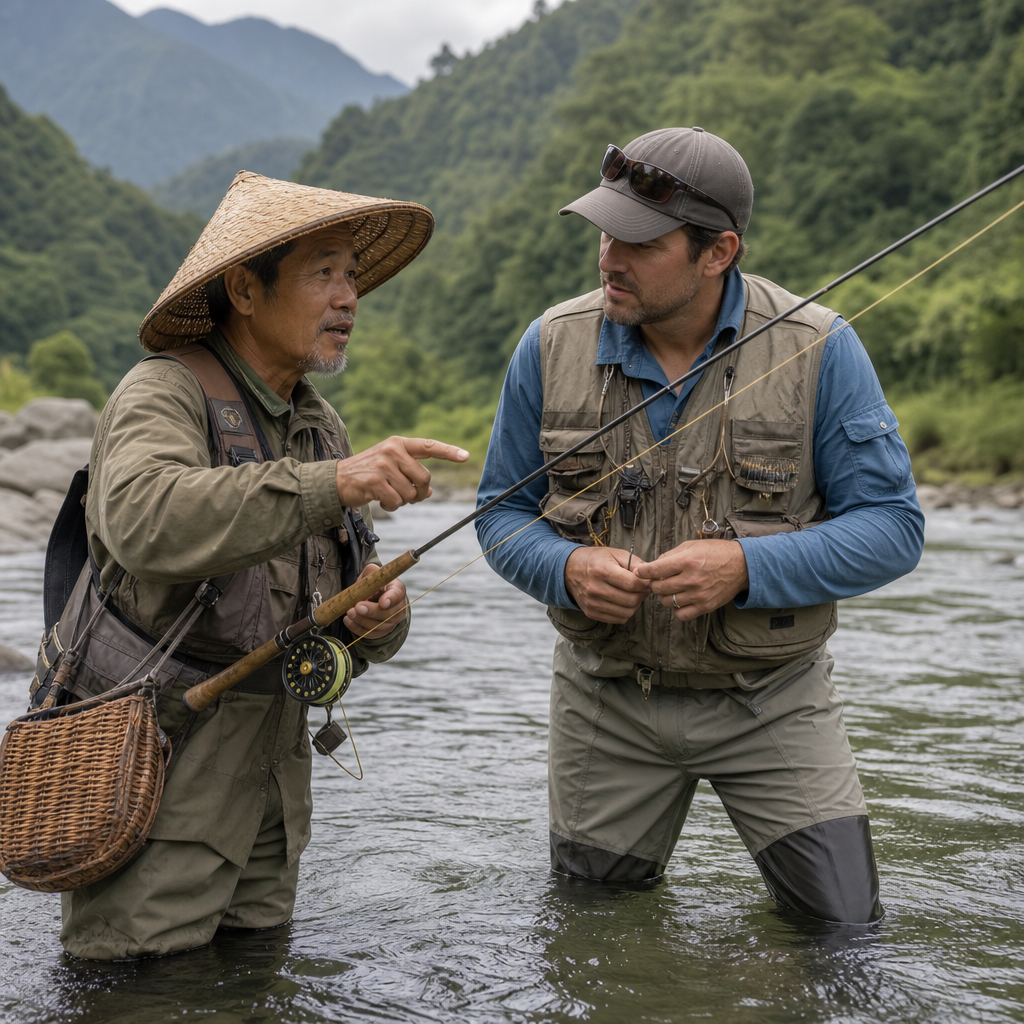
With guides, honesty matters more than optimism. I never tell a guide I am comfortable on difficult wading if I am not. Saying “intermediate caster, accurate to 40 feet, weak in wind, comfortable in moderate current” is far more useful than saying “experienced.” The guide can then choose water and tactics that fit your actual ability. Ask the guide to explain the day using landmarks, estimated hiking time, and expected fly changes. If language is limited, use maps, hand signals, and repeated confirmation. Good guides appreciate clarity because it helps them deliver results safely.
In shops, bring gear dimensions in metric and imperial units. Many international tackle counters work in millimeters, grams, and centimeters. Know your boot size in EU sizing, rod length in feet and meters, and tippet diameters as well as X ratings. If airline damage forces a last-minute replacement, that small preparation saves hours. For transport, save hotel and river names in the local alphabet when applicable. A taxi driver may not recognize your English pronunciation of a mountain valley, but a written address usually solves it immediately.
Prepare for safety, medical needs, and problem solving under stress
Safety communication deserves separate planning because stress narrows attention and makes simple words hard to recall. Before departure, create a printed card and phone note in the local language stating your name, blood type if known, allergies, medications, emergency contact, and any relevant condition such as asthma, diabetes, or severe bee allergy. Add phrases like “I slipped,” “I may have a fracture,” “I need a doctor,” “Please call emergency services,” and “I am at the river.” If you fish remote water, include your satellite communicator details and lodge contact.
Wading incidents, hook injuries, vehicle breakdowns, and weather changes all become easier to manage when key phrases are ready. I also save offline maps through Google Maps or Maps.me and mark the lodge, hospital, pharmacy, fuel station, and permit office. In countries where emergency numbers differ from 112 or 911, memorize the local standard. If your destination has tick exposure, snake risk, or glacial rivers, ask local staff to explain the specific hazards in simple language before leaving camp. Do not assume universal safety signage. Mountain storm warnings, dam releases, and avalanche-area notices may be posted only in the local language, and misunderstanding them is a serious mistake.
Use language to build rapport and fish more like a respectful guest
The best reason to improve your language skills is not only efficiency. It is connection. Even basic effort changes how local people respond. A greeting, thanks, apology, and a few fishing terms show respect for the place and for the people who live there year-round. On several trips, the most useful information I received came after I tried speaking the local language badly but sincerely. A shop owner drew a map to a productive public access point. A guide shared why one pool should be rested after lunch. A riverkeeper explained a local insect hatch pattern that was not on any English website.
Rapport matters because fly fishing is built on local knowledge and trust. In many destinations, the best practical tips for international travel come from conversations with hosts, not brochures. Ask where anglers usually park, whether studs are appropriate, which flies locals prefer during low light, and whether photographs of certain private beats are sensitive. If you do not understand, ask again politely. People are generally generous when they see genuine effort. As you plan your broader fly fishing destinations research, keep language preparation in the same category as wader repair kits and travel insurance: essential equipment. Build your phrase bank, verify every critical detail in writing, and arrive ready to listen as carefully as you cast.
Frequently Asked Questions
Why does language matter so much on an international fly fishing trip?
Language affects nearly every part of destination fly fishing, not just casual conversation. Clear communication helps you understand permits, private access rules, protected water boundaries, seasonal restrictions, and local conservation expectations before you ever make a cast. It also shapes your interactions with guides, lodge staff, drivers, shop owners, and landowners. If you cannot explain where you are going, what species you are targeting, what equipment you need, or whether you understand a safety instruction, small misunderstandings can quickly become expensive or even dangerous. A missed shuttle, the wrong license, the wrong fly line, or confusion about where wading is allowed can derail a day on the water.
Language also matters because many fly fishing decisions are specific and technical. You may need to ask whether the river is fishable after rain, whether felt soles are allowed, whether barbless hooks are required, whether a beat rotation system is in place, or whether a guide expects you to bring lunch, cash, or extra leaders. In remote areas, clear communication can be critical in emergencies, especially if someone is injured, lost, hypothermic, or dealing with a vehicle problem far from town. Anglers often prepare carefully for fish behavior and local conditions, but communication is what connects all of that preparation to the real trip. In practical terms, better language preparation makes the experience smoother, safer, more respectful, and more enjoyable.
What words and phrases should I learn before fly fishing in a non-English speaking country?
Start with the terms that affect logistics, legality, and safety. Learn how to say and recognize words for fishing license, permit, guide, river, lake, access, private property, catch and release, closed season, barbless, hook, waders, boots, net, flies, leader, tippet, rod, reel, drift boat, bank fishing, and wading. Add numbers, dates, times, directions, distances, and money-related terms so you can handle bookings, transportation, and purchases without confusion. You should also know how to ask practical questions such as: Do I need a permit? Is this water private? What time do we leave? Is lunch included? Can I pay by card? Where can I buy leaders? Is this section open today? Where is the boat launch? These are the phrases that solve real problems.
Do not overlook emergency and comfort vocabulary. Learn how to say: I need help, I am hurt, I lost my passport, I need a doctor, I am allergic to this, I am cold, I fell, the road is closed, my vehicle is stuck, and there is no phone signal. It is also smart to learn polite social phrases such as hello, thank you, please, excuse me, and I do not speak your language well. That last phrase is especially useful because it lowers pressure and usually encourages patience from locals. If possible, save key phrases in your phone both in English and in the local language, and practice pronunciation enough that someone can recognize what you mean. Perfect grammar is not necessary. What matters is being understandable when the situation counts.
How can I communicate effectively with guides, lodges, and local anglers if I do not speak the language well?
The best approach is to simplify, confirm, and document important information. Use short sentences instead of complicated explanations. For example, say, “I need a permit for two days,” or “I fish dry flies and nymphs,” or “Please show me where wading is unsafe.” When discussing plans with a guide or lodge, confirm the basics in writing: pickup time, meeting location, target species, daily schedule, included meals, gear requirements, payment method, and whether licenses are handled for you. Messaging apps can be extremely useful because translation tools work better when both sides can read and review the text. Written details also reduce the risk of misunderstandings about dates, weights, sizes, and prices.
Visual communication is also powerful in fishing. Photos of flies, tackle, vehicles, maps, fish species, and equipment often bridge gaps faster than spoken words. If you need a specific fly line or a certain style of nymph, showing a picture is usually more effective than trying to describe it. The same goes for dietary restrictions, medical conditions, and pickup locations. During guided days, ask guides to demonstrate rather than only explain. A quick visual example of where to stand, how deep to wade, or how to fish a run can save a lot of frustration. Most importantly, repeat key details back in simple language. If a guide says the river rises quickly in the afternoon or a lodge says a permit is only valid on one section, make sure you clearly confirm that you understood. This habit prevents mistakes and shows professionalism and respect.
What are the biggest language-related mistakes traveling anglers make?
One common mistake is assuming that basic English will be enough in every situation. In many fishing destinations, some tourism staff may speak English, but drivers, tackle shop employees, landowners, rural police, permit offices, and local anglers may not. Relying on one person to translate everything can create unnecessary risk, especially if plans change on short notice. Another major mistake is not learning the vocabulary connected to legal access. In many countries, rules about private water, club water, indigenous territory, protected areas, beat systems, and species regulations are specific and strictly enforced. If you do not understand the terminology, you may accidentally fish without the correct authorization.
Another frequent error is focusing only on fishing words while ignoring practical travel language. Many trip problems happen before the first cast: missed airport pickups, confusion over baggage with rods and reels, transport to remote rivers, meal arrangements, weather warnings, and misunderstanding lodge schedules. Anglers also make the mistake of not confirming prices, inclusions, or expectations. If you assume flies, lunches, licenses, or gratuities are included and they are not, communication problems can become expensive quickly. Finally, some travelers speak too fast, use slang, or ask long, complex questions that are hard to translate accurately. Simpler language works better. Slow down, use plain terms, and check for understanding. Good communication is not about sounding fluent; it is about reducing ambiguity when details matter.
What tools and preparation strategies can help me overcome language barriers before and during the trip?
Preparation should start well before departure. Research the exact region, because fishing vocabulary and even common words can differ by country or by local dialect. Build a short custom phrase list based on your itinerary, not just a generic travel phrasebook. Include the name of your lodge, river systems, target species, permit offices, transport providers, and any special gear you plan to bring. Save copies of reservations, licenses, insurance information, emergency contacts, passport details, and medical notes in both digital and printed form. It is also wise to preload offline translation apps and offline maps, since many fishing destinations have weak or nonexistent service. If possible, ask your guide or outfitter in advance for local terms you are likely to hear on the water.
During the trip, use a layered strategy rather than relying on one tool. Translation apps are excellent for signs, text messages, and basic conversations, but they are less reliable in noisy wind, rain, or fast-moving river situations. That is why screenshots, printed cards, maps, and written addresses still matter. Keep key phrases accessible on your phone lock screen or in a small waterproof notebook. If you have dietary needs, allergies, medication requirements, or safety concerns, carry these translated clearly and professionally. It also helps to share your daily fishing plan with someone at the lodge or in your travel group in simple written form. The goal is not to become fluent overnight. The goal is to create enough communication support that permits are handled correctly, meetings happen on time, safety instructions are understood, and help is available if something goes wrong. That level of preparation makes international fly fishing more efficient, more confident, and far more enjoyable.