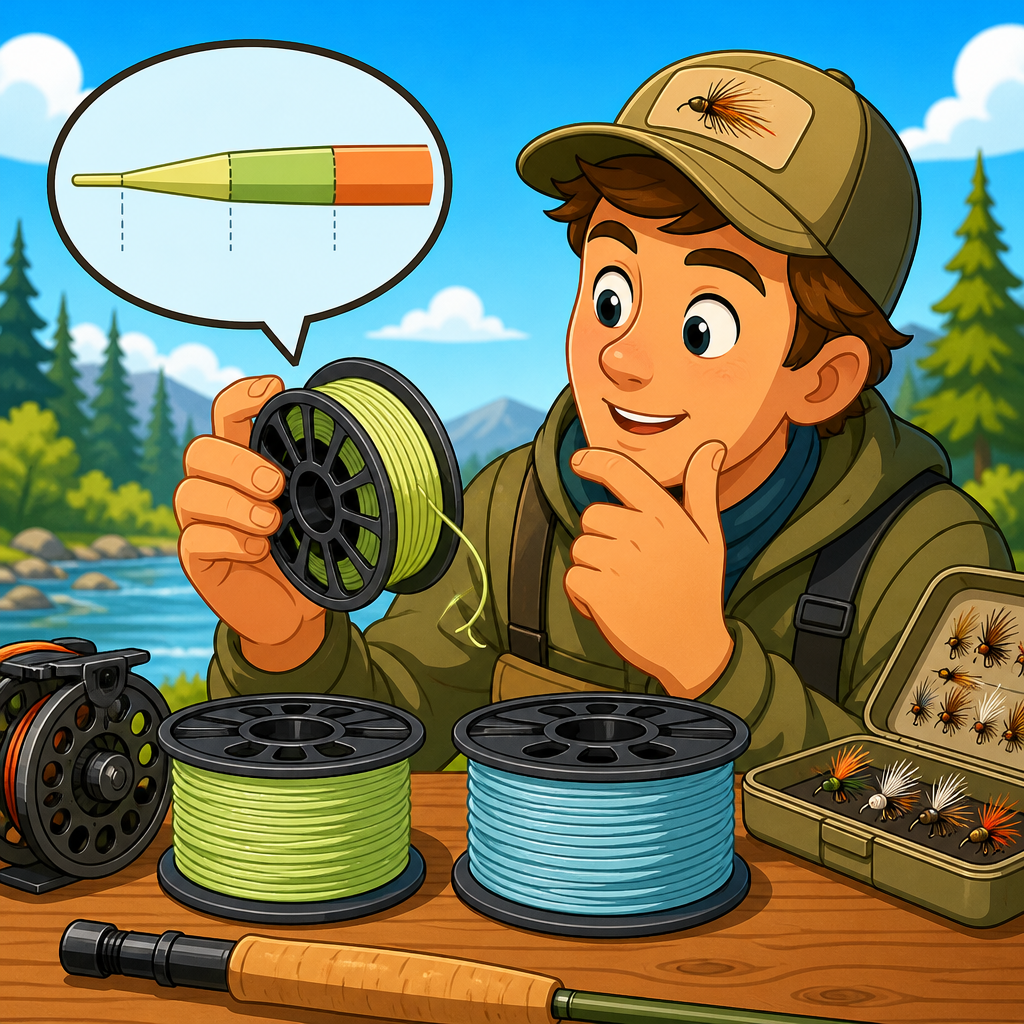
Fly line labels look cryptic at first, but once you know how to read codes like WF5F, DT4F, or S6, you can match line to rod, water, and presentation with confidence. In fly fishing, the line does the casting work, so understanding line labels is not a minor gear detail; it is central to accuracy, distance, depth control, and fishability. I have rigged beginner outfits, tested specialty tapers on stillwaters and rivers, and watched many casting problems disappear once the wrong line was replaced with the right one. That is why this guide matters: most anglers spend time comparing rods and reels, yet the fly line often determines whether the setup feels crisp, overloaded, delicate, or simply frustrating.
A fly line label usually compresses several specifications into a short string of letters and numbers. Those characters identify taper style, line weight, buoyancy, sink rate, and sometimes intended use. WF means weight forward, DT means double taper, and the number usually indicates line weight under the AFFTA standard, such as 5 for a 5-weight rod. The final F means floating, while I means intermediate and S indicates sinking. Some labels add more detail, like sink rate in inches per second, line family names, grain windows for specialty heads, or abbreviations for textured coatings, tropical cores, or coldwater formulas. When you can decode those labels quickly, you can buy line more intelligently, set up your reel correctly, and avoid expensive mismatch.
This article serves as a practical hub for fly fishing gear and equipment within the broader Fly Fishing Basics topic. It explains the main fly line codes, shows how manufacturers apply standards, highlights where labels can mislead, and connects line choice to rods, reels, leaders, backing, and fishing situations. If you are asking what WF5F means, whether a DT4F still makes sense, how sink tips differ from full sink lines, or why one 6-weight line casts better than another, you are asking the right questions. The answers begin with the label, but they extend to the entire system. Once you understand that system, every later gear decision becomes easier and more consistent on the water.
The Core Fly Line Codes: What WF5F, DT4F, and Similar Labels Mean
The most common fly line label has three parts: taper, weight, and density. In WF5F, WF means weight forward, 5 means 5-weight, and F means floating. In DT4F, DT means double taper, 4 means 4-weight, and F again means floating. Those compact labels summarize the line’s front-loaded or symmetrical profile, the mass used to load a rod, and whether the line rides on the surface or below it. Once you know those three building blocks, most standard trout line labels become readable at a glance.
Weight-forward lines concentrate more mass toward the front section. That shape helps most anglers load the rod quickly, pick up line efficiently, and turn over indicators, larger dry flies, nymph rigs, or streamers with less false casting. It is the dominant taper for modern general-purpose fly fishing because it is versatile and forgiving. Double-taper lines are symmetrical, with a long gradual front taper and matching rear taper. They excel at delicate short-to-medium presentations, roll casting, mending, and economy, because when one end wears out you can reverse the line on the reel. On small streams with dry flies, DT lines still make real sense.
The number in the middle refers to line weight under the AFFTA standard, which measures the grain weight of the first 30 feet of line, excluding level tip. A 5-weight line should weigh 134 to 146 grains in that first 30 feet. A 4-weight should weigh 114 to 126 grains. This standard allows rods and lines from different brands to work together reasonably well, though modern tapers often push the upper end or exceed it slightly for easier loading at typical fishing distances. That is why one 5-weight line may feel true to the rod while another may cast like a half-size heavy line.
The final letter describes buoyancy. F means floating, the standard choice for dry flies, nymphing, and many streamer applications. I means intermediate, which sinks slowly and is useful in lakes, estuaries, and shallow streamer fishing where you want the fly just under the surface film. S means sinking. A label may simply say S, or it may specify sink rate such as S3, S6, or 3 ips. The more precise the density designation, the easier it is to choose a line for the depth and retrieve speed you actually need.
How Line Weight Standards Work and Why “5-Weight” Is Not Always Identical
Many anglers assume a 5-weight line is a universal constant, but in practice line design is more nuanced. The AFFTA standard covers the first 30 feet only, while modern lines vary dramatically in head length, front taper length, belly shape, rear taper, and total mass beyond 30 feet. A line built for easy short-range loading may place more weight toward the front and feel heavier in use, even if it technically fits the standard. Another line designed for distance casting may carry weight farther back in a longer head and feel lighter at close range. Labels tell the truth, but not the whole truth.
This matters because rods load according to the amount of line mass beyond the tip. On a small creek, where you may cast 15 to 25 feet of line, a half-size-heavy or full-size-heavy 5-weight can wake up a fast-action rod and make it feel more responsive. On a spring creek or lake where you carry longer lengths in the air, that same line can feel overloaded and lose precision. I have seen beginners blame their rod when the issue was simply an aggressive line taper designed for quick-loading at close distance rather than technical presentation farther out.
Manufacturers often use terms like “true to line weight,” “half-size heavy,” or “aggressive taper.” Those phrases are useful if you understand them. A true-to-weight line usually tracks the AFFTA standard closely and often suits moderate rods, classic rods, and anglers who carry line in the air. A half-size-heavy line adds enough mass to help modern fast rods load with less effort. An aggressive taper may combine extra front-end weight with a shortened head to turn over indicators, split shot, or bushy flies. The label remains concise, so the package details or product page become essential reading before you buy.
Beyond WF and DT: Other Common Fly Line Label Terms You Will See
Once you move beyond basic floating trout lines, labels expand quickly. ST usually means shooting taper or shooting head. Skagit and Scandi indicate two major spey-style head families: Skagit heads are short, powerful, and built to cast sink tips and large flies; Scandi heads are longer, finer, and better for touch-and-go casting with smaller flies. TT may stand for triangle taper in some product lines. Nymph, Creek, Bass Bug, Pike, Bonefish, Tarpon, and Euro labels point to specialized tapers and cores designed around particular fly sizes, climates, and casting styles.
Density labels also become more specific. Hover lines sit just under the surface. Intermediate lines may be clear or colored and typically sink around 1 to 2 inches per second. Sink-tip lines combine a floating running line with a sinking front section, often labeled by tip length and sink rate, such as F/S3 or 10′ tip, 5 ips. Full-sinking lines may list a uniform sink rate or use density compensation, where the thinner tip and thicker rear sections are engineered to sink evenly. That feature matters because uneven sink profiles can cause a hanging belly and poor depth control during the retrieve.
| Label | Meaning | Best Use |
|---|---|---|
| WF5F | Weight-forward, 5-weight, floating | General trout fishing, dries, nymphs, small streamers |
| DT4F | Double-taper, 4-weight, floating | Delicate dry-fly work, roll casting, small streams |
| WF6I | Weight-forward, 6-weight, intermediate | Lakes, shallow streamer fishing, estuaries |
| WF7S6 | Weight-forward, 7-weight, sink rate 6 ips | Deep streamer fishing, lakes, fast drop presentations |
| F/S3 | Floating body with sink-3 tip | Rivers where depth and line control are both needed |
Other useful clues include core material and temperature rating. Monofilament cores are common in many saltwater and warmwater lines because they stay stiff enough in heat. Braided multifilament cores are common in trout lines for better suppleness in cold water. If you fish a tropical line in a cold freestone river, it may coil badly. If you fish a coldwater line on a hot flats skiff, it may turn limp and sticky. Labels do not always spell this out clearly, so reading the line family description is part of reading the label correctly.
How to Match Fly Line Labels to Rods, Reels, Leaders, and Fishing Situations
The fastest way to choose correctly is to start with the rod’s rated line weight, then narrow by fishing style. A 5-weight trout rod usually begins with a WF5F floating line. That is the default because it covers the most common tasks: dry flies, light nymphs, and small streamers. But the best line for that rod still depends on where and how you fish. If you primarily fish 20-foot casts on brushy streams, a short-head, slightly heavy WF5F can be ideal. If you fish technical dry flies at 40 feet, a true-to-weight line with a longer front taper is often better.
Reels matter less for casting performance, but they matter for capacity and balance. A bulky full-sink line or integrated sink-tip can take more space than a fine dry-fly line, especially on smaller reels. You need enough room for backing without overfilling the spool, because an overpacked reel creates line management problems. Leaders should also follow the line’s purpose. Floating lines pair naturally with tapered nylon leaders for dries and indicators. Sink-tip and full-sink lines often work better with shorter, stouter leaders to maintain depth and direct contact to streamers.
Consider three common examples. First, a beginner buying an all-around trout setup with a 9-foot 5-weight rod should usually choose a WF5F floating line from a reputable line maker such as Scientific Anglers, Rio, Airflo, or Cortland. Second, an angler fishing a 7-weight for bass bugs around weed edges may prefer a WF7F line with an aggressive bass taper to turn over deer-hair poppers. Third, a stillwater angler fishing chironomids or leeches may carry a floating line, an intermediate, and a type 5 or type 6 full sink. The rod weight stays the same, but the label changes with the presentation.
Common Mistakes When Reading Fly Line Labels and Buying Gear
The most common mistake is assuming any line with the right number will perform the same way. It will not. Taper design changes casting behavior dramatically. Another mistake is buying a specialty line before mastering a standard floating line. New anglers often think more sink rate or a more aggressive taper will solve presentation problems that are actually caused by timing, leader setup, or fishing too much line. In many cases, a standard WF floating line is the best teacher because it exposes technique cleanly and handles the broadest range of practice situations.
A second mistake is ignoring the fishing environment. River anglers buy full-sinking lines they rarely need, while lake anglers try to cover every depth with one floater and weighted flies. Saltwater anglers sometimes use trout lines in tropical heat and end up with sticky memory and poor shootability. Another frequent issue is mismatching line taper to fly size. A long delicate dry-fly taper will not turn over weighted indicators or bulky hopper-dropper rigs as efficiently as an all-purpose taper. Conversely, an aggressive short-head line can land too hard for technical dry-fly fishing in low clear water.
Finally, many anglers overlook maintenance and age. Cracked coatings, embedded dirt, and line memory can make a good line feel bad enough that people misdiagnose the label as the problem. Clean fly lines regularly with approved dressing or manufacturer-recommended cleaners, inspect loops and tips for wear, and replace lines that no longer float or shoot properly. A premium line often lasts several seasons if cared for well, but neglected lines degrade quickly. In gear terms, the fly line is a consumable, not a forever purchase.
Building a Smart Fly Fishing Basics Gear System from the Line Outward
If this article is your hub for gear and equipment, the big lesson is that fly line should anchor the rest of your choices. Start with target species and water type, choose the rod weight that fits that fishing, and then select the line label that matches the presentation. After that, balance the reel for capacity and drag needs, choose backing appropriate to the fish, and finish with leaders and tippet sized to the flies you actually fish. This outside-in approach prevents the common beginner mistake of buying gear based on rod marketing while treating line as an afterthought.
A simple trout kit proves the point. For most freshwater beginners, a 9-foot 5-weight rod, medium-arbor reel, WF5F floating line, 20-pound backing, and 9-foot tapered leaders in 4X and 5X create a dependable baseline. From there, you can add a sink-tip for streamers, a euro-specific setup for tight-line nymphing, or a lighter 3-weight outfit for small streams. For bass and warmwater, move toward a 6- or 7-weight, stronger leaders, and an aggressive floating line. For lakes, add intermediate and full-sink options before buying another rod. Better line selection usually expands capability faster than more hardware.
Reading fly line labels is ultimately about making informed, confident decisions. WF5F and DT4F are not just codes; they are shorthand for how a setup will cast, mend, sink, present, and fish throughout the day. Learn the core abbreviations, understand how AFFTA weight standards interact with taper design, and evaluate every label in context with your rod, reel, leader, and water type. That habit will save money, reduce frustration, and improve performance immediately. If you are building your fly fishing basics knowledge, start by checking the label on every line you own, then compare it to how and where you actually fish. That is the fastest path to smarter gear choices.
Frequently Asked Questions
What does a fly line code like WF5F actually mean?
WF5F is a shorthand label that tells you three important things about the fly line: its taper shape, its line weight, and its buoyancy. In this example, “WF” means weight forward, which is the most common taper for modern fly fishing. A weight-forward line concentrates more mass toward the front of the head, making it easier to load the rod quickly, cast at a range of distances, and turn over typical trout flies, indicators, or small streamers. The “5” means it is a 5-weight line, designed to pair with a 5-weight rod in most situations. The final “F” means floating, so the line is built to stay on or near the surface.
Once you know this format, many labels become much less intimidating. For example, DT4F means double taper, 4-weight, floating. A label like WF6S would be weight forward, 6-weight, sinking. Some brands add extra terms such as “MPX,” “Infinity,” “Nymph,” or “Streamer,” which describe a specific taper style or intended use, but the core code still gives you the basic identity of the line. If you are just learning, focus first on those three essentials: taper, weight, and float or sink behavior. That alone will solve most line-matching questions.
What is the difference between WF and DT, and which one should I choose?
WF and DT refer to taper design, and that design strongly affects casting feel and presentation. A weight-forward line has a thicker, heavier front section and a thinner running line behind it. That layout helps the rod load efficiently and generally makes it easier to cast farther, handle wind, and turn over larger flies or rigs. This is why WF lines are so widely recommended for beginners and for all-around use. They are versatile, forgiving, and practical across many fishing situations.
A double-taper line is more symmetrical. It has a long, level belly with matching taper sections on both ends, so either end can be used. DT lines are often appreciated for delicate presentation, smooth roll casting, and close- to mid-range fishing, especially on smaller rivers and spring creeks. Because the mass is distributed more evenly, many anglers feel they land softer and mend more gracefully on the water. Another practical advantage is longevity: when one end wears out, the line can often be reversed.
Which one should you choose? If you want one line for general trout fishing, a WF floating line is usually the safest and most useful answer. If your fishing emphasizes gentle dry-fly presentation, controlled mends, and moderate distances, a DT line may be a better fit. Neither is automatically superior. The right choice depends on how you fish, what flies you use, and what kind of rod action you are trying to complement.
How important is it to match the line weight number to the rod weight number?
In most cases, matching line weight to rod weight is the correct starting point. A 5-weight rod is usually designed to cast a 5-weight line, a 4-weight rod a 4-weight line, and so on. That rating system exists because the mass of the fly line is what loads the rod during the cast. If the line is too light, the rod may feel underloaded and unresponsive. If the line is too heavy, the rod may feel overloaded, sluggish, or imprecise, especially at typical fishing distances.
That said, exact matching is not a rigid law. Many modern fly lines are built a half-size or even a full-size heavy compared with traditional standards in the head section, particularly lines marketed for quick-loading, beginner-friendly casting, or turning over indicators and streamers. In practical terms, a line labeled as a 5-weight may cast heavier than an older or more traditional 5-weight line. This is one reason some rods feel wonderful with one brand of 5-weight line and not nearly as good with another.
There are also times when intentionally overlining or underlining makes sense. Some anglers put a slightly heavier line on a fast-action rod to help it load better at short range. Others use a slightly lighter line for specialty distance work. But those are tuning decisions, not starting recommendations. For most anglers, especially beginners, the best move is to start with the rod’s stated line weight and then pay attention to how the outfit performs in real fishing conditions. If the cast feels difficult, the issue is not always technique; sometimes the wrong taper or line design is the real problem.
What do sinking labels like S3, S6, sink-tip, and intermediate mean?
These labels describe how fast the line sinks or which parts of it sink. “S” usually stands for sinking, and the number often indicates the approximate sink rate in inches per second. For example, S3 typically means the line sinks around 3 inches per second, while S6 sinks about 6 inches per second. In general terms, the higher the number, the faster the line gets down in the water column. That matters because depth control is one of the biggest differences between random casting and consistently presenting a fly where fish are actually feeding.
An intermediate line sinks very slowly, often just below the surface film. It is useful when fish are not feeding on top but are still relatively shallow, or when you want to avoid surface chop pulling a floating line around. A full sinking line sinks along its entire length and is often used in lakes, reservoirs, or deeper runs where maintaining a consistent subsurface path is important. A sink-tip line combines a floating rear section with a sinking front section, allowing the fly to get down while keeping some line on the surface for easier control and mending.
The right sinking designation depends on water depth, current speed, retrieve style, and target species. An S6 line in a deep stillwater setting can be ideal, while the same line may be too aggressive or difficult to manage in a shallow river. Likewise, a sink-tip can be excellent for swinging streamers or soft hackles because it helps the fly drop without forcing the entire line underwater. The code is not just a technical note; it is a presentation tool that directly affects whether your fly rides too high, too low, or right in the feeding zone.
Are fly line labels enough to choose the right line, or should I look for other details too?
The label is the foundation, but it is not the whole story. A basic code like WF5F or DT4F tells you the essential category of the line, yet it does not fully explain how that line behaves. Two different WF5F lines can cast very differently because of head length, front taper shape, overall grain weight, coating texture, and intended application. One may be built for delicate dry-fly work, another for all-around trout fishing, and another for aggressively turning over nymph rigs or streamers. On paper, they may share the same basic code, but on the water they can feel like very different tools.
This is why it helps to read the full product description rather than relying only on the shorthand printed on the box. Look for clues about the intended use: trout, bass, saltwater, nymphing, stillwater, streamer fishing, technical dry flies, or distance casting. Pay attention to whether the line is described as true-to-weight, half-size heavy, or built with a compact or long head. Those details can explain why one line makes your rod feel crisp and easy while another feels awkward, even though both appear to be the same line weight.
If you want the simplest decision framework, start with the label, then narrow by fishing style. A floating WF line is the default choice for most trout anglers. A DT line makes sense for softer presentation and moderate-range work. A sink-tip or sinking line is chosen when depth matters more than surface control. From there, pick a taper designed for the flies and waters you fish most. That approach removes a lot of confusion and leads to a setup that actually improves accuracy, distance control, and overall fishability instead of just looking correct on the packaging.