Choosing between fast and medium-action fly rods changes far more than casting feel; it affects loop shape, timing, line control, fish-fighting pressure, and ultimately how effectively you fish specific water. In fly fishing basics, “action” describes where and how a rod bends under load, while “power” describes how much force it takes to make that bend. Many anglers mix those terms, then wonder why one rod feels crisp and another feels forgiving. After fitting beginners, guides, and traveling anglers with rods across trout, bass, and light saltwater setups, I have found that action is usually the first equipment choice that either accelerates learning or creates frustration.
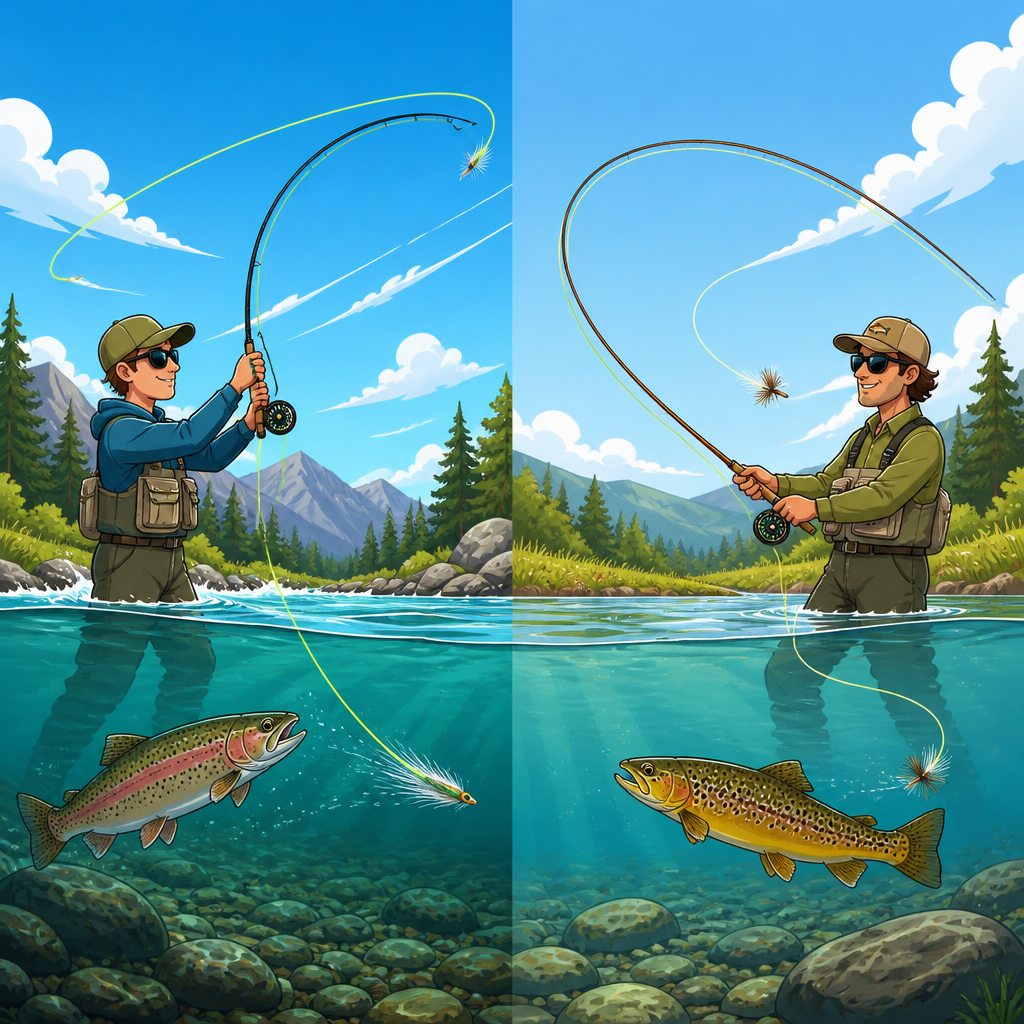
A fast-action fly rod bends mostly in the upper third, recovers quickly, and typically produces higher line speed. A medium-action fly rod bends deeper into the blank, loads more easily at common fishing distances, and usually gives the caster more feedback. Neither is universally better. The right choice depends on casting stroke, fly size, wind, leader length, and the kind of presentations you need to make repeatedly, not just once on a lawn. On the water, these differences show up immediately when you are trying to roll cast under trees, pick up forty feet of line and redirect, protect 6X tippet on a close trout, or punch a weighted streamer across a gusty seam.
This matters because the fly rod anchors every other gear decision in your setup. Line taper, leader design, reel balance, fly size, and even wader-pocket organization make more sense when the rod’s behavior matches the fishing problem. As a hub page for fly fishing basics and gear and equipment, this article explains exactly what changes on the water with fast versus medium-action fly rods, where each shines, what tradeoffs matter, and how to choose a setup that supports your learning curve instead of fighting it. If you understand rod action clearly, every future gear purchase becomes easier.
What fast and medium action really mean in practical fishing terms
Manufacturers often market action with broad labels, but practical differences are easier to understand through line loading and rod recovery. A fast-action rod needs a firmer, more deliberate stroke to bend efficiently, especially at short range. Once loaded, it recovers rapidly, creating tight loops, higher line speed, and sharper turnover. That helps when casting into wind, carrying longer lengths of line in the air, or driving larger flies with less collapse. Medium-action rods flex deeper with less input, so they “tell” the caster more about timing. You feel the rod load sooner, which is why many anglers describe medium actions as smoother or more intuitive.
In real fishing, that translates into different strengths. On a small trout stream with twenty-five-foot casts, a medium-action 4-weight often feels alive immediately, making dry-fly placement and roll casts easier. On a broad western river with afternoon wind, a fast-action 5-weight may handle reach casts, mends, and longer shots more efficiently because it generates speed without excessive false casting. The key is not casting distance in isolation; it is how the rod behaves across the distances you actually fish most. Most trout are not caught at seventy feet. Most presentations happen between twenty and fifty feet, where timing, line pickup, and accuracy matter more than parking-lot hero casts.
Another practical point is that action varies by brand and series. A “medium-fast” from Sage may feel different from one from Orvis, Scott, Echo, Redington, or TFO because taper design, resin systems, guide spacing, and swing weight influence perceived stiffness and recovery. That is why experienced anglers compare rods with the same line and leader before making conclusions. If possible, cast with a standard reference line such as Scientific Anglers MPX, Rio Gold, or Airflo Universal Taper, because line weights and head designs can make a rod feel faster or slower than the blank actually is.
How action changes casting, accuracy, and presentation on the water
The biggest on-water difference is timing. Fast-action rods reward compact, efficient strokes and punish rushed transitions less than sloppy tracking. Medium-action rods reward smooth acceleration and cleaner pauses because the deeper bend is easier to sense. For beginners, that feedback often shortens the learning curve. You can feel the rod load on short casts, which helps develop a consistent casting rhythm. For experienced casters, a fast rod can deliver superior line control when the stroke is dialed in, especially with long leaders, weighted flies, or changing wind angles.
Accuracy also changes in ways anglers notice quickly. At short to medium distances, many anglers place flies more accurately with medium actions because the rod loads with less line out and does not demand perfect tempo. Fast rods can be highly accurate too, but they tend to expose timing flaws, tailing loops, and overpowering. I see this often when anglers punch hard with their shoulder instead of accelerating smoothly with the forearm and hand. The result is a narrow loop that collides with itself, especially when trying to force tight shots under pressure.
Presentation quality matters just as much as accuracy. Medium-action rods usually deliver softer turnover with standard trout leaders, making them excellent for dry flies, emergers, and small nymphs in moderate conditions. Fast rods can still present delicately, but they do it best with matching lines and disciplined power application. A fast rod paired with an aggressive overweight line may fire tight loops brilliantly, yet land too hard for spooky fish at thirty feet. Conversely, the same rod with a longer-belly line and longer leader can present beautifully in skilled hands. Action is never separate from line choice, leader architecture, and casting mechanics.
Where each rod action performs best by water type, fly size, and conditions
The simplest way to choose between fast and medium action is to match common fishing scenarios, not marketing language. Medium-action rods excel on small to midsize rivers, spring creeks, farm ponds, and drift-boat trout fishing where casts are frequent but not extreme. They shine with dry flies, unweighted nymph rigs, soft hackles, and light streamers. Because they flex deeper, they roll cast and mend naturally, and they protect lighter tippets well during sudden surges. Fast-action rods excel when conditions are demanding: big rivers, lakes, windy banks, heavy indicator rigs, sink tips, articulated streamers, and saltwater flats where speed and authority matter.
| Fishing situation | Medium-action advantage | Fast-action advantage |
|---|---|---|
| Small stream dry flies | Loads at short range, softer landing | Useful only if brush demands tight loops |
| Technical trout with long leaders | Better feel and tippet protection | Good in wind with precise timing |
| Indicator nymphing | Easier close control, smoother mends | Turns over split shot and bobbers better |
| Streamer fishing | Comfortable with smaller patterns | Handles bulky flies and sink tips better |
| Stillwater and windy banks | Pleasant with balanced setups | Higher line speed cuts wind efficiently |
| Light saltwater | Fun on smaller fish in calm weather | Best for distance, wind, and quick shots |
These patterns are consistent across common rod weights. In 3- to 4-weight trout rods, medium actions are often ideal for dry-fly anglers and small water. In 5-weights, the split becomes more nuanced because this category covers everything from beginner all-rounders to high-line-speed technical rods. In 6-weights and above, faster actions become more common because anglers are more likely to throw larger flies, deal with wind, and fight stronger fish. That said, a medium-action 6-weight can be superb for bass bugs at short range or for anglers who prefer a relaxed casting stroke.
How rod action affects fish fighting, tippet protection, and overall fatigue
Many anglers focus on casting and ignore what happens after the eat. On the water, medium-action rods generally cushion sudden runs better because the blank bends deeper, spreading load through more of the rod. That helps protect 5X and 6X tippet on trout and keeps small hooks pinned during head shakes. When I am fishing barbless dries to selective fish in clear water, I often prefer medium action for exactly this reason. You can pressure fish steadily without feeling as if every surge transfers directly into the tippet knot or hook gap.
Fast-action rods fight fish differently. Because more stiffness remains in the butt and midsection, they can apply pressure efficiently, especially on larger trout, bass, carp, or schoolie stripers. They also pick line up quickly after a fish changes direction. However, they require more awareness with light tippets and close fish because sudden high-stick angles can create abrupt pressure spikes. Good anglers compensate with side pressure, smart reel use, and disciplined rod angles, but the tradeoff is real. Fast rods are not automatically harsher; they are simply less forgiving of poor fish-fighting mechanics.
Fatigue is another overlooked factor in gear and equipment decisions. Fast rods are often marketed as light and powerful, and many are, but low static weight does not guarantee low fatigue. Swing weight, recovery speed, and the force required to load the rod repeatedly all affect comfort over a long day. On short- to medium-distance trout water, a medium-action rod can feel less tiring because it casts efficiently without repeated hard acceleration. By contrast, stripping streamers or casting into sustained wind may actually be less tiring with a fast rod because the rod does more of the work once matched with the right line. Comfort depends on task repetition.
How to choose the right rod for a complete beginner and build the rest of the setup
For most beginners learning fly fishing basics, a medium or medium-fast 5-weight, nine feet long, remains the best all-around starting point. It handles dry flies, nymphs, small streamers, and mixed river conditions without forcing perfect technique. It also offers enough feedback to teach timing. Truly fast beginner rods can work, especially if paired with a slightly heavy line like a half-size-heavy trout taper, but they often hide poor mechanics until the angler hits a wall with accuracy and presentation. A beginner does not need the stiffest blank on the rack; they need a rod that makes twenty- to forty-foot fishing feel understandable.
If your local water is consistently windy, large, or streamer-heavy, move toward fast action in a 5- or 6-weight. If your fishing centers on dry flies, smaller rivers, stocked trout, or learning roll casts and mends, lean medium or medium-fast. Then build the rest of the setup around that decision. Match the reel for balance and drag quality, not prestige. Use a floating weight-forward line from a reputable maker like Rio, Scientific Anglers, or Airflo. Buy good leaders in the sizes you fish most, then learn to adjust with tippet spools rather than endlessly changing factory tapers.
As a gear and equipment hub, this is where the broader category connects: fly line selection, backing capacity, leader formulas, tippet diameter, rod weight matching, reel arbor size, wading tools, packs, and eyewear all become easier choices once rod action is settled. If you are building your first kit, test rods with the line you expect to fish, not just the line mounted for demos. Make ten short casts, several roll casts, one reach mend, and a few pickups from the water. Lawn casting reveals some traits; water reveals the rest.
Fast versus medium-action fly rods is not a debate with one winner; it is a question of matching rod behavior to the fishing you actually do. Fast rods bring line speed, authority, and efficiency in wind, with heavy rigs, and at longer ranges. Medium-action rods bring feel, forgiveness, smoother loading, and often better short-range presentation. On the water, those differences show up in timing, loop control, mending ease, tippet protection, fish-fighting pressure, and how tired you feel after a full day. That is why action is one of the most important gear and equipment decisions in fly fishing basics.
If you remember one rule, make it this: choose the rod that performs best at your normal fishing distance with your normal flies in your normal conditions. Ignore parking-lot distance contests and focus on useful tasks: roll casting under brush, delivering a dry fly softly at thirty feet, turning over an indicator rig, or punching a streamer through afternoon gusts. A rod that helps you execute those jobs repeatedly will catch more fish than a rod that excels only in ideal conditions. Action should support your casting stroke and your water, not your ego.
Start with honest self-assessment. Where do you fish most, what flies do you throw most, and how experienced is your casting? Then compare a few rods side by side with the same line and leader. If possible, cast on water before buying. Once you narrow the action, the rest of your fly fishing basics setup becomes simpler, from line taper to leader length to reel balance. Use this article as your hub for gear and equipment decisions, then build out the details one smart purchase at a time. The right rod action makes every cast, drift, and hookup easier.
Frequently Asked Questions
What is the real difference between a fast-action and a medium-action fly rod?
The biggest difference is where the rod bends and how quickly it recovers after you stop the cast. A fast-action fly rod bends more in the upper portion of the blank unless it is heavily loaded, which gives it a crisp, quick-recovering feel. A medium-action rod bends deeper into the midsection with less force, so it generally feels smoother, more relaxed, and more forgiving. On the water, that changes much more than comfort in your hand. It influences loop shape, casting tempo, mending ability, accuracy at different distances, and how well the rod protects light tippet.
Fast-action rods tend to generate tighter loops and higher line speed when the caster has good timing. That can be a major advantage in wind, when throwing weighted flies, or when you need to pick up and shoot line quickly. Medium-action rods usually encourage a slightly slower stroke and often make it easier to feel the rod load, which helps many anglers maintain timing and line control at practical fishing distances. In simple terms, a fast rod often feels sharp and powerful, while a medium-action rod often feels connected and forgiving. Neither is automatically better. The better rod is the one that matches your casting style, the flies you fish, and the water in front of you.
How does rod action change casting performance on the water?
Rod action affects nearly every stage of the cast. With a fast-action rod, the blank recovers quickly, so it can create high line speed and tight loops with less wasted motion. That matters when you are casting into the wind, carrying longer lengths of line in the air, or driving a longer leader over with larger dries, streamers, or nymph rigs. Fast rods also make quick pick-up-and-lay-down casts easier, which is valuable when fish are moving or when drift lanes change quickly.
Medium-action rods usually slow the rhythm down a bit and make the rod load more apparent to the caster. That can improve timing, especially for anglers who rush the transition between the back cast and forward cast. Because the rod bends deeper, many anglers feel the cast more clearly and can make smoother presentations at short to medium distance. That often translates into better accuracy at everyday trout-fishing ranges, more controlled roll casts, and less tendency to overpower the stroke.
There are tradeoffs. A fast rod can punish poor timing by producing tailing loops, wide misses, and hard presentations if the caster applies too much force. A medium rod may feel less efficient when trying to punch line through a stiff headwind or carry very long lengths of line. The key point is that action does not just alter “feel.” It changes the timing window, how the line unrolls, and how much precision or forgiveness you get in real fishing situations.
Which rod action is better for beginners, and why?
For many beginners, a medium-action fly rod is easier to learn with because it provides clearer feedback and a more forgiving casting tempo. New anglers often struggle with rushing the cast, overpowering the forward stroke, or failing to wait long enough for the line to straighten behind them. A medium-action rod tends to make the loading process easier to feel, which helps the caster develop rhythm. That deeper bend can also smooth out mistakes, allowing the rod to work with the angler rather than constantly exposing every timing flaw.
That said, “best for beginners” is not a universal rule. Some modern fast-action rods are designed to be user-friendly and can perform well for new casters, especially when matched with an appropriate line. If a beginner is learning in consistently windy conditions, plans to throw heavier rigs, or wants one rod for bigger western rivers, a fast-action model may still make sense. The problem comes when a very stiff, fast rod is paired with a rushed casting stroke. Then the angler often feels like the rod is doing nothing until too much force is applied, which creates inconsistent loops and frustration.
In practical terms, beginners usually benefit from a rod that rewards good timing without demanding perfect mechanics. That is why medium-action rods are so often recommended in fly fishing basics. They help build a clean casting foundation. Once that foundation is in place, an angler can decide whether they want the extra speed and range of a fast rod or whether they prefer the smoother, more relaxed control of a medium action.
How do fast and medium-action rods affect line control, mending, and presentation?
This is where rod action starts to matter even more than lawn casting would suggest. Presentation is not just about getting the fly there. It is about how the line lands, how easily you can reposition it, and how naturally the drift unfolds afterward. Medium-action rods often shine in close to moderate-range fishing because they can deliver a fly with a little more touch. The deeper flex can make it easier to open the loop when needed, soften the landing, and place small dry flies delicately on calmer water.
Medium actions are also often excellent for roll casting and close-range mending because they bend more readily with less line out. On smaller streams or technical dry-fly water, that can make a meaningful difference. Many anglers find they can feel the rod load during short-line casts more clearly, and that translates into better control when changing angles, feeding slack, or making subtle aerial mends.
Fast-action rods can still present delicately in skilled hands, but they tend to favor tighter loops and more direct energy transfer. That can be an advantage when accuracy and speed matter, or when longer mends are needed at distance. A fast rod often lifts more line off the water quickly and can be very effective for reach mends and repositioning line across multiple current seams. However, if overpowered at short range, it may land harder than intended. So while fast rods often win in line speed and range, medium rods frequently feel more intuitive in close-quarter line control and finesse presentations. The better choice depends on whether your fishing emphasizes distance and efficiency or touch and drift management.
Does rod action change how a fish feels during the fight and how much pressure you can apply?
Yes, and this is one of the most overlooked differences. A medium-action rod generally bends deeper under pressure, which helps absorb head shakes, sudden runs, and surges at close range. That deeper flex protects lighter tippets well and often makes smaller to medium fish feel more lively and enjoyable. It also reduces the chance of pulling hooks free when a fish changes direction abruptly, especially with fine leaders and small flies.
Fast-action rods usually have more lifting power in reserve and can apply pressure efficiently, particularly on larger fish or in situations where you need to turn a fish quickly. That can be valuable in heavy current, around structure, or whenever you are trying to keep a fish out of logs, rocks, or weeds. Because the rod is stiffer through more of the blank until heavily loaded, it can transmit force more directly. That power is useful, but it also means the angler needs to be more aware of tippet strength and drag setting.
In everyday fishing, the difference is not that one rod “fights fish better” in every case. It is that each rod applies pressure differently. Medium-action rods are often more forgiving and tippet-friendly. Fast-action rods often offer more control when stronger fish or difficult water require firm pressure. If you regularly fish spring creeks with fine tippet and selective trout, a medium action can feel ideal. If you chase larger fish in wind, current, or bigger water where authority matters, a fast action may give you a more effective advantage.