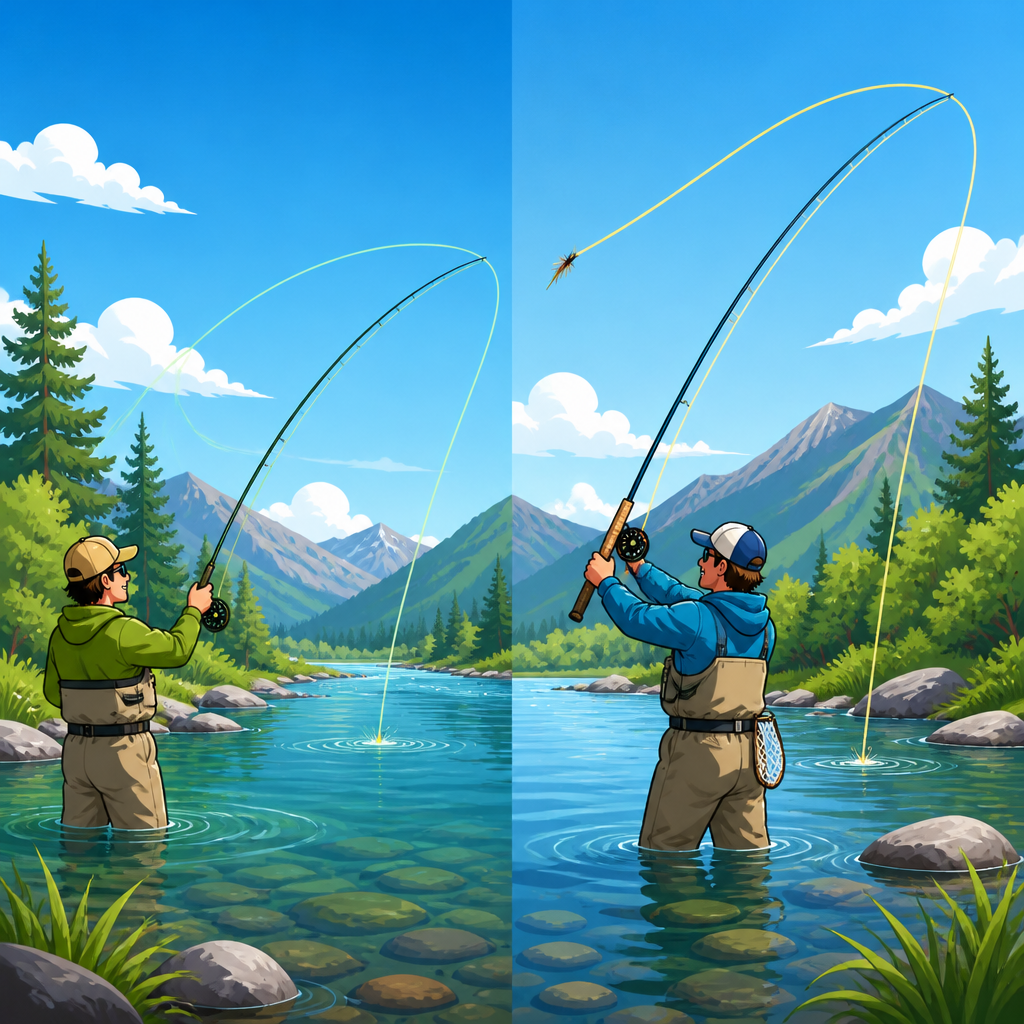
Choosing between a 9-foot and 10-foot fly rod seems simple until you fish both on the same water and realize how differently they handle. In fly fishing basics, rod length shapes almost every part of performance: casting stroke, line control, mending range, hook-setting speed, fish fighting angle, and even how tired your arm feels after a full day. When anglers compare fly rods, they often focus first on weight, action, or brand, but length is just as important because it changes the geometry of how line moves over water. For anyone building a practical understanding of gear and equipment, the 9-foot versus 10-foot decision is one of the clearest examples of how tackle design affects outcomes on the river.
A fly rod’s stated length is the distance from butt to tip, and in modern freshwater fishing, 9 feet is the all-around standard while 10 feet is the specialized extension of that standard. Reach refers to how far the rod can hold, lift, or reposition line without moving your feet. Casting describes how the rod loads and delivers line through the air. Line control means managing drag, slack, drift, mends, and tension after the cast lands. Those three ideas are tightly connected. A longer rod gives more reach, which often improves line control, but it also adds swing weight and can alter timing during casting. A shorter rod usually feels quicker and lighter in hand, but gives up some authority over line once it is on the water.
This choice matters because it influences success across nearly every common trout tactic, from dry-fly presentations and indicator nymphing to streamer fishing and tight-line methods. I have seen anglers instantly improve their drift by switching from a 9-footer to a 10-footer on medium rivers, and I have also watched others lose accuracy and rhythm because the longer rod exposed flaws in their casting stroke. There is no universal winner. The better rod is the one that matches your fishing method, water size, and tolerance for extra length. As the gear and equipment hub within fly fishing basics, this article explains where each length excels, where each struggles, and how to choose with confidence.
How rod length changes reach, leverage, and on-the-water control
The easiest difference to understand is reach. A 10-foot fly rod extends your working range by 12 inches, but in practice that extra foot does more than the number suggests. Because the tip sits farther from your hand, it can lift more line off conflicting currents, steer mends around seams, and maintain contact with flies at a flatter angle. On moving water, that usually means better drag-free drifts and fewer missed strikes. When high-sticking nymphs through a pocket-water lane, a 10-footer often keeps nearly all the fly line off the current. A 9-footer can do the job, but it requires more stepping, more arm extension, and tighter positioning.
Leverage cuts both ways. The same extra length that improves line control also increases torque against your wrist and forearm. This is why many anglers describe a 10-foot rod as “heavier” even when the scale says otherwise. Total rod weight matters, but swing weight matters more in fishing comfort. Swing weight is the effort required to move the rod through a casting arc, and added length shifts mass farther from your hand. Over a long day of repeated false casting, stripping streamers, or holding an elevated rod tip, that difference becomes noticeable. Better premium rods reduce this effect through material design and taper engineering, but they do not eliminate basic physics.
Hook-setting also changes with length. A 10-foot rod picks up slack faster during indicator nymphing and tight-line presentations, especially when fish eat at distance. In contrast, a 9-foot rod can feel more immediate and precise on short to medium casts because less tip travel is needed to move the line. Fighting fish follows the same pattern. A longer rod protects lighter tippet well by cushioning runs and changing angles around current seams, but it can feel less nimble around brush, under tree canopies, or from a float tube where rod clearance matters.
Casting performance: accuracy, timing, and line speed
Many anglers ask a direct question: does a 10-foot rod cast farther than a 9-foot rod? The honest answer is sometimes, but not automatically. Distance comes from efficient loading, clean tracking, loop control, and line speed. A 10-footer can carry more line and mend better at distance, but only if the caster maintains timing and a stable tip path. For average casters, a 9-foot rod often feels easier to control because the stroke is familiar and recovery tends to feel quicker. The rod stops crisply, tracks straight, and asks less of the caster’s mechanics. That is why 9-foot 5-weights remain the standard recommendation for general trout fishing.
Accuracy depends on context. At short range, especially on small and medium streams, 9-foot rods usually place flies more intuitively. They are easier to cast under overhanging limbs, sidearm around bankside vegetation, and deliver on compact backcasts. A 10-footer can still be accurate, but it magnifies flaws such as tailing loops, drifting rod tip paths, or overpowering the forward stroke. Once anglers adapt, many become extremely precise with the longer rod, but adaptation is real. The transition is easiest for anglers who already cast with a relaxed tempo and a well-defined stop.
Wind performance is nuanced. A 9-footer often punches tighter loops with less effort because it feels quicker in recovery. A 10-footer may help keep more line off rough current after the cast, but if the caster opens the loop due to mistimed power application, wind exposes the problem immediately. Rod action matters here. Fast-action 10-foot rods built for competition nymphing or stillwater distance can cast exceptionally well, while moderate 10-foot rods may feel slower than some anglers prefer. Length alone never tells the whole story, but when all else is equal, 9-foot rods usually offer the simpler casting experience.
Where 9-foot rods excel in everyday trout fishing
The 9-foot fly rod became the benchmark for good reasons. It balances versatility, comfort, and straightforward casting better than any other common length. In 4-weight, 5-weight, and 6-weight models, it covers dry flies, nymphs, small streamers, and light stillwater use without forcing strong compromises. For a newer angler buying one rod, a 9-foot 5-weight remains the best first choice because it teaches fundamental casting mechanics and works across the broadest range of trout conditions. It also pairs easily with standard lines and typical reel sizes, so overall outfit balance is simpler to achieve.
On technical dry-fly water, a 9-footer often feels ideal. It can make aerial mends, reach casts, and slack-line presentations without becoming cumbersome in close quarters. On brushy streams, that shorter overall length helps under trees and beside steep banks. From drift boats and rafts, 9-foot rods are easier to manage around clients, net handles, and anchor lines. They also shine in streamer fishing when repeated casts and strips would make a longer rod tiring. Many guides prefer 9-foot 6-weights or 7-weights for trout streamers because they are easier to drive sink tips, make quick shots, and fight fish aggressively near structure.
Another overlooked advantage is versatility across species. A 9-foot rod transitions smoothly from trout to bass, panfish, and light saltwater work. If your gear and equipment plan centers on owning fewer rods that each cover more tasks, 9 feet stretches your budget further. This matters in a hub-level buying decision because rod length affects not just one tactic but the entire system: travel tubes, car storage, matching lines, leader formulas, and how naturally the outfit fits your fishing routine.
Where 10-foot rods excel in modern nymphing and stillwater tactics
The strongest case for a 10-foot fly rod is line control, especially in subsurface presentations. In indicator nymphing, the extra foot helps lift more belly off the water, execute larger mends, and set the hook faster at range. On broad riffles and seam-heavy runs, this translates directly into better drifts. In tight-line and Euro-nymphing methods, 10-foot 2-weight through 4-weight rods are now standard because they hold leaders higher, reduce sag, and maintain better contact with weighted flies. Competition rules and the influence of international nymphing accelerated this design trend, and mainstream manufacturers followed with specialized models from brands such as Sage, Orvis, Scott, and Thomas & Thomas.
Stillwater anglers also benefit. From shore or a boat, a 10-foot 5-weight or 6-weight can improve hang control, line lifting, and long-leader tactics with chironomids, balanced leeches, and indicator setups. The extra reach helps pick up more line for recasts, which is useful when fish cruise at varying distances. On large western rivers, a 10-foot 6-weight can be excellent for bobber rigs, light streamers, and mending from a drift boat. Many guides keep one rigged specifically for clients who struggle to mend efficiently with standard rods.
| Fishing scenario | 9-foot rod advantage | 10-foot rod advantage |
|---|---|---|
| Dry flies on brushy streams | Quicker, easier under cover | Longer reach for line pickup |
| Indicator nymphing on medium rivers | Lighter feel all day | Better mending and hook sets |
| Euro nymphing | Usable but limited reach | Clear standard for contact control |
| Streamer fishing | Lower fatigue, faster shots | More steering at distance |
| Stillwater from shore or boat | Simpler casting rhythm | Improved line lifting and reach |
The tradeoff is specialization. A 10-footer often becomes the best tool for a narrower set of jobs rather than the best compromise for everything. That is not a drawback if those jobs match how you actually fish. If more than half your trout days involve indicators, contact nymphing, or mending across mixed currents, the added control is not theoretical. It shows up in drift quality, strike detection, and fish landed.
How to choose the right rod for your water, skill level, and setup
The best buying framework starts with where and how you fish most. If your home water is small to medium streams with tree cover, short casts, and a mix of dries and light nymphs, choose a 9-foot rod. If you fish wider rivers, make frequent mends, or use indicators and tight-line rigs regularly, choose a 10-foot rod. Skill level matters too. Newer anglers generally learn timing faster with a 9-footer because it asks less adaptation. Intermediate anglers who already cast cleanly can unlock real advantages from a 10-footer quickly, especially if they receive a short casting tune-up.
Balance the rod with the right reel and line. Longer rods can benefit from slightly heavier reels to improve overall hand balance, though adding too much reel weight is not a cure for poor swing weight. Use the line the rod was designed around. Some 10-foot nymph rods perform best with specialized thin-diameter fly lines or tactical nymph lines, while all-purpose 9-foot rods usually pair well with standard weight-forward tapers. Leader design matters as much as rod choice. A 10-foot rod with a poor indicator leader will not mend well, and a 9-footer with a smart dry-fly leader can outperform expectations in delicate presentations.
Finally, think in terms of systems, not isolated gear. Your rod should fit your line, leader formulas, wading style, and fishing positions. For most anglers building a fly fishing basics kit, the smartest progression is a 9-foot all-around rod first, then a 10-foot specialty rod once patterns in your fishing become obvious. That approach keeps gear and equipment decisions grounded in real use rather than marketing language.
The 9-foot versus 10-foot fly rod debate is really a question of priorities. If you want the most versatile, easiest-to-cast, least fatiguing option for broad trout use, a 9-foot rod remains the standard for a reason. It handles dry flies, nymphs, and streamers with fewer compromises and suits the widest range of anglers and waters. If you want maximum reach, better mending, faster slack pickup, and stronger contact in modern nymphing or stillwater tactics, a 10-foot rod offers measurable advantages that show up immediately on the water.
The key takeaway is simple: longer does not mean better in every situation, and shorter does not mean outdated. The right fly rod length depends on casting environment, presentation style, and how much line control matters after the fly lands. In a complete gear and equipment plan, rod length should be chosen as deliberately as rod weight, action, line taper, and leader setup. That is how experienced anglers avoid expensive overlap and build outfits that truly solve problems.
If you are choosing your first trout rod, start with a 9-foot model unless your fishing is already centered on indicator or tight-line nymphing. If you already own a 9-footer and often wish for more mending reach or better drift control, a 10-footer is the logical second rod. Use those questions to evaluate your water honestly, then match your purchase to the method you fish most. That single decision will improve casting efficiency, line control, and confidence every time you step into the river.
Frequently Asked Questions
Is a 10-foot fly rod always better for line control than a 9-foot rod?
A 10-foot fly rod usually gives you a clear advantage in line control, but “better” depends on how and where you fish. The extra foot increases your reach, which helps you lift more line off the water, make longer mends, and keep a tighter connection to flies and indicators. In practical terms, that means better drag management in currents, cleaner drifts, and more control when fishing at distance. On rivers with multiple current seams, that added reach can make a noticeable difference because you can reposition line without moving as much of it across conflicting currents.
That said, a 9-foot rod is often more than enough for many trout situations, especially on smaller rivers, moderate casting distances, or water where long mends are not critical. A shorter rod can feel quicker in hand, less cumbersome under trees, and easier to manage for anglers who prefer a more compact casting stroke. So while a 10-footer generally wins on pure line control, a 9-footer may still be the more efficient tool if your fishing style values agility, versatility, and lower swing weight over maximum reach.
How does rod length affect casting between 9-foot and 10-foot fly rods?
Rod length changes casting mechanics more than many anglers expect. A 10-foot rod creates a longer lever, which can help with roll casts, aerial mends, and carrying line, but it also asks for more precise timing. If your casting stroke is rushed or too short, the longer rod can feel slower to recover and less crisp. Many anglers notice that a 10-footer rewards a smoother tempo, especially when casting nymph rigs, indicators, or longer leaders where line management matters as much as raw distance.
A 9-foot rod typically feels more neutral and familiar because it suits a broad range of casting styles. It is often easier to pick up for overhead casting, quicker to track, and less fatiguing over repeated presentations. For dry flies, streamers, and all-around trout fishing, many anglers find the 9-footer more intuitive because it balances control with efficiency. The 10-footer is not necessarily harder to cast, but it tends to be more specialized in feel. If you spend much of your day making technical line adjustments after the cast, the longer rod makes sense. If you value easy rhythm and broad versatility, the 9-foot rod often feels more natural.
Which is better for nymphing and indicator fishing: a 9-foot or 10-foot fly rod?
For most dedicated nymphing and indicator setups, a 10-foot fly rod has the edge. The extra reach helps keep more line off the water, reduces drag, and improves strike detection by maintaining a more direct connection from rod tip to flies. It also helps with high-sticking, leading drifts, and adjusting line around currents without constantly repositioning your body. When fishing from slightly farther away or across complex current seams, that added foot can translate into better drift quality and faster hook sets.
A 9-foot rod can still nymph very effectively, especially on smaller streams or when using lighter, simpler rigs. In tighter quarters, the shorter rod may actually be easier to maneuver and less tiring over a full day. But when anglers specifically compare the two for euro nymphing, tight-line tactics, or indicator fishing on medium to larger rivers, the 10-footer is commonly preferred because it improves both reach and control. In other words, if nymphing is your primary game, the 10-foot rod is often the purpose-built choice. If nymphing is only one part of a mixed day, a 9-footer may be the better compromise.
Does a 10-foot fly rod make hook sets and fighting fish easier?
A 10-foot rod can improve hook-setting speed and fish-fighting control in several situations, especially when there is slack line, long leader, or current between you and the fish. Because the rod tip starts farther from your hand, you can move more line with the same lifting motion. That matters when nymphing, indicator fishing, or fishing at distance, where quick contact is everything. Many anglers feel they get cleaner, more immediate hook sets with a 10-footer because the rod helps take up slack faster.
During the fight, the longer rod also changes angles in your favor. You can steer fish around rocks, guide them through current seams, and apply side pressure with more reach. However, those benefits come with trade-offs. A 10-foot rod can feel heavier over time, and if the rod’s swing weight is high, some anglers become less precise late in the day. A 9-foot rod may feel more responsive and lively during close-range fights and can be easier to handle if fish are making sudden directional changes nearby. So yes, a 10-footer often helps with hook sets and line pickup, but a 9-footer still offers excellent fish-fighting performance with a slightly more compact, nimble feel.
How do I choose between a 9-foot and 10-foot fly rod for all-around fishing?
The best choice comes down to where you fish most, how you present flies, and what trade-offs you are willing to accept. A 9-foot fly rod is the classic all-around option because it performs well across dry flies, small streamers, light nymph rigs, and general trout applications. It tends to cast with less effort, feel lighter in hand, and adapt better to a wider variety of water types. If you want one rod that does nearly everything well, a 9-footer is often the safest and most balanced choice.
A 10-foot rod makes more sense when line control is central to your success. If you frequently fish larger rivers, mend often, lead drifts, tight-line nymph, or use indicators at distance, the added reach is not just a small upgrade; it can materially improve presentation. The trade-off is that a 10-footer may feel less compact, slightly more demanding in casting rhythm, and more tiring for some anglers over long sessions. A good rule is this: choose 9 feet if you want maximum versatility and comfort, and choose 10 feet if your fishing consistently rewards extra reach, drift control, and faster line management. Neither length is automatically superior in every situation, but each changes the geometry of fishing enough that the right match can noticeably improve your performance on the water.