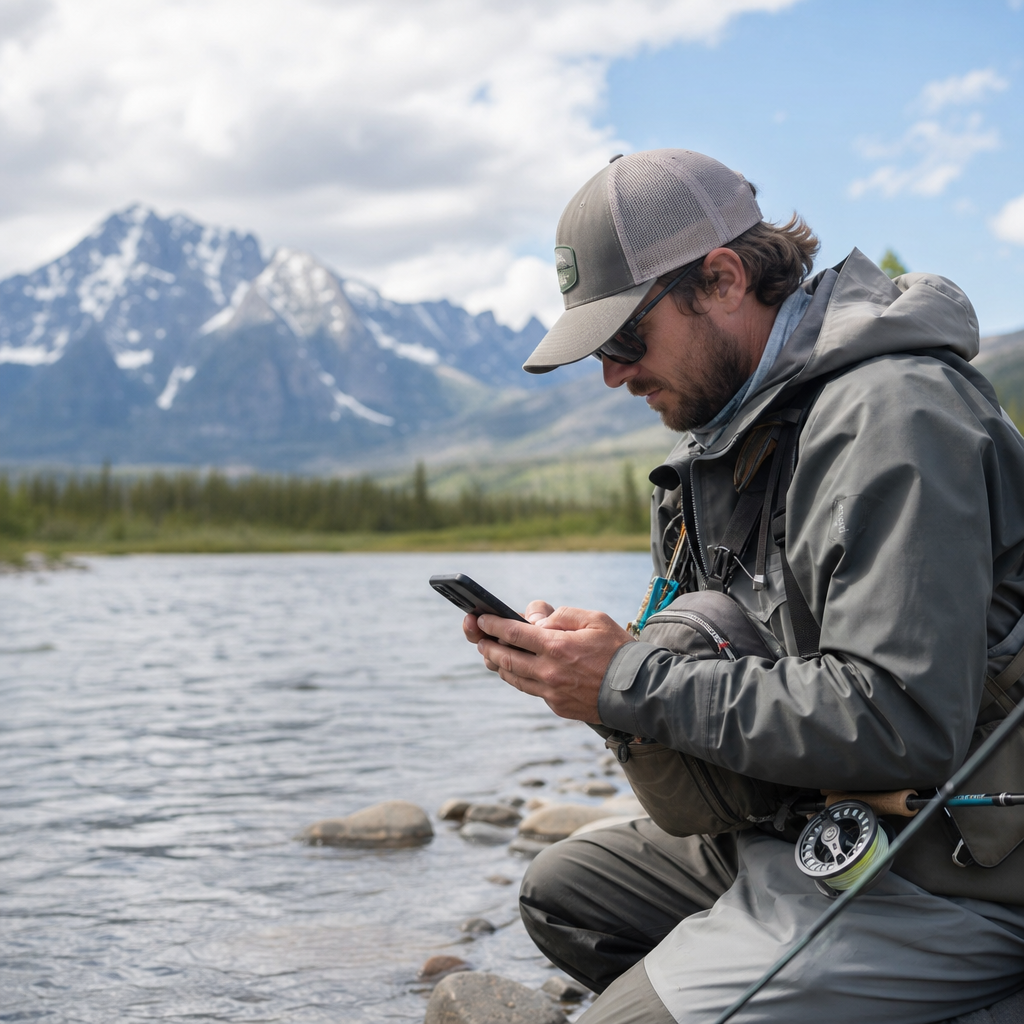
Staying connected while fly fishing internationally is no longer a luxury; it is a practical part of planning safe, efficient, and enjoyable travel in remote fisheries around the world. For traveling anglers, connectivity means more than posting grip-and-grin photos. It includes navigation, weather intelligence, border paperwork, luggage tracking, emergency communication, digital payments, translation, and staying in touch with lodges, guides, and family. On international fly fishing trips, especially in Patagonia, Iceland, New Zealand, Alaska via Canada, Mongolia, or the Yucatán, unreliable service can disrupt transfers, permit checks, or even river safety decisions.
In my own trip planning, I treat connectivity the same way I treat wader repairs and fly boxes: as a system with backups. International travel adds variables domestic trips rarely do, including roaming fees, eSIM compatibility, customs inspections of electronics, local power standards, rural tower coverage, and the fact that many famous fisheries are several hours from the nearest town. A smart setup keeps your phone useful when signals are weak and keeps critical information accessible when there is no signal at all.
For anglers researching tips for international travel, the central question is simple: how do you stay connected without overpacking, overspending, or relying on fragile assumptions? The best answer combines three layers. First, secure affordable primary service through eSIM, local SIM, or an international roaming plan. Second, prepare offline tools such as maps, reservation records, and translated addresses. Third, carry emergency communication options when heading into true backcountry water. This hub article covers each layer in practical terms, explains where each option works best, and shows how to make connectivity support your fishing rather than distract from it.
Choose the right mobile strategy before you leave
The cheapest and easiest international mobile setup is often decided before you board your first flight. Start by checking whether your phone is unlocked and eSIM compatible. Most recent iPhone, Google Pixel, and Samsung Galaxy models support eSIM, but not every regional variant does. If your device is locked to a carrier, a local data plan may not activate, and that can leave you paying expensive roaming charges. Verify this in settings and with your provider at least two weeks before departure, because carrier unlock requests sometimes take time.
For most anglers, there are three workable options: your home carrier’s international day pass, a travel eSIM, or a local physical SIM purchased on arrival. Day passes from providers such as Verizon, AT&T, and T-Mobile are convenient because your number continues to work, but costs add up on longer trips. Travel eSIM providers like Airalo, Holafly, Nomad, and GigSky are usually more economical for data and can be installed before departure. Local SIM cards often offer the best value and stronger regional support, especially in countries where one domestic network clearly dominates rural coverage, but buying one after arrival can be inconvenient after overnight travel.
The right choice depends on trip style. If you are fishing near Reykjavík and then moving around Iceland in a rental car, an eSIM with decent national coverage is often enough. If you are crossing multiple provinces in Argentina or Chile and coordinating pickups with several lodges, keeping your home number active while adding local data via eSIM is safer. If you are spending three weeks in New Zealand with self-drive logistics, a local carrier plan can be the most cost-effective option. Coverage matters more than advertised speed; on fishing travel, a stable signal for messaging and maps is far more valuable than peak download performance.
Match connectivity tools to the destination and fishing style
Not all international fly fishing trips require the same communications kit. A lodge-based saltwater trip on Mexico’s Ascension Bay has different needs than hiking into a taimen river in Mongolia or chasing trout across South Island backroads. The more independent and remote the itinerary, the more redundancy you need. I classify trips into three categories: connected travel corridors, partially connected rural travel, and true off-grid expeditions. Each one changes what counts as an acceptable setup.
Connected travel corridors include destinations with reliable cellular service in towns, airports, and most highways, even if river canyons have dead zones. Much of Iceland, New Zealand, and popular parts of Europe fit here. A phone with eSIM, offline maps, and a power bank is usually sufficient. Partially connected rural travel includes areas where service exists near towns and main roads but drops out in valleys, steppe, jungle, or estuaries. Patagonia, parts of the Yucatán, and portions of British Columbia often fall into this category. Here, downloaded maps, prearranged pickup plans, and a second charging method become essential. True off-grid expeditions include remote Alaska fly-outs, Kamchatka, Mongolia, and some Amazon tributaries, where your phone should be considered a convenience rather than a lifeline. In those places, a satellite communicator is the standard, not an optional gadget.
| Trip type | Typical destinations | Best primary option | Critical backup |
|---|---|---|---|
| Connected corridor | Iceland, much of New Zealand, urban Europe | Travel eSIM or carrier day pass | Offline maps and power bank |
| Partially connected rural | Patagonia, Yucatán, parts of Canada | Dual setup: home number plus local or eSIM data | Printed contacts, downloaded reservations |
| True off-grid expedition | Mongolia, remote Alaska, Amazon headwaters | Whatever cellular service exists near transit points | Satellite messenger or satellite phone |
This framework prevents one of the most common mistakes in international travel: assuming a phone plan solves a wilderness communication problem. It does not. Cellular planning handles airports, transfers, lodging coordination, and day-to-day messaging. Wilderness safety requires a different layer. When anglers separate those functions, they buy the right gear and spend money where it matters.
Prepare offline access for maps, documents, and language barriers
Offline preparation is the highest-return step in this entire process because it works regardless of carrier, country, or weather. Before any trip, download offline map areas in Google Maps or Maps.me for every airport, city, transfer route, and fishing region. Save your lodge, guide meeting point, rental car office, hospital, embassy, and nearest fuel station as starred locations. In Patagonia and New Zealand, where roads can be long and signage sparse, this eliminates a lot of avoidable stress when service disappears between towns.
Next, store travel documents in at least three forms: cloud access, local phone storage, and paper copies. Keep passports, visas, travel insurance, fishing licenses, luggage tags, medication lists, and emergency contacts in a folder that is accessible without signal. I also save screenshots of reservation confirmations because some booking emails load poorly on weak networks. If your airline loses a rod tube in transit, having the baggage claim number and itinerary instantly available can save an hour at the service desk.
Language support matters too. Download offline packs in Google Translate or a comparable app for Spanish, Icelandic, Japanese, or whichever language your destination requires. Save common phrases specific to fishing travel, such as “I need a taxi to this address,” “Where is the fuel station,” “I have a reservation,” and “Can you call my lodge.” In rural areas, precise practical phrases outperform broad conversational study. Connectivity is not just signal strength; it is your ability to retrieve useful information the moment you need it.
Use satellite communication when the water is genuinely remote
When an itinerary involves backcountry camps, long drifts beyond roads, helicopter access, or multi-day float sections, satellite communication becomes part of standard risk management. The two most common tools for traveling anglers are satellite messengers and satellite phones. Devices like the Garmin inReach Mini 2 and ZOLEO allow two-way messaging, location sharing, weather forecasts, and SOS activation through the Iridium network. Satellite phones offer voice calling but are bulkier, costlier, and usually less practical for typical fly fishing travel. For most anglers, a modern satellite messenger is the better balance of weight, battery life, and utility.
The key is understanding what these devices do well and what they do not. They are excellent for scheduled check-ins, emergency escalation, and sending updated coordinates if pickup points change. They are slower than normal texting, can struggle under dense canopy or steep canyon walls, and should never be tested for the first time after the bush plane leaves. Set preset messages before the trip, teach your emergency contacts what those messages mean, and confirm who monitors them. If a guide already carries a satellite device, ask whether guests still need one. On some expeditions the answer is no; on independent trips it is usually yes.
One more nuance matters: SOS capability is only useful if your travel insurance and evacuation planning align with the regions you are fishing. Read the policy language for medical evacuation, adventure activities, and destination exclusions. Emergency communication, transport logistics, and insurance coverage are parts of the same safety chain.
Manage power, charging, and device durability in wet environments
A perfect data plan fails the minute your battery dies in a transfer van or your charging plug does not fit the lodge outlet. International fly fishing travel often combines long transit days with wet, cold, sandy, or salty conditions that shorten battery life and damage ports. Start with plug standards for your destination. Much of Europe uses Type C and F, the United Kingdom uses Type G, Australia and New Zealand use Type I, and parts of South America vary by country. Bring a compact universal adapter from a reputable brand such as Epicka or Ceptics, not a flimsy airport impulse buy.
Carry at least one high-quality power bank in the 10,000 to 20,000 mAh range and charge it whenever power is available. Anker, Nitecore, and Belkin all make reliable options. If you use a satellite messenger, pack its cable separately from your phone cable so a single loss does not disable both systems. For drifts and wet wading, use a waterproof pouch with a secure lanyard rather than trusting a damp wader pocket. Saltwater trips add corrosion risk, so rinse and dry equipment daily and inspect ports before charging.
Cold weather also changes performance. Lithium-ion batteries drain faster in freezing temperatures, which matters on shoulder-season trout trips in Patagonia, Tierra del Fuego, or Iceland. Keep your phone and battery bank in an inner layer when possible. A dead phone on the river is usually a power management problem, not a coverage problem.
Protect privacy, payments, and communication reliability abroad
International connectivity is also a cybersecurity issue. Airport Wi-Fi, hotel networks, and public hotspots in transit hubs are convenient but not trustworthy by default. Keep your phone operating system updated before departure, enable device encryption and biometric locking, and turn on Find My iPhone or Android’s equivalent. Use a password manager, store backup codes for key accounts offline, and activate multifactor authentication that does not rely only on your primary phone number. Authentication apps are usually more reliable abroad than SMS codes.
Payments deserve the same planning. Many lodges, guides, and transport providers accept cards, but rural terminals may fail or process slowly on weak networks. Carry two cards from different networks, typically Visa and Mastercard, and notify issuers of travel plans. Save card support numbers separately in case fraud blocks a transaction. Messaging apps matter as well. In many countries, WhatsApp is the default for drivers, lodge managers, and guides. Install it before departure and verify your account while your home number is active.
Finally, set expectations with family and fishing partners. Share your itinerary, expected blackout periods, and the difference between no service and a real emergency. This simple step prevents unnecessary worry and reduces the temptation to overuse limited connectivity while you should be focused on the river.
The best way to stay connected while fly fishing internationally is to build a layered system instead of trusting a single device, app, or carrier plan. Start with the right mobile option for your destination, whether that is a travel eSIM, a local SIM, or a home-carrier roaming plan. Add offline maps, saved documents, translated addresses, and printed backups so airports, border crossings, and lodge transfers continue smoothly when service drops. Then match your communication tools to the actual remoteness of the trip. For many destination fisheries, a phone and power bank are enough. For backcountry floats, fly-outs, and wilderness camps, a satellite messenger is the responsible standard.
The main benefit of good connectivity planning is not constant screen time. It is reduced friction. You spend less time solving preventable travel problems and more time watching weather windows, meeting pickups, protecting gear, and fishing effectively. On a well-planned trip, connectivity fades into the background because it works when needed and stays out of the way when it is not. That is exactly the balance most traveling anglers want.
Use this hub as your starting point for every international fly fishing trip. Review your destination’s coverage, confirm your device setup, download your offline tools, and build one backup for every critical link in the chain. Do that before departure, and you will travel with more confidence from the first airport transfer to the last cast.
Frequently Asked Questions
Why is staying connected so important on an international fly fishing trip?
Staying connected while fly fishing abroad is about far more than convenience. In remote fisheries, reliable access to a phone or data connection supports safety, logistics, and better decision-making throughout the trip. Anglers often depend on connectivity for GPS navigation, weather forecasts, tide and river condition updates, digital maps, airline notifications, baggage tracking, border entry documents, and communication with lodges, guides, and transportation providers. In many destinations, especially where transfer schedules are tight or infrastructure is limited, being reachable can prevent small travel issues from turning into major disruptions.
Connectivity also helps anglers respond quickly to changing fishing conditions. A guide may need to adjust a meeting location, a lodge may notify guests of delayed boats or weather-related changes, or a local outfitter may send updates about access roads, river clarity, or licensing requirements. If you are moving between cities, charter flights, and remote camps, having dependable communication reduces uncertainty and allows you to travel with more confidence.
There is also an important personal and emergency dimension. Family members at home often want check-ins, particularly when you are traveling to isolated areas. If there is a medical issue, equipment loss, transportation problem, or border documentation question, your ability to contact the right person quickly can be invaluable. In short, staying connected is now a practical part of international trip planning that helps make fly fishing travel safer, smoother, and more enjoyable.
What is the best way to get mobile service internationally: roaming, a local SIM card, or an eSIM?
The best option depends on your destination, trip length, phone compatibility, and how remote your fishing itinerary will be. International roaming through your home carrier is usually the easiest choice because it often works as soon as you land, requires little setup, and lets you keep your regular number. That simplicity can be valuable during complicated travel days. However, roaming can be expensive, and performance may vary depending on local carrier partnerships. It is often a good short-term solution for airport arrivals, border crossings, and the first day of travel, but not always the most cost-effective choice for a longer trip.
A local SIM card is often the most economical and reliable option if you are spending meaningful time in one country and your phone is unlocked. Local plans frequently offer better data allowances and access to the strongest in-country networks. This can be especially useful if you need maps, messaging apps, weather tools, or translation services every day. The tradeoff is that buying and activating a SIM may take time, may require passport registration in some countries, and typically gives you a local number instead of your usual one unless you keep a second SIM active.
For many traveling anglers, an eSIM is now the most practical middle ground. If your phone supports it, you can usually purchase a data plan before departure, activate it digitally, and avoid the hassle of finding a mobile shop after arrival. eSIMs are ideal for people who want quick setup and data access without swapping physical cards. They are especially useful on multi-country itineraries. That said, not all eSIM providers offer strong coverage in remote fishing regions, so it is worth checking which local network they use and whether that network performs well where you are going.
If your trip includes very remote water, remember that no mobile option is guaranteed once you leave populated areas. The smartest approach is often layered: use roaming or an eSIM for immediate arrival connectivity, rely on a local SIM where practical, and recognize when you may need backup tools such as offline maps or a satellite communicator once you move beyond normal cellular coverage.
How can I prepare my phone and digital tools before leaving for a remote fly fishing destination?
Preparation before departure makes a major difference. First, confirm that your phone is unlocked if you plan to use a local SIM or eSIM. Then check whether your device supports the bands and technologies commonly used in your destination. Make sure your operating system, apps, and security settings are fully updated while you still have stable internet access. It is also wise to review your carrier’s international policies, including roaming rates, hotspot allowances, and any data caps that could affect map use or video calls.
Next, download the tools you are likely to need when service becomes weak or unavailable. This includes offline maps for cities, transfer routes, and fishing areas; airline and lodging apps; translation packs; digital copies of passports, fishing licenses, visas, customs forms, travel insurance details, and emergency contacts. Save addresses, guide phone numbers, boat launch points, and transfer confirmations both in your phone and in a cloud account you can access from another device if needed. It is also smart to screenshot critical reservation details in case an app fails to load.
Power management is another essential step. Bring a dependable power bank, charging cables, and the correct plug adapters for every country on the itinerary. If you will be on skiffs, rafts, or in remote camps, use waterproof storage and consider a rugged or water-resistant phone case. Anglers should also adjust settings to preserve battery life, such as enabling low power mode, reducing background app refresh, and downloading content ahead of time rather than streaming in the field.
Finally, think in terms of redundancy. Carry a printed list of important contacts and itinerary details. Share your travel schedule with family or friends at home. Set up messaging apps commonly used in your destination, because in many countries guides and drivers rely on WhatsApp or similar platforms rather than standard texting. By doing this setup before departure, you reduce stress and improve your ability to adapt when travel conditions change.
What should I do if I will be fishing in places with little or no cell coverage?
If your trip takes you into truly remote country, the key is to plan for limited connectivity rather than assume your phone will work. Start by asking your lodge, outfitter, or guide what kind of coverage exists at the lodge, on the road, and on the water. Some camps may have Wi-Fi in common areas but no reliable mobile service. Others may have no internet at all except for satellite-based emergency communication. Knowing the reality in advance helps you set expectations and choose the right backup equipment.
In areas without dependable cell service, offline capability becomes essential. Download maps, route information, booking confirmations, and translation tools before you leave network coverage. Make sure your phone’s maps are fully saved for offline use and that you know how to access them without data. If you are moving through backcountry terrain, mark key points such as camp, launch sites, border stations, airstrips, and medical facilities. Even when disconnected, your phone’s GPS may still help you navigate if the maps are stored locally.
For serious remote travel, a satellite messenger or satellite phone can be one of the best safety investments you make. Devices such as satellite communicators allow check-ins, SOS alerts, and limited messaging even when there is no cellular network. That can be extremely valuable for float trips, jungle fisheries, saltwater flats in isolated regions, or overland travel between small communities. If you are traveling with a guide service, ask what emergency communication equipment they carry and whether you should bring your own backup.
It is also wise to create a communication plan with family and travel partners. Let people know when you expect to be off-grid, when you expect to reconnect, and what steps they should take if they do not hear from you on schedule. This avoids unnecessary worry and gives everyone a clear protocol. In remote fly fishing, being realistic about connectivity is just as important as bringing the right flies or waders. Good planning lets you enjoy the isolation without losing essential access to help and information.
How can I stay connected securely and avoid common problems like high fees, dead batteries, or lost access to important information?
The most effective strategy is to treat connectivity as part of your travel system, not as a last-minute add-on. To avoid high fees, review your carrier’s roaming terms before departure and compare them with eSIM or local SIM options. Turn off automatic cloud backups, app updates, and unnecessary background data when using paid roaming, because those hidden processes can consume surprising amounts of data. Use Wi-Fi strategically at airports, hotels, and lodges, but be cautious with public networks and avoid transmitting sensitive information unless you are using secure connections.
Security matters because international travelers often access banking apps, passports, reservations, and personal messages from unfamiliar networks and devices. Use strong device passcodes, enable biometric locks if available, and activate find-my-device features before you travel. Two-factor authentication is important, but make sure you can still receive verification codes if your main number is unavailable. Many travelers benefit from using an authenticator app instead of relying only on SMS. It is also smart to save encrypted backups of critical documents and keep copies available in a secure cloud service and offline on your device.
Battery management is another common challenge, especially for anglers who spend long days on the water. Keep your phone in airplane mode when you do not need live service, because constant searching for a weak signal drains power quickly. Carry at least one quality power bank and, for longer days, consider a second backup. Protect charging gear from water, sand, and salt exposure. If you are using your phone for photos, navigation, and messaging all day, power planning should be as routine as packing leaders and fly boxes.
To protect against lost access to important information