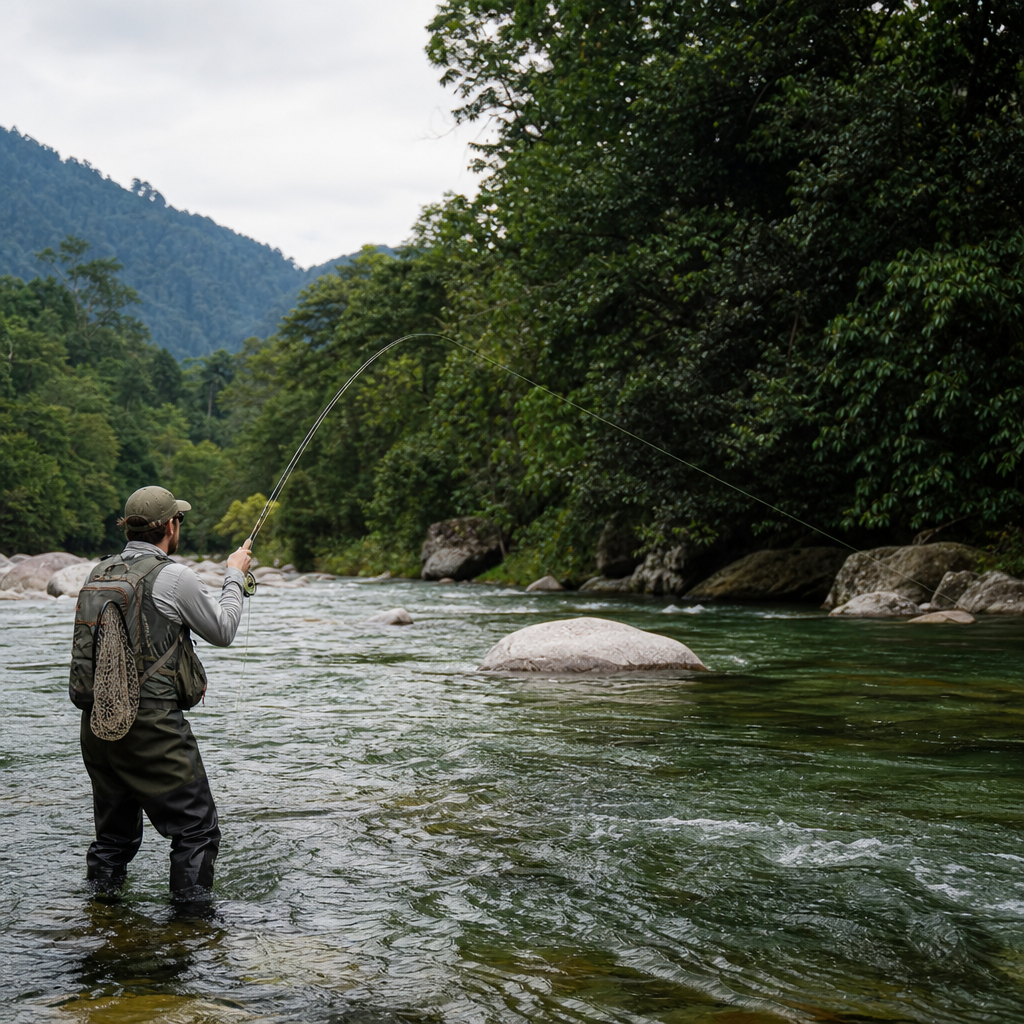
Malaysia offers one of Asia’s most varied fly fishing landscapes, combining jungle rivers, highland streams, floodplain lakes, mangrove estuaries, and bluewater edges within a relatively compact country. For anglers building a serious Asia fly fishing plan, Malaysia matters because it sits at the intersection of tropical biodiversity, accessible travel infrastructure, and year-round fishing opportunities. In practical terms, “fly fishing destinations in Malaysia” means several distinct fisheries rather than one single scene: freshwater systems in Peninsular Malaysia, peacock bass and snakehead venues around urban reservoirs, indigenous jungle species such as sebarau and tengas in clearer upland rivers, and saltwater targets from barramundi to giant trevally along the coasts of Sabah and Sarawak. Having fished and researched these waters with local guides and regional outfitters, I can say Malaysia rewards anglers who match tactics to habitat. It is not a place where one rod and one fly box cover everything. Understanding monsoon timing, water clarity, access rights, and species behavior is the difference between blind casting and purposeful fishing.
As a hub within the broader Asia fly fishing destinations category, this guide explains where Malaysia fits in the region and what makes it distinct. Compared with Japan’s cold-water trout culture, Mongolia’s taimen rivers, or Thailand’s managed freshwater parks, Malaysia is warmer, more mixed, and often more exploratory. The core appeal is species diversity. A visiting angler may sight-cast to snakehead in lotus-fringed impoundments, strip streamers for peacock bass near Kuala Lumpur, dead-drift nymphs for mahseer relatives in forested runs, or throw baitfish patterns at coastal predators under bait schools. Key terms matter here. Sebarau usually refers to the hampala barb, Malaysia’s most celebrated jungle river sport fish. Tengas is a local name commonly used for certain mahseer-type river fish in fast, clean water. Snakehead includes species such as toman, famous for explosive surface takes. Pay attention to these local names when reading reports or booking guides, because they shape expectations. Malaysia is best approached as a multi-species destination where mobility, timing, and local knowledge consistently outperform rigid destination checklists.
Why Malaysia Stands Out in Asia Fly Fishing
Malaysia stands out because it compresses an unusual range of fisheries into one destination with strong transport links. Kuala Lumpur is a major regional aviation hub, road access is generally reliable in Peninsular Malaysia, and domestic flights make East Malaysia reachable without expedition-level logistics. For traveling anglers, that means a realistic chance to combine urban-access peacock bass, remote jungle rivers, and coastal saltwater sessions in one trip. Few countries in Asia offer that breadth with comparable convenience.
The biological mix is equally compelling. In one country, fly anglers can target predatory freshwater species that respond aggressively to streamers and poppers, as well as river fish that demand more delicate presentations. Malaysia’s tropical climate also extends the fishing calendar. There is no short, singular season in the way many trout destinations operate. Instead, conditions shift by coast, drainage, and monsoon pattern. The northeast monsoon typically affects the east coast of Peninsular Malaysia more heavily from roughly November through February, while west coast waters can remain more fishable. Sabah and Sarawak follow their own weather rhythms. This regional variation creates options when one area blows out.
Malaysia also occupies an important place in Asia’s fly fishing progression because it bridges “entry-level tropical” and “specialist jungle” angling. Newcomers can learn casting and fish handling on hard-fighting peacock bass in reservoirs with boat support. More experienced anglers can move into technical jungle river fishing for sebarau or exploratory saltwater work over flats, channels, and reef edges. That ladder of difficulty makes Malaysia useful not just as a single destination, but as a training ground for broader Asia fly fishing travel.
Peninsular Malaysia Freshwater: Sebarau, Toman, and Peacock Bass
Peninsular Malaysia is where most visiting anglers begin, and for good reason. It offers the country’s best-developed combination of access, guide availability, and species variety. The headline species are sebarau, toman, and peacock bass. Each demands a different approach. Sebarau inhabit rivers and some reservoirs, often holding near current seams, submerged timber, rocky runs, and bait-rich shorelines. They are aggressive but not reckless. In clear water, I have had the best results with small to medium streamers in olive, white, gold, and black, worked with sharp strips and pauses. Early morning surface takes can be excellent when fish push bait into shallows.
Toman, the giant snakehead, are among Southeast Asia’s most dramatic fly targets. They breathe air, patrol weedy margins and open pockets, and often reveal themselves by rolling at the surface. Family groups with fry are especially visible, though ethical anglers and reputable guides handle those situations carefully to avoid excessive pressure. Large deer-hair poppers, gurglers, foam divers, and baitfish streamers all produce, but presentation matters more than fly novelty. A long cast placed ahead of a cruising fish, followed by deliberate strips and a pause in the fish’s lane, outperforms repeated casting on top of the fish. Heavy leaders are standard because takes are violent and cover is unforgiving.
Peacock bass, introduced rather than native, have become one of the most consistent urban and suburban fly fishing options around parts of Peninsular Malaysia. Reservoirs and mining ponds near major population centers can fish surprisingly well. They are ideal for visiting anglers with limited time because the learning curve is shorter than for toman or jungle mahseer relatives. Fast-sinking lines or intermediate setups, compact baitfish flies, and active retrieves usually work. When I guide friends into these waters for the first time, peacock bass are often the species that quickly teaches line control, strip-setting, and boat-side discipline.
| Fishery Type | Main Species | Best Tactics | Typical Gear |
|---|---|---|---|
| Jungle rivers | Sebarau, tengas | Streamers, nymphs, pocket-water presentations | 5-7 weight, floating line |
| Reservoirs | Toman, peacock bass | Poppers, baitfish flies, structure casting | 7-9 weight, floating or intermediate line |
| Mangroves and estuaries | Barramundi, mangrove jacks | Ambush-point casts, tide timing, strip pauses | 8-10 weight, floating/intermediate line |
| Coastal bluewater | GT, queenfish, mackerel | Fast retrieves, bait-school coverage, sight-casting | 10-12 weight, tropical lines |
Highland and Jungle River Fishing
Malaysia’s highland and jungle rivers are the country’s most romantic fly fishing environments and, in many cases, the most demanding. These waters often require hiking, local permissions, and a realistic acceptance that conditions can change quickly after rain. The reward is intimate fishing for wild river species in primary or secondary forest settings. In clearer upland flows, anglers target sebarau and tengas around boulders, plunge pools, gravel runs, and undercut banks. Presentation becomes more technical here than in stillwater predator fishing. Short, accurate casts, controlled drifts, and line management in tight corridors matter more than long-distance casting.
Water clarity is the defining variable. In tea-stained or slightly colored rivers, brighter streamers and more animated retrieves can trigger reaction strikes. In clear low water, smaller flies and subtler movements become more important. I have found that lightly weighted baitfish patterns, soft-hackle style wet flies, and compact nymphs all have a place, especially where fish see pressure or hold in shallow current. Wading can be slippery and physically taxing. Felt soles are restricted in some regions globally for invasive species reasons, so many traveling anglers now rely on modern rubber compounds with studs where permitted. A wading staff is not excessive in Malaysia’s granite and moss-covered rivers.
These trips are often guide-dependent not because fish are impossible to find, but because access, river level decisions, and safety judgment are local. Flash floods are a real hazard in tropical catchments. So are elephants or other wildlife in certain corridors, depending on region. The best operators monitor rainfall upstream, know exit routes, and adjust plans early. That practical decision-making is part of the value of a professional jungle river guide and should weigh heavily when comparing outfitters.
Saltwater Opportunities in Sabah, Sarawak, and the Peninsula
Malaysia’s saltwater fly fishing remains less publicized than its freshwater scene, but it deserves attention from traveling anglers exploring Asia. The main opportunities include estuary and mangrove fishing for barramundi and mangrove jack, coastal sight-fishing where conditions permit, and offshore or nearshore action for giant trevally, queenfish, Spanish mackerel, and other pelagics. East Malaysia, especially Sabah, has enormous potential because of its coastline, islands, reef systems, and less crowded image in global fly fishing media.
Barramundi are classic ambush predators that sit around current lines, drains, bridge structures, timber, and mangrove edges. They often eat on the pause, which is why anglers who strip too quickly miss chances. A controlled cast tight to structure, one or two strips, and then a brief suspension regularly converts follows into takes. Mangrove jacks are even more structure-oriented and punish hesitation by burying back into cover. For both species, leaders need abrasion resistance, and hook quality matters because fish hit hard in confined spaces.
Bluewater and reef-edge fishing demand heavier tackle and disciplined fish-fighting technique. Giant trevally are not available everywhere, and not every operator advertising them is genuinely fly-focused. Ask direct questions about casting platforms, line management, average shot distance, and whether spinning tackle dominates the day. Serious fly anglers should look for guides who understand current windows, bait movement, and how to position a skiff or center console for actual presentations rather than token casts between conventional methods.
On the peninsula, estuary systems on both coasts can fish well depending on tide and rainfall. Muddy runoff can shut down visibility-based opportunities but improve ambush feeding near drain mouths. This is where Malaysia differs from postcard flats destinations. Success often comes from reading moving water in working coastal environments rather than expecting endless white sand sight-casting.
Seasonality, Travel Planning, and Tackle Selection
The best time to fly fish in Malaysia depends on species and region, not the country as a whole. For Peninsular Malaysia, many anglers prefer drier windows outside the strongest northeast monsoon effects, but local reservoirs may still fish when rivers are blown out. Urban peacock bass options are especially useful during unstable weather because access is flexible and sessions can be shortened. Jungle rivers usually fish best when water levels are stable and slightly dropping after rain, not during prolonged low clear conditions or heavy flood pulses.
Travel planning should start with a species-first decision. If your priority is toman, build around reservoir and lake guides with boats designed for accurate casting along weed edges. If you want sebarau and river exploration, accept slower fishing in exchange for more immersive environments. If saltwater is the goal, choose operators based on tide knowledge and fly fishing commitment, not resort marketing alone. Domestic connections through Kuala Lumpur, Kota Kinabalu, and Kuching are generally straightforward, and English is widely used in tourism contexts, which lowers friction for international visitors.
A practical Malaysia fly fishing kit usually includes a 6-weight or 7-weight for rivers, an 8-weight or 9-weight for reservoirs and estuaries, and a 10-weight or heavier setup for serious coastal predators. Tropical fly lines are essential in the heat; standard temperate lines can wilt, tangle, and lose performance. Carry wire only if specifically required for toothy species, because many Malaysian targets are better served by heavy fluorocarbon. Polarized glasses with copper or amber lenses help in variable light, and rain gear should be lightweight but genuinely waterproof. Boats, jungle humidity, and sudden storms punish cheap equipment quickly.
Conservation, Local Knowledge, and How to Use This Asia Hub
Malaysia’s fisheries are productive, but they are not immune to pressure. Habitat fragmentation, sedimentation, deforestation in some catchments, dam influences, and localized overharvest all affect quality. Catch-and-release practices are improving in fly fishing circles, yet they are not universal. Anglers should ask guides about fish handling, harvest norms, and whether sensitive river stretches need low-impact approaches. In jungle systems, a single careless group can damage access relationships with local communities. Respect for indigenous land rights, camp protocols, and river etiquette is not optional; it is part of responsible angling in Malaysia.
Local knowledge is especially valuable because many of Malaysia’s best fisheries do not behave consistently from week to week. Water release schedules, sudden rain cells, fruiting trees that alter bait movement, and even boat traffic can shift productive patterns. This is one reason broad internet lists of “best spots” are often less useful than species-based planning with operators who fish those waters regularly. The strongest itineraries build in flexibility: one day for reservoirs, one backup option for dirty rivers, one weather window for the coast.
As the Asia hub for this subtopic, Malaysia should be read as both a destination and a gateway. It introduces anglers to tropical river predators, warmwater reservoir fly tactics, and mixed-condition saltwater fishing in a way that prepares them for broader Asian travel. If you are comparing countries, use Malaysia for range and learning, not just for a trophy checklist. The key takeaway is simple: match region, season, and species, then fish with local insight. Start with one well-planned Malaysian itinerary, and you will understand why it belongs on any serious Asia fly fishing map.
Frequently Asked Questions
What types of fly fishing destinations can anglers expect to find in Malaysia?
Malaysia stands out because it packs several very different fisheries into one country, which is a major advantage for traveling anglers who want variety without crossing multiple borders. In practical terms, fly fishing destinations in Malaysia include jungle rivers, cool highland streams, floodplain lakes and reservoirs, mangrove estuaries, coastal flats, and nearshore bluewater edges. Each of these environments supports different species, techniques, and tackle choices, so the country appeals to both freshwater and saltwater fly fishers.
In inland jungle systems, anglers often focus on strong, structure-oriented tropical species that demand accurate casting and durable gear. These rivers can be remote, visually spectacular, and technically challenging because they feature submerged timber, boulders, undercut banks, and changing water levels. Highland streams offer a completely different feel, often with clearer, cooler water and more delicate presentation opportunities. Floodplain lakes and man-made impoundments can reward anglers targeting aggressive predators in stillwater or slow-moving margins, especially when baitfish activity is high.
Along the coast, Malaysia’s mangrove estuaries are among the most interesting fly fishing environments in Southeast Asia. These systems hold species that are built for ambush and dirty fights in tight quarters, making short, precise presentations essential. Then there are the coastal edges and offshore-influenced areas, where conditions can shift quickly from inshore sight-fishing opportunities to more powerful bluewater scenarios involving pelagic species. This range is exactly why Malaysia deserves attention from anglers planning an Asia fly fishing itinerary: few destinations offer such compact access to so many distinct fisheries.
When is the best time of year to go fly fishing in Malaysia?
Malaysia offers year-round fishing potential, but the best time really depends on which side of the country you are visiting, what species you are targeting, and how rainfall affects local water conditions. Rather than looking for one universal “best season,” serious anglers should think in terms of regional windows. Monsoon patterns influence river clarity, water height, coastal access, and boating safety, so timing matters a great deal, especially for jungle and estuary fisheries.
For freshwater destinations, stable water levels are usually more important than a specific month on the calendar. Jungle rivers often fish best when flows are dropping or holding steady after rain rather than during heavy flooding. Slightly elevated water can help fish feel secure and feed confidently, but extreme runoff usually reduces visibility and makes presentation difficult. Highland streams are often more forgiving, though prolonged rain can still affect clarity and access trails. Reservoirs and lakes can remain productive across wider seasonal windows, especially when fish are feeding on bait concentrations along points, weedlines, or flooded margins.
In saltwater areas, estuaries and flats can produce throughout the year, but local weather and tidal timing are critical. Strong winds, heavy runoff, and dirty water can make certain stretches much less fishable, while protected mangrove systems may still offer opportunities when open coastlines do not. If you are planning a dedicated trip, it is wise to match your destination with local seasonal knowledge instead of relying on broad national averages. The most reliable approach is to identify the exact fishery first, then plan around rainfall, tides, and regional weather rather than assuming all of Malaysia fishes the same way at the same time.
What fish species are commonly targeted on the fly in Malaysia?
Malaysia’s species list is one of its biggest attractions, especially for anglers interested in tropical diversity rather than just one flagship fish. In freshwater, anglers often seek hard-fighting predatory species that respond well to streamers, baitfish patterns, and surface flies under the right conditions. Depending on the region and fishery type, opportunities may include aggressive river predators, snakehead in still or slow-moving water, and other warmwater species that strike with real intensity. Some destinations are known more for exploration and mixed-species action, while others are chosen specifically for a higher chance at a prized target.
In estuaries and coastal systems, the variety becomes even broader. Mangrove-lined water can produce species that are famous across tropical fly fishing circles for their speed, power, and ability to destroy weak tackle. Trevally, barramundi in suitable systems, queenfish, snapper-like estuary species, and other inshore predators may all come into play depending on location. On the flats and nearshore edges, anglers may encounter cruising fish that reward visual hunting and quick presentations, while deeper channels and current lines can hold larger, more aggressive predators willing to chase stripped flies.
For many visiting anglers, the appeal is not simply checking off a species list but adapting to the incredible range of fish behavior. Some Malaysian fish demand stealth and finesse; others reward bold retrieves, noisy surface patterns, or heavy baitfish flies. Because of this variety, Malaysia is especially valuable for anglers who enjoy problem-solving. It is less about a single iconic fishery and more about a collection of highly contrasting angling experiences within one destination, which makes every day on the water feel different.
What gear and fly patterns should I bring for fly fishing in Malaysia?
The right setup depends entirely on whether you are fishing highland streams, jungle rivers, lakes, or saltwater estuaries, but versatility is the key theme. For freshwater, many anglers do well carrying a 5- to 7-weight outfit for streams and lighter predator work, plus an 8-weight if targeting larger fish in heavier cover or bigger stillwaters. Floating lines are often the starting point, especially in rivers and surface-oriented situations, but a sink-tip or intermediate line can be extremely useful when fishing deeper pools, lake drop-offs, or channels where fish are holding below active surface layers.
For saltwater and estuary fishing, an 8- to 10-weight setup is usually the practical range. Fish around mangroves and structure hit hard and run fast, so reels need smooth drags and lines should be tropical-rated to handle heat. Leaders should be abrasion-resistant, and tippet strength should reflect the environment as much as the fish. Around roots, oysters, timber, and rock, going too light often means losing fish quickly. Polarized sunglasses, stripping guards, sun protection, waterproof packs, and footwear suited to mud, boat decks, and uneven banks are all important additions that visiting anglers sometimes underestimate.
As for flies, a well-rounded box should include baitfish patterns, streamers, shrimp imitations, crab patterns for saltwater situations, poppers, gurglers, and a few subsurface bug-style flies for freshwater predators. Dark and natural profiles both have a place, as tropical water clarity can vary dramatically. In colored water or low light, larger silhouettes and noisier surface flies can be very effective. In clearer conditions, more refined patterns and controlled presentations matter more. Durability is crucial in Malaysia because fish are powerful and many environments are hard on hooks, flash, and tying materials. If you are building one travel selection, prioritize proven tropical baitfish and surface patterns over highly specialized niche flies.
Is Malaysia a good destination for international anglers planning a broader Asia fly fishing trip?
Yes, Malaysia is a very strong choice for international anglers, particularly those building a multi-stop Asia fly fishing plan. One of its biggest strengths is accessibility. Major gateways, decent transport infrastructure, a wide range of accommodation options, and relatively straightforward travel logistics make it easier to organize than many remote fisheries in the region. That does not mean every destination is simple or urban-adjacent; some of the best fishing still requires local planning, guides, boats, or overland access. But compared with more logistically demanding parts of tropical Asia, Malaysia often offers a better balance between adventure and convenience.
Another reason Malaysia works so well is its diversity over short travel distances. Instead of committing an entire trip to a single fishery type, anglers can combine different environments into one itinerary. A traveler might spend part of the trip exploring inland rivers, then shift to estuaries or coastal water without the kind of long-haul transfers that are common elsewhere. That flexibility is valuable if weather affects one region, because alternate fisheries may still be available within the country. For anglers who enjoy maximizing options, that is a major practical advantage.
Malaysia also rewards anglers who appreciate more than just the fishing itself. The country offers a compelling mix of biodiversity, scenery, food, and cultural variety, which makes it appealing for longer travel plans or mixed-purpose trips. From an angling perspective, it sits in a sweet spot: tropical enough to feel exotic and species-rich, but developed enough to reduce many of the frictions that can complicate international fishing travel. For anyone looking to explore Asia beyond the most heavily marketed destinations, Malaysia deserves serious consideration as both a standalone fly fishing trip and a strategic part of a wider regional adventure.