Fly fishing in Australia offers an unusual mix of trout streams, tropical flats, estuaries, impoundments, and remote outback rivers, making it one of the most varied destination categories in Oceania. For anglers planning a trip or building a wider Oceania fly fishing itinerary, Australia is the natural hub because it combines accessible infrastructure with species and landscapes that range from alpine brown trout water to giant trevally territory. In practical terms, fly fishing means presenting artificial flies with a weighted line rather than a sinker-heavy conventional setup, and success depends on matching species behavior, water type, seasonal timing, and local regulations. After years of planning trips, guiding visiting friends, and comparing fisheries across the region, I have found that Australia rewards preparation more than luck. Distances are long, weather can change quickly, and local knowledge matters, but the payoff is exceptional: sight-casting to tailing permit on the flats one month, then drifting a mayfly hatch on a cool Tasmanian river the next.
As a destination hub within Oceania, Australia also matters because it connects anglers to neighboring fisheries in New Zealand, Papua New Guinea, and Pacific island systems while standing on its own as a complete fly fishing country. The key question most travelers ask is simple: where should I fish, for what species, and when? The short answer is that southern states dominate for trout, northern Australia dominates for saltwater fly fishing, and the east coast offers a broad middle ground of bass, saratoga, estuary species, and seasonal pelagics. Understanding those zones helps anglers avoid the biggest mistake I see repeatedly: choosing a famous place without matching it to the right season, target species, and casting skill level. Australia is not a single fishery. It is a network of highly distinct fisheries, each demanding different flies, tackle, and expectations.
Why Australia anchors fly fishing in Oceania
Australia serves as the central fly fishing destination in Oceania because no other country in the region offers such a broad combination of freshwater and saltwater opportunities at scale. Tasmania and Victoria provide classic trout fishing with reliable hatches, New South Wales and Queensland offer estuary and bass systems within easy reach of major cities, and the Northern Territory and far north Queensland deliver world-class flats and bluewater options. That geographic spread means anglers can build one trip around a single species or plan a multi-stop itinerary that samples several fisheries in one season.
For travelers researching fly fishing destinations in Oceania, Australia also stands out for logistics. Major gateways such as Sydney, Melbourne, Brisbane, Darwin, Hobart, and Cairns simplify domestic movement, while a mature guide industry helps visiting anglers access technical water safely. Tackle shops in major centers stock modern fly lines, tropical leaders, and local patterns, which is not always the case elsewhere in the South Pacific. Australia’s fisheries agencies additionally publish detailed licensing and regulation information, including catch limits, seasonal closures, and marine park restrictions. Those details matter. In Tasmania, for example, trout season dates and lake-specific rules shape trip timing, while on the Great Barrier Reef coast anglers need to understand protected zones before poling a flat or running a skiff.
Another reason Australia anchors the subtopic is species diversity. A serious fly angler can pursue brown trout, rainbow trout, Australian bass, Murray cod, barramundi, mangrove jack, queenfish, giant trevally, milkfish, permit, longtail tuna, mackerel, and more without leaving the country. Few places globally support that range. The tradeoff is specialization. The six-weight and delicate dry flies that shine on the Little Pine Lagoon are useless when giant trevally pushes over a coral edge. Australia rewards anglers who think in systems rather than in generic destination lists.
Premier trout regions: Tasmania, Victoria, and the Snowy Mountains
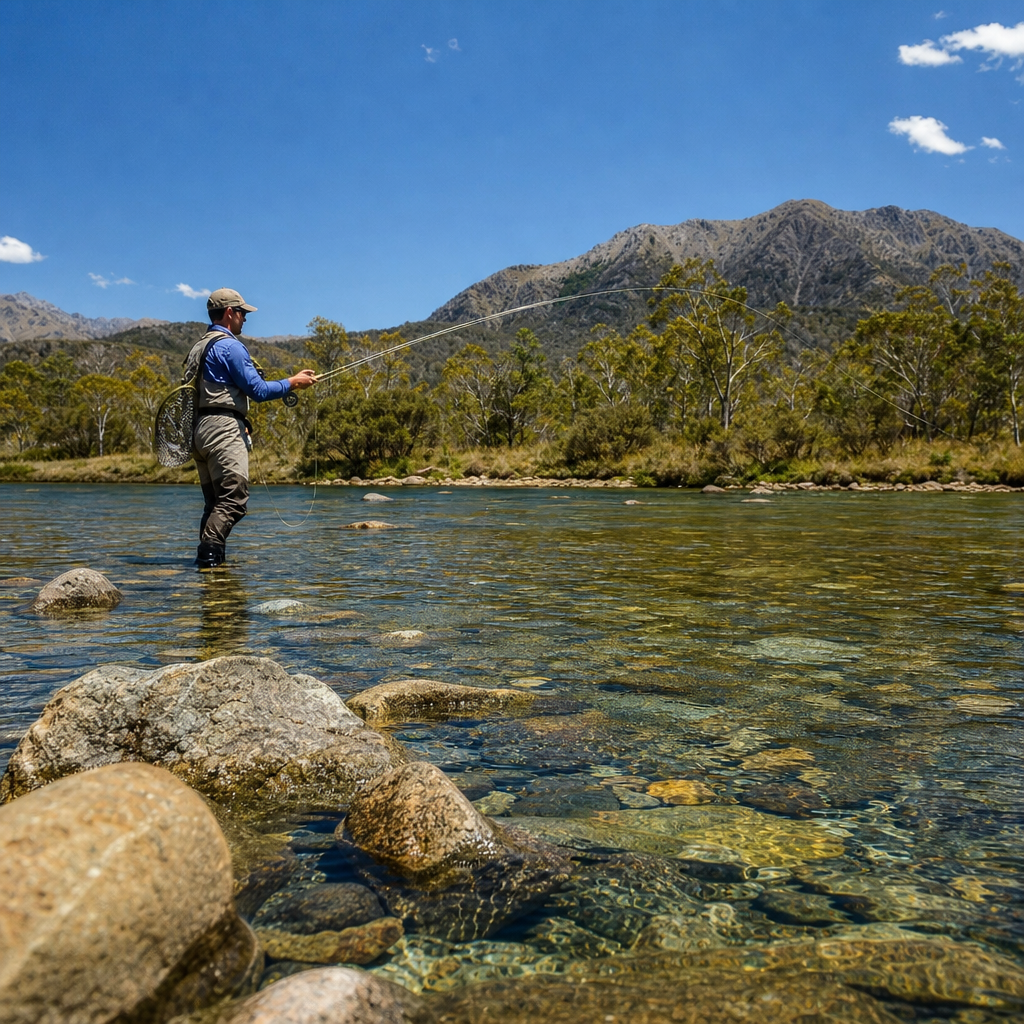
If an angler asks where to start fly fishing in Australia, I usually begin with trout because the learning curve is clearer and the information base is deep. Tasmania is the standout. Its Western Lakes, Penstock Lagoon, Little Pine Lagoon, Arthurs Lake, and rivers such as the Mersey and South Esk have built an international reputation for sight fishing, mayfly hatches, terrestrial action, and technical presentations. Tasmania’s trout fishery is largely wild or naturally recruiting, and the weather-driven nature of the fishing makes mobility essential. On a bright day, polaroiding cruising browns with a beetle or nymph is possible; under cloud, wet fly teams or larger searching patterns can save the session. The best months generally run from spring through autumn, with summer delivering iconic dry fly and terrestrial opportunities.
Victoria adds another premium layer through rivers such as the Goulburn, Delatite, Howqua, and Kiewa, plus high-country streams where hopper fishing can be excellent in warm weather. The Goulburn tailwater in particular is notable because regulated flows can stabilize water temperatures and support strong invertebrate life, creating dependable nymphing and dry-dropper fishing. In these systems, anglers who control drift and mend line well usually outperform those who cast farther. The fish often hold in defined feeding lanes, and drag-free presentation matters more than heroic distance.
The Snowy Mountains region of New South Wales rounds out the classic southeastern trout circuit. Lakes Eucumbene and Jindabyne, together with feeder streams and nearby rivers, produce both lake and river options. During seasonal migrations, spawning runs can create concentrated action, though ethics and local regulations should guide where and how you fish. In my experience, visiting anglers often underestimate wind in these alpine systems. A line weight heavier than you would choose on paper can be the difference between fishing effectively and wasting half the day.
Warmwater and inland fly fishing: bass, cod, barramundi, and saratoga
Australia’s freshwater story extends far beyond trout. On the east coast, Australian bass are one of the most enjoyable native species on fly. They inhabit coastal rivers and impoundments in New South Wales and Queensland, often responding aggressively to surface flies around dawn, dusk, and low-light conditions. Small deer-hair divers, gurglers, and baitfish streamers are productive, especially around timber, rock walls, and shaded banks. Because bass fisheries are often structure-heavy, accurate short casting and quick line management are more important than classic long-loop aesthetics. Many anglers do best with six- to eight-weight outfits and a compact floating line that turns over wind-resistant flies.
Murray cod, the iconic predator of the Murray-Darling Basin, represent a very different challenge. Cod are powerful ambush fish associated with submerged timber, undercut banks, and slower river structure. Fly fishing for cod is still a niche compared with lure fishing, but it has grown rapidly as anglers refine large-profile flies, articulated patterns, and sinking lines suited to big water. A common mistake is fishing too fast. Cod frequently eat on the pause or after a slow strip near structure. Heavy leaders are essential, not because cod are especially leader shy, but because abrasion around timber is relentless.
Further north, barramundi dominate tropical freshwater and brackish systems. In impoundments such as Lake Tinaroo and in tidal rivers across Queensland and the Northern Territory, barramundi can be targeted with large deceivers, hollow ties, and synthetic baitfish patterns on eight- to ten-weight tackle. Water temperature, barometric changes, and tidal movement all influence activity. Saratoga, especially in Queensland’s weedy impoundments and billabongs, offer another distinctly Australian option. They are visual, surface-oriented fish that reward quiet presentations, floating lines, and patient retrieves.
| Region | Primary species | Best general season | Typical tackle | Key approach |
|---|---|---|---|---|
| Tasmania | Brown and rainbow trout | Spring to autumn | 4 to 6 weight | Dry flies, nymphs, polaroiding |
| Victoria High Country | Trout | Late spring to early autumn | 4 to 6 weight | Hoppers, nymphing, pocket water drifts |
| NSW and Queensland east coast | Australian bass | Warm months, low light | 6 to 8 weight | Surface flies near structure |
| Murray-Darling Basin | Murray cod | Warmer months | 8 to 10 weight | Large flies, slow retrieves, timber edges |
| Far North Queensland and NT | Barramundi, saratoga | Dry season and shoulder periods | 8 to 10 weight | Baitfish patterns, weed edges, tides |
| Northern flats and reefs | Permit, queenfish, GT, milkfish | Dry season | 9 to 12 weight | Sight casting, fast shots, tropical leaders |
Saltwater standouts: Queensland, the Northern Territory, and western options
For many traveling anglers, saltwater fly fishing in Australia is the main draw. Far north Queensland, particularly around Cairns, the Cape, and the Hinchinbrook region, provides access to barramundi creeks, mangrove-lined estuaries, reef edges, and tropical flats. Depending on location and season, anglers may encounter permit, golden trevally, queenfish, giant trevally, blue bastard, coral trout, and various tuna and mackerel species. The defining feature of these fisheries is pace. Shots appear quickly, fish move fast, and success often depends on delivering a fly within seconds while managing wind and glare.
The Northern Territory adds another elite dimension. Around Darwin and Arnhem Land, experienced guides target barramundi in tidal systems and a suite of flats species in remote coastal environments. The tropical flats fishery is not identical to the Caribbean or Indian Ocean models many anglers know. Tides can be extreme, substrate varies from sand to turtle grass to broken coral, and species mixes are broader. You may begin the day looking for permit and spend the afternoon casting poppers at queenfish over bait schools. Because of crocodiles, heat, and remoteness, guided fishing is not just convenient here; it is often the sensible standard.
Western Australia receives less global attention in fly media than it deserves. Exmouth and the Ningaloo region have a serious reputation for permit, giant trevally, queenfish, and reef species, while the Kimberley offers remote adventure fishing where barramundi and threadfin can feature strongly. Western systems are often weather-sensitive and logistically demanding, but they can produce extraordinary sight-fishing. Anglers who are comfortable on skiffs, can cast in wind, and understand how tides reposition fish will find western Australia especially rewarding.
Seasonality, gear, and planning a successful trip
The best fly fishing in Australia depends less on the calendar date alone than on climate zone. In the south, trout season generally aligns with warmer months, with insect activity peaking from late spring through summer and into early autumn. In the tropics, the dry season usually offers the most stable weather, clearer access, and safer travel conditions, though the wet season can trigger outstanding barramundi fishing in the right systems. Before booking, check state fisheries departments, local guide calendars, and weather normals rather than relying on a generic national summary.
Gear planning should start with species, not with destination branding. For southeastern trout, bring a four- to six-weight rod, floating line, long leaders, and a box built around mayflies, caddis, beetles, hoppers, and small nymphs. For bass, a six- or seven-weight with surface flies and streamers covers most situations. For barramundi, step up to an eight- to ten-weight, strong hooks, and abrasion-resistant leaders. For flats and reef species, tropical-rated nine- to twelve-weight outfits, large-arbor reels, and true saltwater fly lines are non-negotiable. I have seen more trips compromised by bringing coldwater lines into tropical heat than by any other tackle error. They wilt, tangle, and shoot poorly at exactly the wrong moment.
Travel planning also requires attention to licenses, closures, and access rights. Tasmania uses a dedicated inland angling license system. Some mainland states differ between freshwater and marine regulation structures, and rules can change by waterbody. Biosecurity matters too. Cleaning boots, nets, and boats helps prevent the spread of invasive organisms and aquatic disease. If you are building this page’s broader Oceania itinerary, Australia works best as either a standalone two-week trip or the anchor leg before continuing to New Zealand for sight-fished trout or to Pacific waters for bluewater species.
Practical tips that improve results on Australian water
The most useful tip for fly fishing in Australia is to fish the conditions, not your preselected technique. If Tasmania is windy, switch from delicate dry fly expectations to loch-style wets or foam terrestrials. If a tropical flat is dirty on the making tide, move to a creek mouth, channel edge, or sheltered shoreline instead of forcing bad visibility. The second major tip is to book local expertise when entering a new fishery. Australian waters are too varied to decode quickly, and a good guide will shorten the learning curve on tides, safe wading zones, boat positioning, and fly selection.
Another practical lesson is that Australian fish often live around structure that punishes hesitation. Bass eat close to timber, cod bury in logs, barramundi crash mangrove edges, and trevally turn instantly toward coral. Strip-setting firmly and clearing line cleanly are basic skills, not advanced refinements. So is sun management. Quality polarized glasses, sun gloves, long sleeves, and hydration are essential in every state, even in cooler southern weather where UV exposure remains strong.
Finally, keep expectations realistic and species-specific. Permit on northern flats are difficult everywhere, not just in Australia. Wild Tasmanian trout can vanish under a lighting change. Barramundi windows can be narrow. That variability is part of the appeal. Start with one primary species, one backup option, and a plan flexible enough to follow weather, tides, and local advice. If you are exploring fly fishing destinations across Oceania, use Australia as your foundation: choose the right region, match gear to the target, respect the regulations, and fish with purpose. Done well, Australia delivers one of the most complete fly fishing experiences in the Southern Hemisphere, and it deserves a central place in any serious angler’s travel plans.
Frequently Asked Questions
What are the best fly fishing locations in Australia for different species and styles of angling?
Australia stands out because it offers an unusually broad range of fly fishing environments in one country, so the best location depends on the species you want to target and the style of fishing you enjoy most. If your focus is classic trout fishing, Tasmania is widely regarded as the premier destination. Its lakes, lagoons, and rivers hold strong populations of wild brown trout and rainbow trout, and many anglers visit for sight fishing opportunities during mayfly hatches and windy shoreline sessions. The Snowy Mountains region in New South Wales also deserves attention for alpine streams, rivers, and impoundments that produce excellent trout fishing in a cooler high-country setting.
For saltwater fly fishing, Queensland is one of the major drawcards. The tropical flats and reef-associated waters of the far north can produce prized species such as giant trevally, queenfish, golden trevally, permit, and barramundi in nearby estuaries and creeks. If you are interested in barramundi specifically, the Northern Territory is a top choice, especially around Darwin and Kakadu-linked river systems, where floodplains, billabongs, and tidal estuaries create ideal habitat. Western Australia is another outstanding option for anglers looking for remote adventure, with opportunities for trevally, permit, reef species, and hard-fighting coastal fish in less pressured waters.
Freshwater anglers looking beyond trout can explore Australian bass fisheries in New South Wales and Queensland, particularly in rivers and impoundments where surface fly fishing can be highly visual and exciting. Murray cod also attract dedicated fly anglers in inland river systems, although this style often calls for larger flies and specialized tackle. In short, Australia is not defined by one signature fishery. It is a multi-destination fly fishing country where trout, tropical flats species, estuary predators, freshwater natives, and bluewater-adjacent targets can all fit into a single broader itinerary.
When is the best time of year to go fly fishing in Australia?
The best time to fly fish in Australia depends heavily on the region, because the country spans temperate, alpine, subtropical, tropical, and arid zones. There is no single national peak season, which is actually one of Australia’s great advantages for traveling anglers. In the southern trout regions, including Tasmania, Victoria, and the Snowy Mountains, the main trout season generally aligns with the warmer months, with spring through autumn being the prime window. Spring often brings active fish, rising water temperatures, and productive insect life, while summer can be excellent for early morning and evening sessions, terrestrial patterns, and sight fishing. Autumn is often favored by experienced anglers for stable conditions and aggressive pre-spawn trout behavior.
In tropical northern Australia, the calendar works differently. The dry season is usually the most comfortable and reliable period for travel and fishing, especially for flats fishing, estuary work, and remote lodge-based trips. Lower humidity, clearer water, and more predictable weather can improve access and visibility. Barramundi anglers often pay close attention to transitional periods around runoff events, because changing water levels and bait concentration can trigger very active feeding. That said, specific timing varies from one river system to another and from year to year depending on rainfall patterns.
For estuary and impoundment fisheries in eastern Australia, shoulder seasons are often highly productive. Water temperature, bait movement, and fish behavior matter more than the date on the calendar. If you are planning a wider Oceania fly fishing trip, Australia works especially well as a hub because you can match your route to seasonal opportunities. You might fish trout in the south during one leg of the journey and then head north for tropical species as conditions shift. The key is to research the exact region and target species rather than asking for one blanket “best month” for the entire country.
What gear and fly patterns should I bring for a fly fishing trip in Australia?
Your gear list should be built around target species and environment, because Australian fly fishing can range from delicate dry-fly trout presentations to heavy tropical saltwater casting. For trout fishing in Tasmania or alpine streams, a 4-weight to 6-weight outfit is usually ideal, paired with floating lines and leaders suitable for dry flies, nymphs, and small streamers. Standard trout patterns such as mayfly imitations, caddis, nymphs, Woolly Buggers, and terrestrial flies are all useful depending on the season. Polarized sunglasses are essential, especially for sight fishing, and a layered clothing system is important because mountain weather can change quickly.
For estuaries, impoundments, and native freshwater species such as bass, barra, and cod, anglers often step up to 6-weight through 10-weight rods depending on fly size and fish size. Intermediate or sinking lines may be needed for deeper presentations, and leaders should be stronger and more abrasion-resistant than what you would use for trout. Surface gurglers, baitfish patterns, prawn and shrimp flies, deceiver-style streamers, poppers, and articulated flies are common choices. Barramundi in particular often respond well to large-profile flies worked around structure such as snags, rock bars, and mangrove edges.
For northern saltwater destinations, tackle needs become more specialized. Flats and coastal species may call for 8-weight to 12-weight rods, tropical fly lines, strong reels with dependable drags, and corrosion-resistant gear. Giant trevally and similar species demand heavy leaders, durable hooks, and tackle that can withstand brutal initial runs. Fly selection often centers on baitfish patterns, brush flies, shrimp imitations, crab patterns, and poppers, depending on the species and the type of water you are fishing. No matter where you go, bring quality sun protection, a waterproof pack, line-cleaning supplies, and backup leaders and flies. Australia’s diversity is a major advantage, but it also rewards anglers who pack with purpose rather than relying on one all-around setup.
Do I need a guide for fly fishing in Australia, or can I plan a successful trip on my own?
You can absolutely plan a successful fly fishing trip in Australia on your own, especially in well-known trout regions and accessible freshwater systems, but hiring a guide can dramatically shorten the learning curve and improve your results. This is particularly true if you are traveling long distance, targeting unfamiliar species, or fishing in technical environments such as tropical flats, tidal estuaries, remote river systems, or large impoundments. A good guide does more than find fish. They help with seasonal timing, tide planning, access logistics, local regulations, fly selection, safe boat handling, and species-specific presentation techniques that are hard to master quickly on your own.
For example, trout fishing in Tasmania can certainly be done independently if you are comfortable reading maps, understanding access points, and matching flies to conditions. However, a local guide can be invaluable if you want to maximize limited time, access lesser-known waters, or improve your sight fishing approach. In the tropics, the value of a guide is often even greater. Species such as barramundi, permit, and giant trevally can be highly location-sensitive, and success may depend on subtle factors including tide stage, water clarity, wind angle, bait presence, and boat positioning.
Independent anglers should pay close attention to licensing rules, land access, seasonal closures, and safety. Some areas are straightforward public fisheries, while others require local knowledge to navigate responsibly and legally. If you are confident and enjoy self-guided exploration, Australia offers plenty of opportunities to do that. If your priority is efficiency, species variety, or learning a new fishery properly, a guide is often money well spent. Many experienced anglers use a hybrid approach: guided days at the beginning of the trip to understand the system, followed by self-guided fishing afterward.
What are the most important fly fishing tips for visiting anglers in Australia?
The most important tip is to treat Australia as a collection of distinct fisheries rather than one uniform destination. A plan that works on a Tasmanian trout lake will not translate directly to a tropical estuary near Darwin or a flats session in far north Queensland. Start by choosing target species, then match your destination, timing, tackle, and tactics to that fishery. Many visiting anglers make the mistake of trying to cover too much ground without enough attention to regional conditions. A focused trip usually produces far better fishing than an overly ambitious itinerary.
Second, prioritize observation and presentation. Fly fishing in Australia often rewards anglers who can read water carefully, spot movement, and deliver accurate casts under changing conditions. On trout waters, that may mean stalking fish in clear shallows, adjusting leader length, or switching from dries to nymphs as insect activity changes. In estuaries and tropical systems, it may mean casting tight to structure, stripping with purpose, and understanding how current lanes and tides position predatory fish. In flats environments, a quiet approach, quick target recognition, and accurate first casts are often more important than casting distance alone.
Third, prepare seriously for weather, wildlife, and remote travel realities. Conditions can shift fast, especially in alpine and tropical zones. Sun exposure is intense across much of Australia, so long sleeves, sun gloves, hats, sunscreen, and quality polarized sunglasses are not optional. In some northern environments, anglers also need to think carefully about boating safety, tidal movement, and